You are looking for the solutions to
$$ \bbox[lightyellow] {
\left\{ \matrix{
\tan \left( {a + b} \right)\tan \left( {a + c} \right)\tan \left( {b + c} \right) = 1 \hfill \cr
\tan \left( a \right)\tan \left( b \right),\;\tan \left( a \right)\tan \left( c \right),\;\tan \left( b \right)\tan \left( c \right) < 1 \hfill \cr} \right.
} \tag{1}$$
The equation is symmetric in $a,b,c$, and the solutions will
be centered around the symmetric solution
$$ \bbox[lightyellow] {
a = b = c = \pi /8
} $$
This hints to try and make the substitution
$$ \bbox[lightyellow] {
\left\{ \matrix{
a + b = \pi /4 + \gamma \hfill \cr
b + c = \pi /4 + \alpha \hfill \cr
a + c = \pi /4 + \beta \hfill \cr} \right.\quad \Leftrightarrow \quad \left\{ \matrix{
a = \pi /8 + \left( { - \alpha + \beta + \gamma } \right)/2 \hfill \cr
b = \pi /8 + \left( {\alpha - \beta + \gamma } \right)/2 \hfill \cr
c = \pi /8 + \left( {\alpha + \beta - \gamma } \right)/2 \hfill \cr} \right.
} \tag{2}$$
Making this change of variables we get, for $tan(a+b)$
$$ \bbox[lightyellow] {
\tan \left( {a + b} \right) = \tan \left( {\pi /4 + \gamma } \right) = {{1 + \tan \gamma } \over {1 - \tan \gamma }}
} \tag{3.a}$$
while for $tan(a)tan(b)$ we get
$$ \bbox[lightyellow] {
\eqalign{
& \tan a\tan b = \tan \left( {\pi /8 + \gamma /2 - \left( {\alpha - \beta } \right)/2} \right)\tan \left( {\pi /8 + \gamma /2 + \left( {\alpha - \beta } \right)/2} \right) = \cr
& = {{\tan \left( {\pi /8 + \gamma /2} \right) - \tan \left( {\left( {\alpha - \beta } \right)/2} \right)} \over {1 + \tan \left( {\pi /8 + \gamma /2} \right)\tan \left( {\left( {\alpha - \beta } \right)/2} \right)}}{{\tan \left( {\pi /8 + \gamma /2} \right) + \tan \left( {\left( {\alpha - \beta } \right)/2} \right)} \over {1 - \tan \left( {\pi /8 + \gamma /2} \right)\tan \left( {\left( {\alpha - \beta } \right)/2} \right)}} = \cr
& = {{\tan ^{\,2} \left( {\pi /8 + \gamma /2} \right) - \tan ^{\,2} \left( {\left( {\alpha - \beta } \right)/2} \right)} \over {1 - \tan ^{\,2} \left( {\pi /8 + \gamma /2} \right)\tan ^{\,2} \left( {\left( {\alpha - \beta } \right)/2} \right)}} \cr}
} $$
and imposing the condition that $tan(a)tan(b)<1$ we get
$$ \bbox[lightyellow] {
\eqalign{
& \tan a\tan b < 1\quad \to \; \cr
& \to \;\;\tan ^{\,2} \left( {\pi /8 + \gamma /2} \right) - \tan ^{\,2} \left( {\left( {\alpha - \beta } \right)/2} \right) < 1 - \tan ^{\,2} \left( {\pi /8 + \gamma /2} \right)\tan ^{\,2} \left( {\left( {\alpha - \beta } \right)/2} \right)\;\; \to \cr
& \to \;\;\tan ^{\,2} \left( {\pi /8 + \gamma /2} \right)\left( {1 + \tan ^{\,2} \left( {\left( {\alpha - \beta } \right)/2} \right)} \right) < 1 + \tan ^{\,2} \left( {\left( {\alpha - \beta } \right)/2} \right)\;\; \to \cr
& \to \;\;\tan ^{\,2} \left( {\pi /8 + \gamma /2} \right) < 1\;\; \to \cr
& \to \;\; - 3\pi /4 < \gamma < \pi /4\quad \to \quad \tan \gamma < 1 \cr}
} \tag{3.b}$$
and analogously for the other combinations.
So, the original equation is transformed into
$$ \bbox[lightyellow] {
\eqalign{
& \left\{ \matrix{
\tan \left( {a + b} \right)\tan \left( {a + c} \right)\tan \left( {b + c} \right) = 1 \hfill \cr
\tan a\tan b,\;\tan a\tan c,\;\tan b\tan c < 1 \hfill \cr} \right.\quad \to \cr
& \to \quad \left\{ \matrix{
a + b = \pi /4 + \gamma \hfill \cr
b + c = \pi /4 + \alpha \hfill \cr
a + c = \pi /4 + \beta \hfill \cr
\left( {{{1 + \tan \alpha } \over {1 - \tan \alpha }}} \right)\left( {{{1 + \tan \beta } \over {1 - \tan \beta }}} \right)\left( {{{1 + \tan \gamma } \over {1 - \tan \gamma }}} \right) = 1 \hfill \cr
- 3\pi /4 < \alpha ,\;\beta ,\;\gamma < \pi /4 \hfill \cr} \right.\quad \to \cr}
} $$
$$ \bbox[lightyellow] {
\to \quad \left\{ \matrix{
a = \pi /8 + \left( { - \alpha + \beta + \gamma } \right)/2 \hfill \cr
b = \pi /8 + \left( {\alpha - \beta + \gamma } \right)/2 \hfill \cr
c = \pi /8 + \left( {\alpha + \beta - \gamma } \right)/2 \hfill \cr
0 = \tan \alpha + \tan \beta + \tan \gamma + \tan \alpha \tan \beta \tan \gamma \hfill \cr
\tan \alpha ,\;\tan \beta ,\;\tan \gamma < 1 \hfill \cr} \right.
} \tag{4}$$
Conclusion
Equation (4) tells us that the solutions to (1) are reconducible to the roots of the symmetric polynomial
$$ \bbox[lightyellow] {
P(x,y,z) = x + y + z + xyz = x\left( {1 + yz} \right) + y + z
} $$
which can be easily found by expressing one variable in terms of the other two,
and which are rendered graphically by this plot.
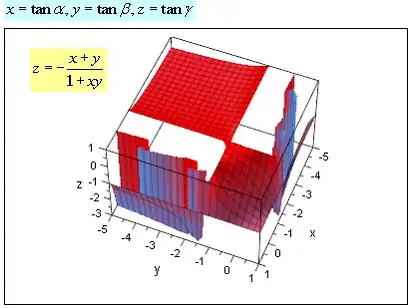
Note the similarity of the solution to the above with the addition formula for $\tanh$
$$ \bbox[lightyellow] {
x = - {{y + z} \over {1 + yz}}\quad \leftrightarrow \quad - \tanh \left( {c + d} \right) = - {{\tanh c + \tanh d} \over {1 + \tanh c\tanh d}}
} $$
which would deserve to be further expanded.
Otherwise, dividing by one of the variables taken to be non-null (e.g., $z$),
the solutions are reconducible to the points on the hyperbola
$$ \bbox[lightyellow] {
h(\xi ,\eta ;z) = z^{\,2} \xi \eta + \xi + \eta + 1 = 0
} $$
and we can use the well developed apparatus of conic sections to analyze the behaviour
of the solutions (existence, axes, canonical form, etc.) and to find appropriated parametric
representations.
example :
In equation (4), choosing $\tan \alpha = 0,\,\;\tan \beta = 1/2$ we get $\tan \gamma = - 1/2 $, and then
$$ \bbox[lightyellow] {
\eqalign{
& \tan \alpha = 0,\,\;\tan \beta = 1/2,\;\tan \gamma = - 1/2 \cr
& \quad \quad \Downarrow \cr
& \alpha = 0,\,\;\beta = \arctan \left( {1/2} \right),\;\gamma = - \arctan \left( {1/2} \right) \cr
& \quad \quad \Downarrow \cr
& \left\{ \matrix{
a = \pi /8 \hfill \cr
b = \pi /8 - \arctan \left( {1/2} \right) \hfill \cr
c = \pi /8 + \arctan \left( {1/2} \right) \hfill \cr} \right. \cr
& \quad \quad \Downarrow \cr
& \tan \left( {a + b} \right)\tan \left( {a + c} \right)\tan \left( {b + c} \right) = \cr
& = \tan \left( {\pi /4 - \arctan \left( {1/2} \right)} \right)\tan \left( {\pi /4 + \arctan \left( {1/2} \right)} \right)\tan \left( {\pi /4} \right) = \cr
& = {{1 - 1/2} \over {1 + 1/2}}{{1 + 1/2} \over {1 - 1/2}} = 1 \cr}
} $$
addendum
The similarity with the addition formula for $\tanh$ provides in fact
an interesting parametric equation for $a,b,c$ in terms of $u,v$, which
for $-\infty<u,v<\infty$ always satisfies the original system (1)
$$ \bbox[lightyellow] {
\left\{ \matrix{
a = \pi /8 + \left( { - \alpha + \beta + \gamma } \right)/2 \hfill \cr
b = \pi /8 + \left( {\alpha - \beta + \gamma } \right)/2 \hfill \cr
c = \pi /8 + \left( {\alpha + \beta - \gamma } \right)/2 \hfill \cr
\alpha = \arctan \left( {\tanh u} \right) \hfill \cr
\beta = \arctan \left( {\tanh v} \right) \hfill \cr
\gamma = \arctan \left( {\tanh \left( { - u - v} \right)} \right) = - \arctan \left( {\tanh \left( {u + v} \right)} \right) \hfill \cr} \right.
} \tag{5}$$
In fact, we have
$$ \bbox[lightyellow] {
\left. {\left\{ \matrix{
0 \equiv \tan \alpha + \tan \beta + \tan \gamma + \tan \alpha \tan \beta \tan \gamma \; \hfill \cr
\tan \alpha ,\;\tan \beta ,\;\tan \gamma < 1\; \to \;\left\{ \matrix{
\tanh u,\;\tanh v < 1 \hfill \cr
- 1 < \tanh \left( {u + v} \right) \hfill \cr} \right. \hfill \cr} \right.\quad } \right|\; - \infty < u,v < \infty
} $$


