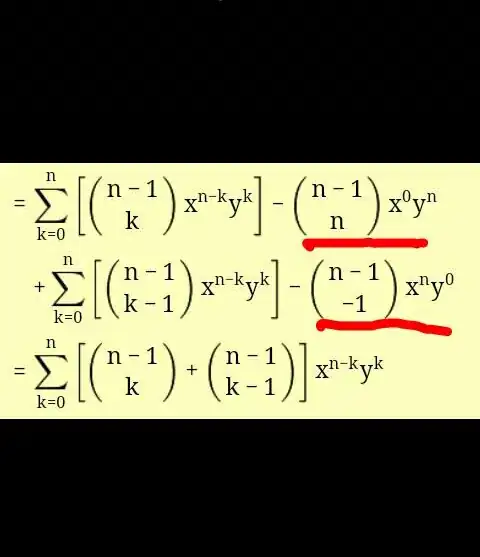
Hello. I was looking for the proof of binomial theorem by mathematical induction and I reached this step . I just don't understand why the terms underlined red are canceled out .
Hello. I was looking for the proof of binomial theorem by mathematical induction and I reached this step . I just don't understand why the terms underlined red are canceled out .
We define for $r\in\mathbb{R}$ and $k\in\mathbb{Z}$ \begin{align*} \binom{r}{k}= \begin{cases} \frac{r(r-1)\cdots (r-k+1)}{k(k-1)\cdots 3\cdot2\cdot1}&\qquad k\geq 0\tag{1}\\ 0&\qquad k<0 \end{cases} \end{align*}
We obtain from (1) \begin{align*} \binom{n-1}{n}=\frac{(n-1)(n-2)\cdots 2\cdot 1\cdot \color{blue}{0}}{n(n-1)\cdots 3\cdot 2\cdot 1}=0 \end{align*}
and \begin{align*} \binom{n-1}{-1}=0 \end{align*}
since the lower entry $-1$ is negative.
Hint: You might find chapter $5$ Binomial Coefficients (definition above is (5.1)) in Concrete Mathematics by R.L.Graham, D.E. Knuth and O. Patashnik helpful.
