23

Prove: $$ \int_{0}^{2}\frac{\mathrm{d}x}{\,\sqrt{\,{1 + x^{3}}\,}\,} = \frac{\Gamma\left(\,{1/6}\,\right) \Gamma\left(\,{1/3}\,\right)}{6\,\Gamma\left(\,{1/2}\,\right)} $$

First obvious sub is $t = 1 + x^{3}$: $$ \frac{1}{3}\int_{1}^{9}{\left(\,{t - 1}\,\right)}^{-2/3}\, t^{-1/2}\, \mathrm{d}t $$ From here I tried many things like $\frac{1}{t}$, $t-1$, and more. The trickiest part is the bounds! Reversing it from the answer the integral should be like $$ \frac{1}{6}\int_{0}^{1} x^{-2/3}\left(\,{1 - x}\,\right)^{-5/6}\,\mathrm{d}t $$ I'm not sure where the $1/2$ comes from and the $0$ to $1$ bounds. Any idea or tip please ?.

Felix Marin
  • 89,464

5 Answers5

27

An elementary solution: Consider the substitution $$t = \frac{{64 + 48{x^3} - 96{x^6} + {x^9}}}{{9{x^2}{{(4 + {x^3})}^2}}}$$ $t$ is monotonic decreasing on $0<x<2$, and $$\tag{1}\frac{{dx}}{{\sqrt {1 + {x^3}} }} = -\frac{{dt}}{{3\sqrt {1 + {t^3}} }}$$ this can be verified by explictly computing $(dt/dx)^2$ and compare it to $9(1+t^3)/(1+x^3)$. When $x=2, t=-1$, so $$\int_0^2 {\frac{1}{{\sqrt {1 + {x^3}} }}dx} = \frac{1}{3}\int_{ - 1}^\infty {\frac{1}{{\sqrt {1 + {t^3}} }}dt} $$ I believe you now have no difficulty to solve last integral via Beta function.


A conceptual solution: Consider the elliptic curve $E:y^2=x^3+1$, $P=(2,3),Q=(0,1)$ on $E$, $\omega = dx/y$ is the invariant differential on $E$. For the multiplication-by-$3$ isogeny $\phi:E\to E$, we have $3P=(-1,0), 3Q=O$. So $3\int_0^2 \omega \cong \int_{-1}^\infty \omega$ up to an element of $H_1(E,\mathbb{Z})$.

$t$ given above is the $x$-component of $\phi$ and $(1)$ is equivalent to $\phi^\ast \omega = 3\omega$.

The $P$ above is $6$-torsion, if we consider $4$ or $5$-torsion instead, we obtain results like $$\int_0^\alpha {\frac{1}{{\sqrt {1 + {x^3}} }}dx} = \frac{\Gamma \left(\frac{1}{6}\right) \Gamma \left(\frac{1}{3}\right)}{12 \sqrt{\pi }} \qquad \alpha = \sqrt[3]{2 \left(3 \sqrt{3}-5\right)} \approx 0.732 $$ $$\int_0^\alpha {\frac{1}{{\sqrt {1 + {x^3}} }}dx} = \frac{2 \Gamma \left(\frac{1}{6}\right) \Gamma \left(\frac{1}{3}\right)}{15 \sqrt{\pi }}\qquad \alpha = \left(9 \sqrt{5}+3 \sqrt{6 \left(13-\frac{29}{\sqrt{5}}\right)}-19\right)^{1/3}\approx 1.34$$

pisco
  • 18,983
  • 17
    how in the world did you pull out that substitution? – C Squared Aug 06 '20 at 04:48
  • 15
    This is probably the most "obvious" substitution I ever saw. Back to serious, how did you find it ? – Claude Leibovici Aug 06 '20 at 04:54
  • 6
    @CSquared How the substitution arises is explained in the "*conceptual solution*" below. For someone doesn't know much about elliptic curves, unfortunately he/she might simply need to accept the magical appearance of it. But once the substitution has been explicitly written down, every detail can be verified. – pisco Aug 06 '20 at 04:59
  • @pisco am inspired of what i saw and read, in addition to elliptic curves what context i should read to got your substitution ? – mnsh Aug 06 '20 at 08:48
  • 4
    @adam I am not sure if there are contexts where the substitution arise more naturally than elliptic curve. But there is a wealth of theory behind such integral, such as theory of algebraic curves and elliptic functions. – pisco Aug 06 '20 at 09:08
  • Thank you for the detailed answer. But how would I go about integrating $$\frac{1}{3} \int_{-1}^{\infty} \frac{dt}{\sqrt{1+t^3}}$$ We want the lower bound to be $0$ and upper to be $\infty$ I think, so I thought $u=t+1$ but that doesnt help. –  Aug 06 '20 at 13:57
  • 3
    @MoQabar Split it into $(-1,0)$ and $(0,\infty)$. The former can be converted into beta function via $t\mapsto -t$. Latter is of course also convertible to beta. – pisco Aug 06 '20 at 13:59
  • 3
    +1 for the extremely magical solution. Your conceptual solution is beyond my reach but maybe someday I will be able to get it. – Paramanand Singh Aug 06 '20 at 16:41
  • I'd love to see some sage code for how you generated those identities at the bottom! Can't quite figure it out myself. – Nico A Aug 08 '20 at 02:58
  • 1
    @NicoA Sage seems unable to generate torsion points in algebraic closure. Those bottom identities are obtained by solving equation $x(3P) = x(P)$ for $4$-torsion and $x(3P) = x(2P)$ for $5$-torsion using Mathematica. – pisco Aug 08 '20 at 03:45
  • @pisco Ah, that's also the problem I ran into. Glad I'm not alone! But I wasn't aware you can do elliptic curve arithmetic with Mathematica - I'd love to see a sample of that code if possible. – Nico A Aug 08 '20 at 15:38
  • @NicoA I did not use Mathematica to do arithmetic on elliptic curve, the CAS was only used to find radical solutions of equations $x(3P) = x(P)$ and $x(3P) = x(2P)$. – pisco Aug 08 '20 at 15:40
  • I'm a little confused on extending your conceptual solution to the $4$-torsion case - using the point with x-coordinate $\alpha$, you have that $x(3P)=x(P)=\alpha$, so you just end up with the identity $3\int_{0}^{\alpha} \omega = \int_{\alpha}^{\infty} \omega $. Where do you go from there?? Or am I missing something (I'm very new to elliptic curves)? – TeaFor2 Aug 08 '20 at 18:30
  • @TeaFor2 You're on the right track. You proved $4\int_{0}^{\alpha} \omega = \int_{0}^{\infty} \omega$, and latter integral is beta function. Your reasoning still works for the $5$-torsion given, but there is a subtlety for other $5$-torsions. – pisco Aug 08 '20 at 19:32
  • @pisco Ah! It all clicked. Thank you. Out of sheer curiosity - could you guide me to some hints/terms to look into to understand the subtlety of the other $5$-torsion? – TeaFor2 Aug 08 '20 at 19:39
  • 1
    @TeaFor2 The subtlety is, for $5$-torsion $\alpha$, $3\int_{0}^{\alpha} \omega = 2\int_{\alpha}^{\infty} \omega$ only holds modulo so-called "periods" of the elliptic curve. You have exact equality for the $\alpha$ given in my answer, but equality is in generally false for other torsions. – pisco Aug 09 '20 at 14:03
8

A hypergeometric solution: Modulo Beta function $I_0=\int_0^{\infty } \frac{1}{\sqrt{x^3+1}} \, dx=\frac{2 \Gamma \left(\frac{1}{3}\right) \Gamma \left(\frac{7}{6}\right)}{\sqrt{\pi }}$ one may evaluate $I_1=\int_2^{\infty } \frac{1}{\sqrt{x^3+1}} \, dx$ instead. Substitute $x\to\frac 1x$ and binomial expansion gives $$I_1=\sqrt{2} \, _2F_1\left(\frac{1}{6},\frac{1}{2};\frac{7}{6};-\frac{1}{8}\right)=\frac{2 \sqrt{\frac{\pi }{3}} \Gamma \left(\frac{7}{6}\right)}{\Gamma \left(\frac{2}{3}\right)}$$ Where the last step has invoked the following formula $$\, _2F_1\left(a,a+\frac{1}{3};\frac{4}{3}-a;-\frac{1}{8}\right)=\frac{\left(\frac{2}{3}\right)^{3 a} \Gamma \left(\frac{2}{3}-a\right) \Gamma \left(\frac{4}{3}-a\right)}{\Gamma \left(\frac{2}{3}\right) \Gamma \left(\frac{4}{3}-2 a\right)}$$

Computing $I_0-I_1$ gives the desired result.


Update: Hypergeometric method can also establish @pisco's result (the case of $4$-torsion)

$$\int_0^\alpha {\frac{1}{{\sqrt {1 + {x^3}} }}dx} = \frac{\Gamma \left(\frac{1}{6}\right) \Gamma \left(\frac{1}{3}\right)}{12 \sqrt{\pi }} \qquad \alpha = \sqrt[3]{2 \left(3 \sqrt{3}-5\right)} \approx 0.732$$

Since by binomial expansion again, it equals $$\left(\sqrt{3}-1\right) {_2F_1}\left(\frac{1}{3},\frac{1}{2},\frac{4}{3},10-6 \sqrt{3}\right)=\frac{\sqrt{\frac{1}{2} \left(6 \sqrt{3}-9\right) \pi } \Gamma \left(\frac{1}{3}\right)}{3\ 3^{3/4} \left(\sqrt{3}-1\right) \Gamma \left(\frac{5}{6}\right)}$$ due to certain transformation of hypergeometric series (see Special values of hypergeometric series by Akihito Ebisu). The rest are trivial.

Infiniticism
  • 8,644
  • 1
  • 22
  • 67
5

This is a late solution, after the structural solution of pisco was already accepted, it also uses the elliptic curves intuition, and tries to give a "simpler substitution" and the way to obtain it. The substitution is $$X = \frac{x^3+4}{x^2}\ ,$$ but let us see how first it was obtained free of charge, since this is the main point. I will give full details of the computations, CAS support, and show the pictures of the involved elliptic curve paths.


(1) How to obtain the substitution?

(The reader considering sage code annoying may please completely skip (1) and extract only the information that an isogeny killing the $3$-torsion point $(0,1)$ is used.)

The given integral can be seen as the integral of the invariant differential $dx/y$ on the path $\gamma$ from the point $P=(x_0,y_0)=(0,1)$ to $Q=(x_1,y_1)=(2,3)$ on $E(\Bbb R)$, where $E$ is the elliptic curve given by the (affine) equation: $$ E\ :\ y^2=x^3+1\ . $$ In a picture:
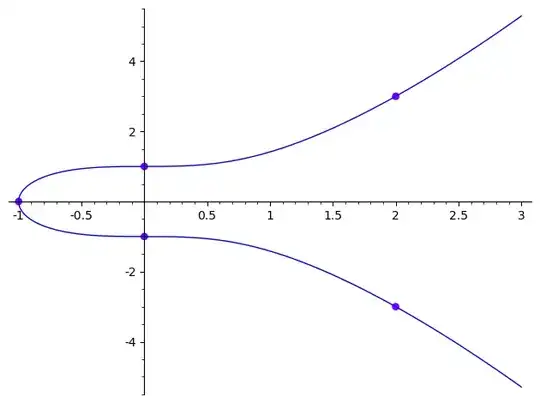
The real view of yy = xxx + 1

Just for the protocol: This was obtained in sage via:

sage: E = EllipticCurve(QQ, [0, 1])
sage: points = [E(P) for P in [ (-1,0), (0,1), (0,-1), (2,3), (2,-3) ]]

sage: pic = E.plot(xmin=-2, xmax=3) sage: for P in points: ....: pic += point(P.xy(), size=40, rgbcolor=hue(0.75)) ....: sage: pic

As the OP remarks, there would be no problem to compute the integral from $P=(0,1)$ to the infinity point using the substitution $t=x^3+1$ to introduce the beta function, but we integrate from $P$ to $Q$, and the same substitution leads to an "incomplete beta" value. So the problem is the upper integration limit $2$ corresponding to $Q$.

We would like to use an algebraic substitution and move $Q$ to a "simpler point" (possibly on some other elliptic curve). Note that the points that appear have finite order, using sage to print this information...

sage: for P in points:
....:     print(f'The point {P.xy()} has order {P.order()}')
....: 
The point (-1, 0) has order 2
The point (0, 1) has order 3
The point (0, -1) has order 3
The point (2, 3) has order 6
The point (2, -3) has order 6

The idea to proceed is natural, we use the isogeny which "simplifies" the complicated torsion point $Q=(2,3)$ of order $6$. Note that $2Q=P$ on $E$:

sage: P, Q = E.point((0,1)), E.point((2,3))
sage: 2*Q == P
True

(So using the isogeny which "kills" $P$ will also "simplify" $Q$.)

We ask sage for this isogeny in the one-liner:

sage: phi = E.isogeny(kernel=P)

and let it give us its underlying information:

sage: phi
Isogeny of degree 3
    from Elliptic Curve defined by y^2 = x^3 + 1  over Rational Field
    to   Elliptic Curve defined by y^2 = x^3 - 27 over Rational Field
sage: phi.rational_maps()
((x^3 + 4)/x^2, (x^3*y - 8*y)/x^3)
sage: phi(P), phi(Q)
((0 : 1 : 0), (3 : 0 : 1))

This leads to a map $\phi:(x,y)\to\phi(x,y)=(X,Y)$ between the elliptic curves $$ \begin{aligned} E\ :\qquad && y^2 &= x^3+1\text{ and}\\ E'\ :\qquad && Y^2 &= X^3-27\text{ given by the passage}\\ && X &=\frac{x^3+4}{x^2}\ ,\\ && Y &=y\cdot\frac{x^3-8}{x^3}\ . \end{aligned} $$ and the image curve is $Y^2=X^3-27$, the path $\gamma$ from $P$ to $Q$ on $E(\Bbb R)$ becomes the path $\gamma'$ from $P'=\infty$ to $Q'=(3,0)$ on $E'(\Bbb R)$. I can plot only $Q'$ on $E'(\Bbb R)$...
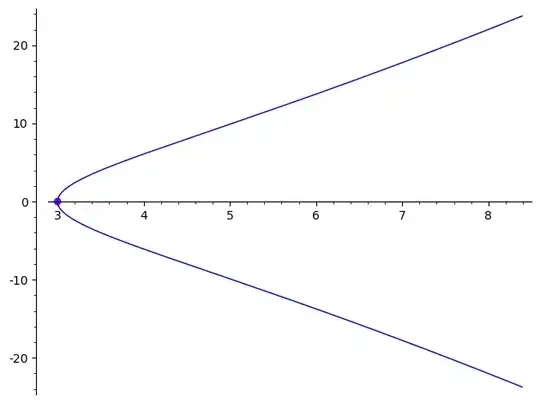
The real view of YY = XXX-27

So we integrate alternatively the invariant differential form $dX/Y$ on the "upper branch" starting from $Q'=(3,0)$ to the infinity point.

Indeed, the above expressions $X,Y$ satisfy: $$ \begin{aligned} X^3-Y^2 &=\frac{(x^3+4)^3}{x^6}-\underbrace{y^2}_{x^3+1}\cdot\frac{(x^3-8)^2}{x^6}\\ &=\frac 1{x^6} \Big[\ (x^9+12x^6+48x^3+64) - (x^9-15x^6+48x^3+64) \ \Big] \\ &=27\ . \end{aligned} $$


(2) Using the substitution:

We formally use $X=(x^3+4)/x^2$, $Y=y(x^3-8)/x^3$, and compute formally: $$ \begin{aligned} dX &= \left(x+\frac 4{x^2}\right)'\; dx = \left(1-\frac 8{x^3}\right)\; dx = \frac {x^3-8}{x^3}\; dx \ ,\text{ so as expected}\\ \frac{dX}Y %&=\frac {x^3-8}{x^3}\; dx\cdot\frac {x^3}{y(x^3-8)}\\ &=\frac{dx}y\ . \end{aligned} $$ (The isogeny connects the invariant differentials.) This gives: $$ \begin{aligned} \int_0^2\frac {dx}{\sqrt{x^3+1}} &= \int_{\gamma\text{ from }(0,1)\text{ to }(2,3)\text{ on }E(\Bbb R)} \frac{dx}y \\ &= \int_{\gamma'\text{ from }(3,0)\text{ to }\infty\text{ on }E'(\Bbb R)} \frac{dX}Y \\ &= \int_{Y=0}^{Y=\infty} \frac{d(Y^2+27)^{1/3}}Y =\int_0^\infty \frac 23(Y^2+27)^{1/3-1}\; dY \\ &\qquad\text{ (Substitution: $27t=Y^2+27$, $Y=27^{1/2}(t-1)^{1/2}$)} \\ &=\int_1^\infty \frac 23\cdot 27^{-2/3}\; t^{-2/3}\; 27^{1/2}\; \frac 12(t-1)^{-1/2}\; dt \\ &\qquad\text{ (Substitution: $u=1/t$)} \\ &=\int_0^1 \frac 13\cdot 3^{-2}\; u^{2/3}\; 3^{3/2}\; (1-u)^{-1/2}\; u^{1/2}\; \frac 1{u^2}\;du \\ &= 3^{-3/2}\int_0^1 u^{1/6-1}\; (1-u)^{1/2-1}\;du \\ &= 3^{-3/2}B\left(\frac 16,\frac 12\right) \ . \end{aligned} $$ $\square$


(3) Note:

The above value involving the beta function $B$ is equal to $\frac 16B\left(\frac 16,\frac 13\right)$, use for this the multiplication theorem for the gamma function:

$$ \Gamma\left(\frac 13\right) \Gamma\left(\frac 23\right) \Gamma\left(\frac 33\right) =(2\pi)\;3^{-1/2}\;\Gamma(1)\ .$$

dan_fulea
  • 32,856
  • 3
    Do you have any sources or recommendations for learning more about elliptic curves, namely the types you use here? –  Apr 13 '21 at 23:22
5

Consider $$ y^2=4x^3+4,g_2=0,g_3=-4 $$ The real period of $\wp(z)$ is $$ \omega_1=\int_{-1}^{\infty} \frac{1}{\sqrt{1+x^3}} \text{d}x =\frac{\Gamma\left ( \frac{1}{3} \right )\Gamma\left ( \frac{1}{6} \right ) }{2\sqrt{\pi} } $$ And $$ \wp\left ( \frac{\omega_1}{2} \right ) =-1 $$


We have the addition formula: $$ \begin{aligned} &\wp(3z) = \frac{1}{4}\left [ \frac{\wp'(z)-\wp'(2z)}{\wp(z)-\wp(2z)} \right ]^2 -\wp(z)-\wp(2z)\\ &\wp(2z)=\frac{1}{4} \left [ \frac{\wp''(z)}{\wp'(z)} \right ] ^2-2\wp(z)\\ &\wp(u+v) =\frac{1}{4} \left [ \frac{\wp'(u)-\wp'(v)}{\wp(u)-\wp(v)} \right ]^2 -\wp(u) -\wp(v) \end{aligned} $$ where $3z,2z,z$ is not at the period lattices. Let $x=\wp\left ( \frac{\omega_1}{6} \right ) ,y=\wp\left ( \frac{\omega_1}{3} \right )$.And they have two relations: $$ \begin{aligned} &\frac{1}{4} \left [ \frac{\sqrt{4x^3+4}-\sqrt{4y^3+4} }{x-y} \right ]^2-x-y = -1\\ &y=\frac{9x^4}{4x^3+4} -2x \end{aligned} $$ Solve it and gives, $$ \wp\left ( \frac{\omega_1}{6} \right )=2, \wp\left ( \frac{\omega_1}{3} \right )=0 $$ So, $$ \begin{aligned} I:&= \int_{0}^{2} \frac{1}{\sqrt{1+x^3} } \text{d}x\\ &=2\left(\frac{\omega_1}{3} -\frac{\omega_1}{6} \right)\\ &=\frac{\omega_1}{3} \end{aligned} $$


We have $\wp\left ( \frac{\omega_1}{4} \right ) =\sqrt{3}-1$,hence $$ \int_{0}^{\sqrt{3} -1} \frac{1}{\sqrt{1+x^3} }\text{d}x =\frac{\Gamma\left ( \frac{1}{3} \right )\Gamma\left ( \frac{1}{6} \right ) }{12\sqrt{\pi} } $$


We have $t=\wp\left ( \frac{\omega_1}{8} \right ) = -1+\sqrt{3} +\sqrt{3}\sqrt{2-\sqrt{3} } +\sqrt{3} \sqrt{2-\sqrt{3}+2\sqrt{2-\sqrt{3} } }$,hence $$ \int_{0}^{t} \frac{1}{\sqrt{1+x^3} } \text{d}x =\frac{5\Gamma\left ( \frac{1}{3} \right )\Gamma\left ( \frac{1}{6} \right ) }{24\sqrt{\pi} } $$


We have $t=\wp\left ( \frac{\omega_1}{12} \right ) =2+\sqrt{3}+\sqrt{3} \sqrt{3+2\sqrt{3} }$,hence $$\int_{0}^{t} \frac{1}{\sqrt{1+x^3} } \text{d}x =\frac{\Gamma\left ( \frac{1}{3} \right )\Gamma\left ( \frac{1}{6} \right ) }{4\sqrt{\pi} }$$


We have $ t=\wp\left ( \frac{\omega_1}{9} \right ) =2^{1/3} \left ( 16+3\cdot2^{2/3}\sqrt[3]{37+i\sqrt{3} }+ 6\cdot2^{-1/3}\sqrt[3]{37-i\sqrt{3} } \right )^{1/3}\approx4.5707391614928... $,hence $$ \int_{0}^{t} \frac{1}{\sqrt{1+x^3} } \text{d}x =\frac{2\Gamma\left ( \frac{1}{3} \right )\Gamma\left ( \frac{1}{6} \right ) }{9\sqrt{\pi} } $$


If $t\ge0$,and $$\int_{0}^{t} \frac{1}{\sqrt{1+x^3} } \text{d}x =R\cdot\frac{\Gamma\left ( \frac{1}{3} \right )\Gamma\left ( \frac{1}{6} \right ) }{\sqrt{\pi} }$$ where $R$ is rational with $0\le R\le\frac{1}{3}$.$t$ must be an algebraic number.

3

$\newcommand{\bbx}[1]{\,\bbox[15px,border:1px groove navy]{\displaystyle{#1}}\,} \newcommand{\braces}[1]{\left\lbrace\,{#1}\,\right\rbrace} \newcommand{\bracks}[1]{\left\lbrack\,{#1}\,\right\rbrack} \newcommand{\dd}{\mathrm{d}} \newcommand{\ds}[1]{\displaystyle{#1}} \newcommand{\expo}[1]{\,\mathrm{e}^{#1}\,} \newcommand{\ic}{\mathrm{i}} \newcommand{\mc}[1]{\mathcal{#1}} \newcommand{\mrm}[1]{\mathrm{#1}} \newcommand{\pars}[1]{\left(\,{#1}\,\right)} \newcommand{\partiald}[3][]{\frac{\partial^{#1} #2}{\partial #3^{#1}}} \newcommand{\root}[2][]{\,\sqrt[#1]{\,{#2}\,}\,} \newcommand{\totald}[3][]{\frac{\mathrm{d}^{#1} #2}{\mathrm{d} #3^{#1}}} \newcommand{\verts}[1]{\left\vert\,{#1}\,\right\vert}$ \begin{align} &\bbox[10px,#ffd]{\int_{0}^{2}{\dd x \over \root{1 + x^{3}}}} = 2\int_{0}^{1}\pars{1 + 8x^{3}}^{-1/2}\,\dd x \\[5mm] = & {2 \over 3}\int_{0}^{1}x^{-2/3}\,\bracks{1 + 8x}^{-1/2}\,\dd x \\[5mm] & = {2 \over 3}\int_{0}^{1}x^{\color{red}{1/3}\ -\ 1}\, \pars{1 - x}^{\color{#0f0}{4/3}\ -\ \color{red}{1/3}\ -\ 1} \,\bracks{1 -\pars{\bf\color{red}{-8}}x}^{\,-{\bf 1/2}}\,\dd x \\[5mm] & = {2 \over 3}\,\mrm{B}\pars{\color{red}{1 \over 3}, \color{#0f0}{4 \over 3} - \color{red}{1 \over 3}} \mbox{}_{2}\mrm{F}_{1}\pars{\bf{1 \over 2}, \color{red}{1 \over 3};\color{#0f0}{4 \over 3};-8} \label{1}\tag{1} \\[5mm] & = {2 \over 3}\,{\Gamma\pars{1/3}\Gamma\pars{1} \over \Gamma\pars{4/3}} \,\mbox{}_{2}\mrm{F}_{1}\pars{\bf{1 \over 2}, \color{red}{1 \over 3};\color{#0f0}{4 \over 3};-8} \\[5mm] & = \bbx{\large {\Large 2}\,\,\mbox{}_{2}\mrm{F}_{1}\!\!\!\pars{\bf{1 \over 2}, \color{red}{1 \over 3};\color{#0f0}{4 \over 3};-8}} \approx 1.4022 \\ & \end{align} Step (\ref{1}): See the Euler Type Hypergeometric Function.

Felix Marin
  • 89,464