This is a follow-up to my previous question "Asymptotic expansion of the inverse of $x\mapsto x+x^\phi$ near zero".
Consider a continuous real-valued monotone increasing function $f:\mathbb R^+\to\mathbb R^+$ satisfying $f\big(x+x^{\small\sqrt2}+x^2\big)=x.$
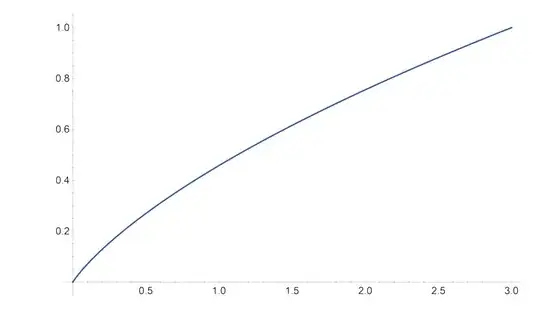
I am interested in an asymptotic expansion of $f(z)$ for $z\to0^+$ in terms of powers of $z$. I was able to find a few initial terms by manually balancing coefficients: $$f(z)=z-z^{\small\sqrt2}+\sqrt2\;z^{\small\unicode{x202f}2\unicode{x202f}\sqrt2-1}-z^2+\mathcal O\big(z^{\small\unicode{x202f}3\unicode{x202f}\sqrt2-2}\big), \quad z\to0^+.\tag{$\diamond$}$$ Computing next terms in an ad hoc fashion quickly becomes tedious, so I am looking for a more systematic approach that would allow to obtain a general formula for the terms of this series. I expect it to be a mix of integer powers of $z$ and irrational powers involving $\sqrt2$. Also, I would like to know the radius of convergence of that series.
More generally, I am looking for a uniform approach for inverting generalized polynomials of a single variable that may contain both rational and irrational powers.


