Using Lagrange multipliers, it can be shown that a triangle with given perimeter has the maximum possible area, if it is equilateral. Is there a simple geometric proof of that fact ?
Asked
Active
Viewed 4.7k times

6 Answers
14
You can use Heron's formula for the area of a triangle to help here. $$A = \sqrt{s(s-a)(s-b)(s-c)}$$ where $s$ is the semi-perimeter $$s = \frac{a+b+c}{2}$$ To find the conditions for the maximum area, we want to compute derivatives w.r.t. $a$, $b$ and $c$, but since they are not independent variables, we first substitute the semi-perimeter equation into the are equation, to get rid of $c$. $$c = 2s-a-b$$ $$\therefore A = \sqrt{s(s-a)(s-b)(a+b-s)}$$ Setting the derivative w.r.t. $a$ to zero: $$\frac{\text{d}A}{\text{d}a} = \frac{s(s-b)(2s-2a-b)}{2A} = 0$$ $$\Rightarrow 2s-2a-b = 0$$ (Note that $b=s$ is not a solution since $A \ne 0 \Rightarrow b \ne s$.)
Similarly, setting the derivative w.r.t. $b$ to zero yields $$2s-2b-a = 0$$ Solving simultaneously gives $$a = b = \frac{2s}{3}$$ and substituting back gives $$c = \frac{2s}{3}$$ So $a=b=c$ and the triangle is equilateral.

Carl
- 865
-
1
-
I don't understand how can you derive wrt one variable to maximize a function of three variables. Isn't Lagrange multipliers needed when there is more than 1 variable? – Jun 10 '20 at 20:41
-
1@Wybie The problem is originally framed with 3 variables, reduced to 2 by substituting $c = 2s-a-b$. Then derivatives are computed w.r.t. both $a$ and $b$ and not just one of them. By setting both derivates to 0 and solving, we get the solution. So, we solve a problem in 2 variables by taking 2 derivatives. Substitution is often an alternative path to a solution in optimization problems that could also be solved using Lagrange multipliers. – Carl Jun 11 '20 at 08:38
10
As Carl pointed out, Heron's formula gives the area of a triangle with sides $a$, $b$, and $c$ as $A = \sqrt{s(s-a)(s-b)(s-c)}$, where $s=\displaystyle\frac{1}{2}(a+b+c)$.
Let $2s=a+b+c>0$, and suppose $A^2=s(s−a)(s−b)(s−c)$ is maximized for $a$, $b$, and $c$ that are not all equal. Without loss of generality, assume $a<b$.
It's straightforward to show that $s(s−\displaystyle\frac{a+b}{2})(s−\frac{a+b}{2})(s−c)>A^2$, which means that you'll get a triangle of larger area if you replace the unequal sides $a$ and $b$ with equal sides, keeping the same perimeter. This contradicts the assumption that $a\neq b$ at the maximum.

Steve Kass
- 14,881
8
For what it's worth, here's another proof without calculus.
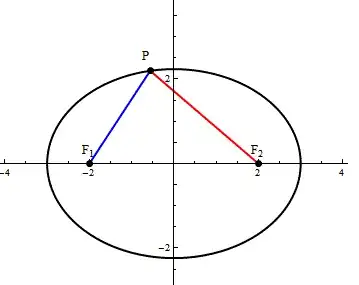
Fix a perimeter $p$, and suppose that $a$, $b$, and $c=p-a-b$ are the side lengths of a largest triangle with perimeter $p$. Let $F_1$, $F_2$, and $P$, respectively, be the vertices of the triangle opposite the sides of length $a$, $b$, and $c$.
Given $c$, we'll show that it must be the case that $a=b$, proving that the largest triangle is isosceles. Repeating the argument given $a$ or $b$ will prove it must be equilateral.
Place $F_1$ and $F_2$ on the $x$-axis, and consider where $P$ can lie. Wherever it is, the sum of the distances from $P$ to the two points $F_1$ and $F_2$ is $a+b$, which is constant, so the locus of possible locations of $P$ is an ellipse with foci $F_1$ and $F_2$. The area of $F_1F_2C$ is $c|y|$, where $y$ is the $y$-coordinate of $P$, so the triangle's area is greatest when $P$ is at a point on the ellipse as far from the $x$-axis as possible. Therefore $P$ is at an endpoint of the ellipse's vertical axis, and by symmetry, $a=b$.
Here's a picture with $P$ not at the optimal position.
Steve Kass
- 14,881
6
assume that a,b,c are the sides of a triangle, we know that: $$P=\sqrt{S\left(S-a\right)\left(S-b\right)\left(S-c\right)} ~~\mbox{ (Heron's formula)}$$ and: $$2S=a+b+c$$ $$S=\frac{a+b+c}{2}$$ Due to the inequality of arithmetic and geometric we can say: $$\frac{(S-a)+(S-b)+(S-c)}{3}\ge\sqrt[3]{(S-a)(S-b)(S-c)}$$ $$=\frac{3S-(a+b+c)}{3}\ge\sqrt[3]{(S-a)(S-b)(S-c)}$$ $$=\frac{3S-2S}{3}\ge\sqrt[3]{(S-a)(S-b)(S-c)}$$ $$=\frac{S}{3}\ge\sqrt[3]{(S-a)(S-b)(S-c)}$$ $$=\frac{S^3}{27}\ge{(S-a)(S-b)(S-c)}$$ $$=\frac{S^4}{27}\ge{S(S-a)(S-b)(S-c)}$$ $$=\frac{S^2}{3\sqrt{3}}\ge\sqrt{S\left(S-a\right)\left(S-b\right)\left(S-c\right)}$$ now we proved that the maximum area in this case cannot exceed : $$\frac{S^2}{3\sqrt{3}}$$ and for the equality situation $(S-a)=(S-b)=(S-c)$ so $a=b=c$ and our triangle is equilateral .

L F
- 3,644
2
By Heron's formula we have,
$$A^2=S(S-a)(S-b)(S-c)$$
Where $S$ is half the perimeter of a triangle with sides $a,b,c$.
This gives,
$$y: =\sqrt[3]{\frac{A^2}{S}}$$
$$=\sqrt[3]{(S-a)(S-b)(S-c)}$$
We can maximize this instead as $x^{\frac{2}{3}}$ is increasing for $x>0$.
By Am-GM we have,
$$y \leq \frac{(S-a)+(S-b)+(S-c)}{3}$$
$$=\frac{3S-2S}{3}=\frac{S}{3}$$
Equality occurs if and and only if $S-a=S-b=S-c$ which implies that the triangle with maximum area is equilateral.

Ahmed S. Attaalla
- 18,518
1
It can be shown with the help of area of triangle.
Hint: Area = $(s(s-a)(s-b)(s-c))^\frac12$ where s is the semi-perimeter of triangle
It will be max when (s-a)(s-b)(s-c) is max.

user2369284
- 2,231
-
But how can I deduce that the expression gets maximal for a=b=c ? Remember, I search a solution without optimization tools. – Peter Dec 04 '13 at 19:44
-
1Let $2s=a+b+c>0$, and suppose $A^2=s(s−a)(s−b)(s−c)$ is maximized for $a$, $b$, and $c$ that are not all equal. Without loss of generality, assume $a<b$. It's straightforward to show that $s(s−(a+b)/2)(s−(a+b/2)(s−c)>A^2$, which contradicts the assumption that $a\neq b$ at the maximum. – Steve Kass Dec 04 '13 at 20:13
-
1@Steve Formulate it as an answer, so I can upvote and accept it. That is exactly what I wanted. – Peter Dec 04 '13 at 20:28