29

I found this problem in a collection of contest problems of a Russian competition in 1995 and wasn't able to solve it.

Solve for real $x$: $$ \cos (\cos (\cos (\cos(x))))=\sin (\sin (\sin (\sin (x)))) $$

My guess is that there is no solution, but how do I prove it? I tried to estimate

$LHS\ge \cos (1) \ge \cos(\pi/3)=1/2 $

and RHS similarly but the ranges overlap..

Do you have a better idea?

Blue
  • 75,673
  • Of course there is no solution because $ cos (cos (cos (x)))\ge 1/2 $ as explained. What do you mean? – user129798 Feb 18 '14 at 21:44
  • Plotting both functions with Wolfram Alpha does indeed indicate that the two functions don't overlap: http://www.wolframalpha.com/input/?i=plot+sin%28sin%28sin%28sin%28x%29%29%29%29+and+cos%28cos%28cos%28cos%28x%29%29%29%29 – Arno Feb 18 '14 at 21:46
  • Ooops! I deleted the comment because I misunderstood your question. Sorry! – enoughsaid05 Feb 18 '14 at 21:47
  • Related: http://math.stackexchange.com/questions/589663/how-prove-this-inequality-sin-sin-sin-sinx-le-frac45-cos-cos-cos – Hans Lundmark Feb 25 '14 at 22:08
  • Using MATLAB we can determine the approximate complex solution $x^\star = 0.756888895567887 -0.610156387039054 \cdot i$. If we define $f(x) = |\cos \cos \cos \cos x - \sin \sin \sin \sin x|$ and $f(x^\star) = 9.289 \cdot 10^{-9}$. – Pantelis Sopasakis Aug 12 '22 at 21:38

3 Answers3

46

Rephrase the problem as:

$$ \sin( \pi/2 + \sin(\pi/2 + \sin(\pi/2 + \sin(\pi/2 + x) ) ) ) = \sin(\sin(\sin(\sin(x))))$$ Our strategy will be to assume the expression above is true for some $x$, "invert" the sine on both sides, and show that the resulting expression cannot possibly have a solution. Doing this process once, we have

\begin{align} \pi/2 + \sin(\pi/2 + \sin(\pi/2 + \sin(\pi/2 + x) ) ) & = \sin(\sin(\sin(x))) + 2\pi n \\ \textrm{or} & \\ \pi/2 + \sin(\pi/2 + \sin(\pi/2 + \sin(\pi/2 + x) ) ) & = \pi - \sin(\sin(\sin(x))) + 2\pi n \end{align} for some integer $n$, which implies $$ \sin(\pi/2 + \sin(\pi/2 + \sin(\pi/2 + x) ) ) = \pm (\sin(\sin(\sin(x))) + 2 \pi (n - 1/4)),$$ where the $\pm$ covers the two cases above, and indicate that at least one of the two possibilities must hold, but not necessarily both. We must have $n = 0$ since both sine terms must have values in $[-1,1]$. So $$ \sin(\pi/2 + \sin(\pi/2 + \sin(\pi/2 + x) ) ) = \pm (\sin(\sin(\sin(x))) - \pi/2),$$ and so it must be that both sides of the above expression lie in either the interval $[-1, 1 - \pi/2]$ or the interval $[-1 + \pi/2, 1]$. Applying our strategy once more, we have $$\sin(\pi/2 + \sin(\pi/2 + x) ) = \pm (\arcsin( \sin(\sin(\sin(x))) - \pi/2) - \pi/2).$$ On the left side, clearly the expression must be in $[-1,1]$, while on the right side, the expression must be either in the interval $[-\pi, \arcsin(1 - \pi/2) - \pi/2]$ or in the interval $[\pi/2 - \arcsin(1 - \pi/2), \pi]$.

We derive a contradiction by showing that neither of these two intervals intersect with $[-1,1]$. In particular, we show that $\arcsin(1 - \pi/2) - \pi/2 < -1$. Using the fact that $\pi > 3$, $$ \arcsin(1 - \pi/2) - \pi/2 < \arcsin(1 - 3/2) - \pi/2 = -\pi/6 - \pi/2 = - 2\pi/3 < -1.$$

Christopher A. Wong
  • 22,445
  • 3
  • 51
  • 82
  • 7
    +1 Wow, the only numerical approximation you use is $\pi>3$ – Hagen von Eitzen Feb 18 '14 at 23:08
  • I know the question was for real x. I am curious if we allow complex x if there are solutions. – Michaela Light Feb 27 '14 at 11:48
  • 2
    @MichaelSmith, It seems likely there is a complex solution, simply because then the equation is equivalent to solving $F(z) = 0$ for an entire function $F$, and Picard's theorem says that the range of such a function can only exclude at most one point in $\mathbb{C}$. It's not a proof, but that's my intuition so far... – Christopher A. Wong Feb 27 '14 at 20:36
  • Cool use of Picard's Theorem! Makes sense to me. I was thinking of converting the sin() and cos() to expressions in exp()s but it gets pretty complex due to the nesting. – Michaela Light Feb 28 '14 at 00:52
  • Alternative just looking at the imaginary axis putting ix for x and using cosh(x) = cos(ix) and i sinh(x) = sin(ix). I will play around with this a bit. – Michaela Light Feb 28 '14 at 00:59
  • As sin(ix) = i sinh(x) (for real x) it is purely imaginary. So sin(sin(ix)) = i sinh(sinh(x)). Similarly for any more iterations of sin() and sin(sin(sin(sin(ix) = i sinh(sinh(sinh(sinh(x)))) is purely imaginary too.

    However cos(ix) = cosh(x) is purely real and taking cos() of this value three more times cos(cos(cos(cos(ix)))) is also purely real.

    Hence there is no solution to this equation on the imaginary axis.

    The imaginary solution(s) must lie somewhere else.

    – Michaela Light Mar 01 '14 at 11:42
  • Christopher, would you please help me understand? $\sin( \pi/2 + \sin(\pi/2 + \sin(\pi/2 + \sin(\pi/2 + x) ) ) ) = \sin(\sin(\sin(\sin(y))))$ has a solution, but your argument seems to still work. Where did you use $x=y$? Thanks – Stephen Harrison Jan 28 '22 at 19:50
  • 1
    In the second display line, how do you exclude the possibility that $$\pi/2 + \sin(\pi/2 + \sin(\pi/2 + \sin(\pi/2 + x) ) ) =\pi- \sin(\sin(\sin(x))) ?$$ – John Bentin Aug 12 '22 at 21:25
  • @JohnBentin This is a great catch, and to resolve this requires an addition to the argument. Since this answer seems to have some popularity I will endeavor to write up the modification shortly. – Christopher A. Wong Aug 12 '22 at 22:39
  • Looks good now (+1). However, the notation would be clearer if you wrote (for example) $$\pm(\arcsin(\sin(\sin(\sin(x))) - \pi/2)-\pi/2)$$ as $$ \pm[\arcsin (\sin\sin\sin x - \pi/2)-\pi/2].$$ – John Bentin Aug 13 '22 at 09:15
8

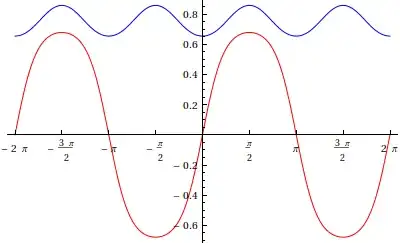
This is not a solution, but here's a pretty compelling picture of the the fourth iterates of cosine and sine (in blue and red, respectively).

It suggests that you can't uniformly bound the two apart from one another. (The functions appear to have slightly overlapping ranges).

enter image description here

Sammy Black
  • 25,273
  • 2
    As I said, I know that picture. But I'm looking for a formal argument. – user129798 Feb 18 '14 at 21:49
  • 8
    You can turn the picture into a formal argument.
    1. The functions are $2\pi$-periodic, so it suffices to check on $[-\pi,\pi]$.

    2. Clearly one is negative on $[-\pi,0]$ while the other is positive, so it suffices to check on $[0,\pi]$.

    3. $\mathrm{cos}(\mathrm{cos}(\mathrm{cos}(\mathrm{cos}(x))))$ is injective on this domain, so it's easy to compute exactly when it dips below $\mathrm{sin}(\mathrm{sin}(\mathrm{sin}(1)))$, which is the maximum of the other function. Then you make sure they don't intersect on this domain.

    – Michael Kasa Feb 18 '14 at 22:01
  • 5
    Probably he wanted to know how this problems was supposed to be solved, since in this kind of contest you don't get pictures or wolframalpha :-) Usually you can't even bring a calculator ;-) – Ant Feb 18 '14 at 23:23
7

Let $f(x)=\cos(\cos(\cos(\cos x)))-\sin(\sin(\sin(\sin x)))$

For $x\in[\pi,2\pi], f(x)>0$ As cos term positive and sin term negative !

Also $f(x)=f(\pi-x)\implies \text{it is sufficient to solve it for}\,\,x\in[0,\pi/2]$

$\implies \cos x+ \sin x\le \sqrt 2<\frac{\pi}{2}\,\,\,\text{ or }\cos x<\frac{\pi}{2}–\sin x$

$\implies \cos(\cos x)>\sin(\sin x)\implies \cos(\cos(\cos x))<\cos(\sin(\sin x))$

$\implies \cos(\cos(\cos x))+\sin(\sin(\sin x))<\cos(\sin(\sin x)) +\sin(\sin(\sin x)) \le \sqrt2<\frac{\pi}{2}$

$\implies \cos(\cos(\cos x))<\frac{\pi}{2}-\sin(\sin(\sin x))$

$\implies\cos(\cos(\cos(\cos x)))>\sin(\sin(\sin(\sin x)))$

Hence no solution in real numbers !

Makar
  • 2,267