Origin - p5 - Example 5
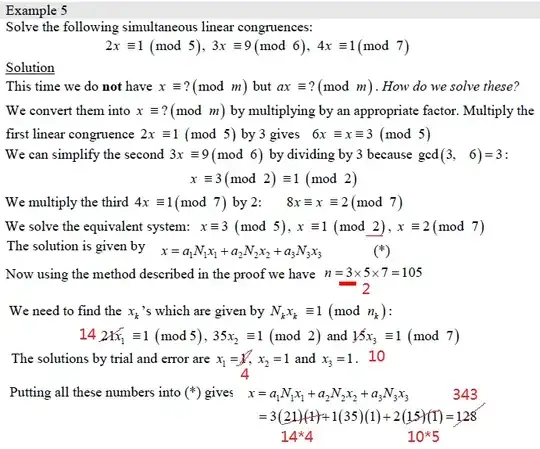
I'm querying a possible error, thence I show the pdf as is. Is the 3 underlined in red supposed to be 2? scilicet, the last line should be $n = 2 \times 5 \times 7 $? Notation hails from here.
Origin - p5 - Example 5
I'm querying a possible error, thence I show the pdf as is. Is the 3 underlined in red supposed to be 2? scilicet, the last line should be $n = 2 \times 5 \times 7 $? Notation hails from here.
The error is in your last line. The addition is wrong
$$3\cdot14\cdot4+1\cdot35\cdot1+2\cdot10\cdot5=168+35+100=\color{red}{303}=23\pmod{70}$$
Some ideas:
$$\begin{align*}2x=1\pmod5&\iff x=2^{-1}\pmod5&\iff& x=3\pmod 5\\{}\\ 3x=9\pmod 6&\iff x=3\pmod 2&\iff&x=1\pmod 2\\{}\\ 4x=1\pmod7&\iff x=4^{-1}\pmod7&\iff&x=2\pmod7\end{align*}$$
Observe that equations (1)-(2) above already show the number must end in $\;3\;$, and together with equation (3) we get the solution $\;23\;$ (modulo $\;5\cdot2\cdot7=70\;$, of course)
If you want to apply the CRT (in fact, one of its proofs), then as follows is one way:
$$\begin{align*}14^{-1}\pmod 5&=4\\{}\\ 35^{-1}\pmod2&=1\\{}\\ 10^{-1}\pmod7&=5\end{align*}$$
Thus, a solution modulo $\;7\cdot2\cdot5=70\;$ is
$$3\cdot14\cdot4+1\cdot35\cdot1+2\cdot10\cdot5=168+35+100=303=23\pmod{70}$$


