Given that I have the following knots vector U1, U2, U3
U1 = {0.25, 0.25, 0.5, 0.5, 0.75, 0.75, 0.8};
U2 = {0.21, 0.25, 0.3, 0.6, 0.7, 0.8};
U3 = {0.25, 0.3, 0.7, 0.8};
Now I would like to calculate their common knots vector , i.e., a knots vector that contains all of the elements of U1, U2, U3 and has the least length. For example, containing all of the elements of U1 means containing
{0.25, 0.25, 0.5, 0.5, 0.75, 0.75, 0.8}, rather than {0.25, 0.5, 0.75, 0.8}.
Then with the help of common knots vector, I want to compute the complementary elements of each knots vector. For this case, the common knots vector is:
commonKnotsVector = {0.21, 0.25, 0.25, 0.3, 0.5, 0.5, 0.6, 0.7, 0.75, 0.75, 0.8}
and the corresponding complementary elements are
(*
 U1 --> {0.21, 0.3, 0.6, 0.7}
 U2 --> {0.25, 0.5, 0.5, 0.75, 0.75}
 U3 --> {0.21, 0.25, 0.5, 0.5, 0.6, 0.75, 0.75}
*)
For the common knots vector, my algorithm as shown below:

commonKnotsVector[knots_] :=
  Module[{step1, step2, step3, step4},
   step1 = SortBy[Join @@ Tally /@ knots, First];
   step2 = GatherBy[step1, First];
   step3 = Last /@ (SortBy[#, Last] & /@ step2);
   step4 = step3 /. {x_, n_} :> ConstantArray[x, n];
   Flatten[step4]
]

commonKnotsVector[{u1, u2, u3}]
(*{0.21, 0.25, 0.25, 0.3, 0.5, 0.5, 0.6, 0.7, 0.75, 0.75, 0.8}*)
For the complementary elements,
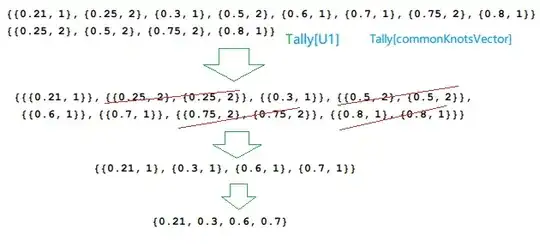
knotsVectorMinus[commonKnotsVector_, knots_] :=
  Module[{step1, step2},
   step1 = GatherBy[Join[Tally@commonKnotsVector, Tally[knots]], First];
   step2 = step1 /. {{{x_, n1_}, {x_, n2_}} :>{x, Abs[n1 - n2]},
                     {{x_, n1_}} :> {x, n1}};
   Flatten[step2 /. {x_, n_} :> ConstantArray[x, n]]
 ]

knotsVectorMinus[commonKnotsVector, #] & /@ {u1, u2, u3}
(*{{0.21, 0.3, 0.6, 0.7},
  {0.25, 0.5, 0.5, 0.75, 0.75},
  {0.21, 0.25, 0.5, 0.5, 0.6, 0.75, 0.75}}*)
I think my method is not the best/efficient, so I asked this question to seek other elegnant/effective solution.

