For example I have PDE:
$\tan^2 x\frac{\partial^2 u}{\partial x^2}-2y \tan x \frac{\partial^2 u}{\partial x \partial y}+y^2\frac{\partial^2 u}{\partial y^2}+\tan^3 x \frac{\partial u}{\partial x}=0$
And I need to classify that PDE.
I don't know naming conventions for such subject and I will use this document (it mostly corresponds with my course of Mathematical physics): Second-Order linear PDE
I need to clarify that I need to demonstrate following steps: finding the discriminant, partial derivatives, and the resulting canonical form of the equation.
- $∆(L)(x,y)=(y\tan x)^2-(\tan^2x) y^2=0 \Rightarrow parabolic \; type$;
- Method of characteristics
$\tan^2 x(\mathrm{d}y)^2+2y\tan x \mathrm{d}x\mathrm{d}y+y^2(\mathrm{d}x)^2=0 \\ \tan x \mathrm{d}y+y\mathrm{d}x=0 \\ \tan x y'+y=0$
DSolve[Tan[x]*y'[x] + y[x] == 0, y[x], x] // Simplify;
res[x_] = y[x] /. %[[1]];
Solve[res[x] == y /. C[1] -> c, c][[1, 1]]
$c\to y \sin (x)$
- New variables:
$\left\{\begin{matrix} \xi & = & y\sin x & \\ \eta & = & x & \end{matrix}\right. $
- Finding partial derivatives and canonical form.
Code:
pdConv[f_] := TraditionalForm[f /. Derivative[inds__][g_][vars__] :>
 Apply[Defer[D[g[vars], ##]] &,
  Transpose[{{vars}, {inds}}] /. {{var_, 0} :>
   Sequence[], {var_, 1} :> {var}}]]
a[x_, y_] := (Tan[x])^2;
b[x_, y_] := -2 y*Tan[x];
c[x_, y_] := y^2;
d[x_, y_] := ((Tan[x])^3)*D[u[x, y], {x, 1}];
res = DChange[
  {
   D[u[x, y], {x, 1}],
   D[u[x, y], {y, 1}],
   D[u[x, y], {x, 2}],
   D[u[x, y], {y, 2}],
   D[u[x, y], x, y],
   a[x, y]*D[u[x, y], {x, 2}] + b[x, y]*D[u[x, y], x, y] +
     c[x, y]*D[u[x, y], {y, 2}] + d[x, y] == 0
   },
  {ξ == y*Sin[x], η == x},
  {x, y},
  {ξ, η},
  {u[x, y]}
]
formatted = pdConv[res]
Next part of code you can see on the screenshot (I defeated insert it as code):

Can I get result such as in the last part (after ToString) and don't lose style after
pdConv?Is it badly to get error with
Solve? All right or an error occurred?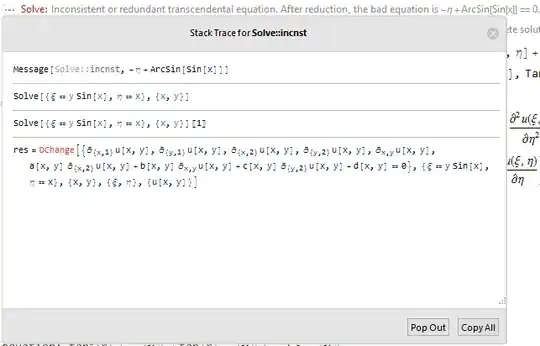

P.S. pdConv from here, DChange from answer.
P.P.S. Please do not judge strictly. I am a newbie. Any tips are welcome.


ArcSin[\[Xi]/y] == xinstead, but in this case it's not necessary becauseSolvestill manage to find the correct result. – xzczd Oct 23 '16 at 04:04Out[98]andOut[99]. I want to add labels for derivatives. Because it is difficult to navigate in the result set. So I convert result with help of theToStringand add text. ButToStringbreaks style as you can see. I didn't thought up any better way; Can you help me avoid ambiguous transformation rules? Are there some tips? – Woland Oct 23 '16 at 08:35%99is no longer the same as%98? Then wrap anotherTraditionalFormoutside of the string i.e.TraditionalForm[(*first string*) <> ToString[formatted[[1, 1]], TraditionalForm]]. As to the second question, just consider if your equations can deduce a unique rule. If you're not sure, try solving out the new variables and old variables from the equation respectively withSolvefirst and see ifSolvecomplains or gives multiple solutions, if not, then the transformation rule is OK, never forgetDChangeis built onSolve. – xzczd Oct 23 '16 at 08:58AssumingbeforeDChangeis forξandη. But what if I have no idea how convert limitations forxandyto limitations forξandη? I have tried insertAssuminginto DChange params but no result... For examplex>0 && y<0. Where can I tell Mathematica about that? – Woland Oct 23 '16 at 16:33Assumingonly has effect on functions with anAssumptionoption, whileSolvedoesn't have one. It currently only accepts assumptions in this form:Solve[{\[Xi] == y*Sin[x], \[Eta] == x, -Pi/2 <= x <= Pi/2}, {x, y}]. Of course it's not hard to modify the code ofDChangeto make it accept assumption. You may also suggest adding an e.g.solveAssumptionoption to the author ofDChange. – xzczd Oct 24 '16 at 01:18