1

I have the following problem from a textbook I am trying to integrate:
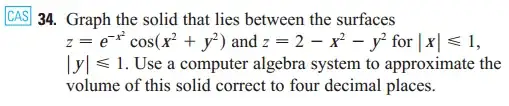
enter image description here

So, following the directions in text, I am required to integrate each function. However, I cannot get Mathematica to integrate the first function. Here is my code:

Z1 := E^-x^2*Cos[x^2 + y^2]
Z2 := 2 - x^2 - y^2
Plot3D[{Z1, Z2}, {x, -1, 1}, {y, -1, 1}, AspectRatio -> 1, ViewPoint -> {4, 1, 1}]
Integrate[Z2, {y, -1, 1}, {x, -1, 1}] - Integrate[Z1, {y, -1, 1}, {x, -1, 1}]

They plot OK:

enter image description here

but give me really strange output:

enter image description here

Could someone please explain how I can overcome this? Wolfram|Alpha can evaluate it without (much) trouble.

Thank you for your time.

J. M.'s missing motivation
  • 124,525
  • 11
  • 401
  • 574
Oliver Spryn
  • 359
  • 4
  • 12

2 Answers2

3

Mathematica is giving you an exact symbolic result. If want a numeric integral, you should use NIntegrate instead of Integrate, or just wrap your result in N. If you want, say, 30 significant digits,

N[Integrate[Z2, {y, -1, 1}, {x, -1, 1}] - 
  Integrate[Z1, {y, -1, 1}, {x, -1, 1}], 30]

3.02706907398351331410210839012 + 0.*10^-31 I

Rojo
  • 42,601
  • 7
  • 96
  • 188
1

You can use, in principle, Boole inside Integrate like this:

NIntegrate[
 Boole[E^-x^2 Cos[x^2 + y^2] < z < 2 - x^2 - y^2], {x, -1, 1}, {y, -1,
   1}, {z, -1, 3}]

the result is given as 3.0138472, despite warnings NIntegrate::slwcon: and NIntegrate::eincr:

I'm not able to figure out what actually happens at present, but I'm sure this way of using Boole will helps, especially for the integration of irregular regions or volumes.

yulinlinyu
  • 4,815
  • 2
  • 29
  • 36
