When attempting to recreate and generalise the MatLab code for Random Vectors with Fixed Sum by first principles I came across a few issue with RandomPoint.
According to RandomPoint's documentation it should evaluate on any region that is RegionQ and ConstantRegionQ. However this is not always the case.
For s = 1.2; n = 3;
rng = RegionIntersection[
       Cuboid[ConstantArray[0, n]],
       Hyperplane[ConstantArray[1, n], s/ConstantArray[n, n]]
      ];

Through@{RegionQ, ConstantRegionQ}@rng
{True, True}
However,
RandomPoint[rng, 1]
returns unevaluated.
Also, for higher dimensions such as n = 4;
rng4 = RegionIntersection[
       Cuboid[ConstantArray[0, n]],
       Hyperplane[ConstantArray[1, n], s/ConstantArray[n, n]]
      ];

Through@{RegionQ, ConstantRegionQ}@rng4
{True, True}
but
RandomPoint[rng4, 1]
returning unevaluated.
The n = 3 case can be solved by DiscretizeRegion on rng in RandomPoint.
SeedRandom[123];

RandomPoint[DiscretizeRegion@rng, 1]

Show[
 Region[rng, Boxed -> True, Axes -> True],
 Graphics3D[{
   Black,
   PointSize@Small,
   Point@RandomPoint[DiscretizeRegion@rng, 1000]
   }]
 ]
{{0.716182,0.258674,0.225143}}
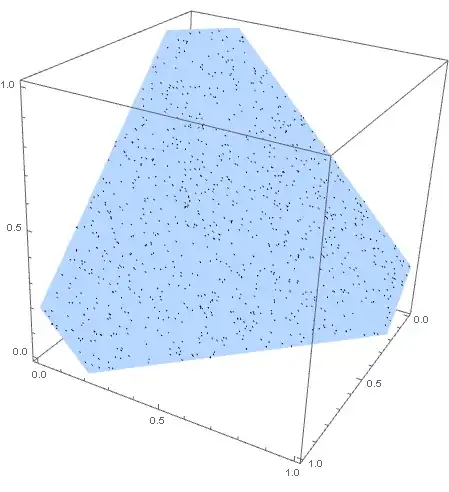
Unfortunately DiscretizeRegion does not work on higher dimensions.
I know that I can generate the vectors in higher dimensions with
s Standardize[RandomReal[1,n],0&,Total]
but the point is to demonstrate from first principles. That actually doesn't work.
Is there a way to get the expected functionality out of
RandomPointfor regions that areRegionQandConstantRegionQ?Can anyone reproduce the issues above? Win 8.1 Mma 11.3.0

rgn4would generate a random point in the boundedCuboidand keep those that lie on the unboundedHyperplane, which would never be expected to happen; so in fact,RandomPointfails when the dimension of the unbounded region is less than the bounded one. It seems to be an undocumented restriction. – Michael E2 May 20 '18 at 14:20RegionIntersectionthen since it is not producing a bounded region in this case? Should it not produce an $\mathbb{R}^{4}$ polygon in then=4case as it does in then=3case? Perhaps too complicated so goes forBooleanRegion. – Edmund May 20 '18 at 14:43RandomPoint, and the restriction applies torng, too. Yes, the region represents a polyhedron in ${\bf R}^4$. But how would represent that in M except by a union ofSimplex[]objects or an intersection of a bounded and unbounded region? If the region is aMeshRegion(which is a union of simplices), then a different algorithm is used, perhaps @ybeltukov's here, which predatesRandomPoint. If you can triangulaterng4into simplices, thenRandomPointwill work. – Michael E2 May 20 '18 at 15:00