Here's another demonstration (CDF, v9 but works with lower versions) I use in class:
Manipulate[
 With[{P0 = ρ (Sin[ϕ] {Cos[θ], Sin[θ], 0} + {0, 0, Cos[ϕ]}),
 $θColor = Red, $ϕColor = Darker[Blue], $ρColor = Brown},
  Graphics3D[{
    {PointSize[Medium], Point[P0],
     Line[{{0, 0, 0}, #} & /@ (3 IdentityMatrix[3])], Opacity[0.3],
     Line[{{0, 0, 0}, #} & /@ (-3 IdentityMatrix[3])]}, {
     {Opacity[0.3],
      EdgeForm[Directive[Thickness[Medium], Opacity[0.3]]],
      Polygon[{{0, 0, 0}, P0, {P0[[1]], P0[[2]], 0}}], $θColor,
       EdgeForm[
       Directive[Thickness[Medium],
        If[Δρ == 0 && Δϕ == 0 && Δθ == 0, Opacity[1],
       Opacity[0.3]], $θColor]],
      Polygon[Append[
        Table[0.3 {Cos[t], Sin[t], 0}, {t,
          Append[Range[0, θ, 0.05], θ]}], {0, 0,
         0}]], $ϕColor,
      EdgeForm[
       Directive[Thickness[Medium],
        If[Δρ == 0 && Δϕ == 0 && Δθ == 0,
       Opacity[1], Opacity[0.3]], $ϕColor]],
      Polygon[Append[
        Table[0.5 (Sin[t] {Cos[θ], Sin[θ], 0} + {0, 0,
             Cos[t]}), {t,
          Append[Range[0, ϕ, 0.05], ϕ]}], {0, 0, 0}]]},
     Line[{{P0, {0, 0, P0[[3]]}}, {{P0[[1]], P0[[2]], 0}, {P0[[1]], 0,
          0}}, {{P0[[1]], P0[[2]], 0}, {0, P0[[2]], 0}}}],
     Point[DiagonalMatrix[P0]]
     },
    Which[
     Δρ == 0 && Δϕ == 0 && Δθ == 0,
      { Thick, $ρColor, Line[{{0, 0, 0}, P0}] },
     Δρ == 0 && Δϕ == 0(*&&Δθ>0*), {
      First@
       ParametricPlot3D[ρ (Sin[ϕ] {Cos[t], Sin[t], 0} + {0,
            0, Cos[ϕ]}), {t, θ, θ + Δθ},
        PlotStyle -> Directive[Thick, $θColor]]
      },
     Δρ == 0 &&(*Δϕ>
      0&&*)Δθ == 0, {
      First@
       ParametricPlot3D[ρ (Sin[s] {Cos[θ], Sin[θ],
             0} + {0, 0,
            Cos[s]}), {s, ϕ, ϕ + Δϕ},
        PlotStyle -> Directive[Thick, $ϕColor]]
      },
     (*Δρ>
     0&&*)Δϕ == 0 && Δθ == 0, {
      First@
       ParametricPlot3D[
        r (Sin[ϕ] {Cos[θ], Sin[θ], 0} + {0, 0,
            Cos[ϕ]}), {r, ρ, ρ + Δρ}, PlotStyle -> Directive[Thick, $ρColor]]
      },
     Δρ == 0(*&&Δϕ>
     0&&Δθ>0*), {
      First@
       ParametricPlot3D[ρ (Sin[s] {Cos[t], Sin[t], 0} + {0, 0,  Cos[s]}),
          {s, ϕ, ϕ + Δϕ},
          {t, θ, θ + Δθ}, Mesh -> None,
        PlotStyle -> Directive[Lighter[$ρColor]]]
      },
     (*Δρ>0&&Δϕ>
     0&&*)Δθ == 0, {
      First@
       ParametricPlot3D[ r (Sin[s] {Cos[θ], Sin[θ], 0} + {0, 0, Cos[s]}),
         {s, ϕ, ϕ + Δϕ},
         {r, ρ, ρ + Δρ}, Mesh -> None,
        PlotStyle -> Lighter[$θColor]]
      },
     (*Δρ>
     0&&*)Δϕ == 0(*&&Δθ>
     0*), {
      First@
       ParametricPlot3D[
        r (Sin[ϕ] {Cos[t], Sin[t], 0} + {0, 0, Cos[ϕ]}),
        {r, ρ, ρ + Δρ},
        {t, θ, θ + Δθ},
        Mesh -> None, PlotStyle -> Lighter[$ϕColor]]
      },
     True(*Δρ>0&&Δϕ>
     0&&Δθ>0*), {
      First@
       ParametricPlot3D[ρ (Sin[s] {Cos[t], Sin[t], 0} + {0, 0, Cos[s]}),
           {s, ϕ, ϕ + Δϕ},
           {t, θ, θ + Δθ}, Mesh -> None,
        PlotStyle ->
         Dynamic@Directive[Lighter[$ρColor], Opacity[opacity]]],
      First@
       ParametricPlot3D[
        r (Sin[s] {Cos[θ], Sin[θ], 0} + {0, 0, Cos[s]}),
           {s, ϕ, ϕ + Δϕ},
           {r, ρ, ρ + Δρ}, Mesh -> None,
        PlotStyle ->
         Dynamic@Directive[Lighter[$θColor],
           Opacity[opacity]]],
      First@ParametricPlot3D[
        r (Sin[ϕ] {Cos[t], Sin[t], 0} + {0, 0, Cos[ϕ]}),
           {r, ρ, ρ + Δρ},
           {t, θ, θ + Δθ}, Mesh -> None,
        PlotStyle ->
         Dynamic@Directive[Lighter[$ϕColor], Opacity[opacity]]],
      First@ParametricPlot3D[(ρ + Δρ) (Sin[s] {Cos[t], Sin[t], 0} + {0, 0, Cos[s]}),
           {s, ϕ, ϕ + Δϕ},
           {t, θ, θ + Δθ}, Mesh -> None,
        PlotStyle ->
         Dynamic@Directive[Lighter[$ρColor], Opacity[opacity]]],
      First@ParametricPlot3D[
        r (Sin[s] {Cos[θ + Δθ],
             Sin[θ + Δθ], 0} + {0, 0, Cos[s]}),
           {s, ϕ, ϕ + Δϕ},
           {r, ρ, ρ + Δρ}, Mesh -> None,
        PlotStyle ->
         Dynamic@Directive[Lighter[$θColor],
           Opacity[opacity]]],
      First@ParametricPlot3D[
        r (Sin[ϕ + Δϕ] {Cos[t], Sin[t], 0} + {0, 0, Cos[ϕ + Δϕ]}),
           {r, ρ, ρ + Δρ},
           {t, θ, θ + Δθ}, Mesh -> None,
        PlotStyle ->
         Dynamic@Directive[Lighter[$ϕColor], Opacity[opacity]]]
      }
     ]
    },
   SphericalRegion -> True, PlotRange -> 2, Lighting -> "Neutral"
   ]],
 Row[{Control[{{ρ, 1}, 0, 2, ImageSize -> Small}],
   Control[{Δρ, 0, 1, ImageSize -> Small}]},
  Spacer[1]],
 Row[{Control[{ϕ, 0, π, ImageSize -> Small}],
   Control[{Δϕ, 0, π, ImageSize -> Small}]},
  Spacer[1]],
 Row[{Control[{θ, 0, 2 π, ImageSize -> Small}],
   Control[{Δθ, 0, 2 π,
     ImageSize -> Small}]}, Spacer[1]],
 {{opacity, 1}, 0, 1}, ControlPlacement -> Left
 ]
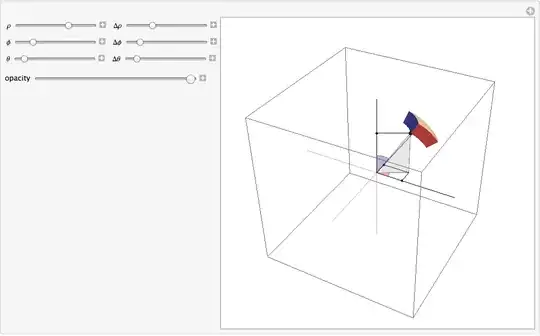
I might add that the reason for submitting it was that it shows, if one moves the ϕ slider, that the surface area element $dS$ or volume element $dV$ decreases as ϕ moves toward 0, or $\pi$, which is in part what his question was about.


SphericalPlot3D? – whuber Jan 08 '13 at 18:51Graphics3D[Sphere[]]. Are you wishing to parametrize the surface with spherical coordinates? – Michael E2 Jan 08 '13 at 18:52