In a series of previous questions, I asked how to solve a series of differential equations describing a series of coupled pendulums, and then how to plot this data by coloring the different pendulums. Using the excellent answers from these two questions, I was able to output a 3-dimensional view of how the pendulums swing.
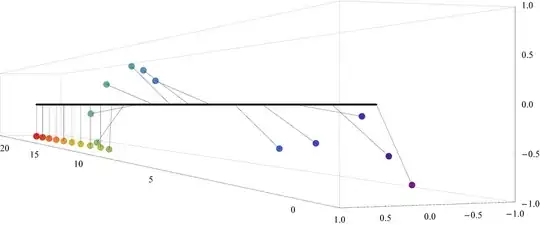
My system's graphics card is pretty outdated, so using Szabolcs' poor man's antialiasing, I attempted to output a movie of the pendulums' motion.
To begin with, my code to generate the individual 3-dimensional views at a given point of time is shown below.
funcposition = Table[{Sin[# + i], 1}, {i, 0, n, 1}] &;

(*the position function of each pendulum, as a function of time. note - this is a dummy variable; you can see the explanation below of why I used a dummy variable. The variable # is the time*)

connectionpoints =
  Transpose[{Table[i, {i, 0, n}], Table[0, {i, 0, n}],
    Table[0, {i, 0, n}]}];

(*the points where the balls are connected to the supporting stick*)

supportstick = {Black, Thick, Line[{{0, 0, 0}, {n, 0, 0}}]};

(*the thick black supporting stick*)

toPolar = {#2 Cos[# - \[Pi]/2], #2 Sin[# - \[Pi]/2]}\[Transpose] & @@ (#\[Transpose]) &;

(*Mr Wizard's method for coloring the points and producing the output here*)

colors = ColorData["Rainbow"] /@ Rescale@Range@Length@funcposition[0];

(*A three-dimensional plot of the data, including the antialiasing*)

antialiasedthreedpendulumviewer =
  ImageResize[
    Rasterize[
     Graphics3D[{PointSize[Large],
        Point[Transpose[
          Prepend[Transpose[toPolar@funcposition[#1]],
           Range[n + 1] - 1]], VertexColors -> colors]}~Join~
       supportstick~Join~{Black, Thin}~
       Join~(Line /@
         Partition[
          Riffle[Transpose[
            Prepend[Transpose[toPolar@funcposition[#1]],
             Range[n + 1] - 1]], connectionpoints], 2]),
      PlotRange -> {{-1, n + 1}, {-1, 1}, {-1, 1}}, Axes -> True,
      ViewPoint -> #2, ImageSize -> Large], "Image",
     ImageResolution -> 8*72], Scaled[1/4]] &;
To export the images as a video, I then apply the following:
starttime=0;
endtime=0.5;
timestep=0.005
perspective={-0.87, 0.25, 0}

tableofimages =
Table[antialiasedthreedpendulumviewer[tdummy, perspective], {tdummy, starttime, endtime, timestep}];
Export["animation.flv", tableofimages]
However, this process is very slow, and producing even ten frames took me three minutes.
My question is - how do we improve the performance of the exporting process? As a side question, how would we reduce the file size of the file exported?
Note: The actual motion of the coupled pendulums is replaced with a toy function in this running example above, as I don't think that the evaluation of the solution is the key rate-determining step for the exporting of the video in the simulation. The actual code that I am running involves solving the ODE first and also replace the funcposition with a substitution of the functions' solution.
m = 0.1;
l = 0.2;
b = 1;
mu = 1;
k = 10;
eta = 0.2;
g = 0.2;
a = 1;

g = 9.81;

n = 20;
tmax = 20;

funch = (1 - eta/(2 (1 - Cos[#1 - #2]) + (g/a)^2)^0.5) &;
funcf = # + Abs[#] &;
tau = Sin[#1 - #2]*k*l^2*funcf[funch[#1, #2]] &;

node = b*m*l^2*
     D[theta[#][t], {t, 2}] == -g*m*mu*l*
      Sin[theta[#][t]] + tau[theta[# - 1][t], theta[#][t]]*
      HeavisidePi[(#*(1 + n*$MachineEpsilon) - 1)/n - 0.5] + tau[
       theta[# + 1][t], theta[#][t]]*
      HeavisidePi[(#*(1 - n*$MachineEpsilon) + 1)/n - 0.5] &;
(*machine epsilon bit is to make side pendula only affected by \
themselves*)

initialposition = theta[#][0] == 0 &;
initialvelocity = theta[#]'[0] == 0 &;

initialconditions = {theta[0][0] == 0, theta[0]'[0] == 50,
    theta[1]'[0] == 45, theta[2]'[0] == 40, theta[3]'[0] == 35,
    theta[4]'[0] == 30, theta[5]'[0] == 25}~Join~
   Table[initialposition[i], {i, 1, n}]~Join~
   Table[initialvelocity[i], {i, 6, n}];

(*initial conditions defined as above*)

equations = Table[node[i], {i, 0, n}];
system = equations~Join~initialconditions;
functions = Table[theta[i][t], {i, 0, n}];
solution =  NDSolve[system, functions, {t, 0, tmax}, MaxSteps -> 10000*n*tmax];

funcposition = Table[{(Evaluate[theta[i][t] /.solution] /.t -> #)[[1]], 1}, {i, 0, n, 1}] &;


Rasterizefunction and that time has -- not to much surprise -- a quadratical dependence on the image resolution. I have not tested it, but I guess that theExportbehaves similar, and of course also the file size depends mainly on that. Do your really need such a high resolution? With my setup a resolution of2*72already looks very nice... – Albert Retey Mar 15 '13 at 09:16