A quick and dirty attempt. Let me know if there is a bug somewhere. All bugs are fixed in the order they are recieved.
code
The function getPatterns thanks to Carl Woll, see
Using Cases and when to make input a list or not
getPatterns[expr_, pat_] :=
  Last@Reap[expr /. a : pat :> Sow[a], _, Sequence @@ #2 &];
The parser
(* Basic Parsing function *)
(*version alpha 1.01 Released . on April 27, 2020 at 9:38 PM*)
checkIfValidODE[odeInput_, y_[arg_], x_] :=
 Module[{ode, lhs, rhs, order, tmp, tmp0, tmp00, maxOrder, n, z,
   independentVariables, xx, yy},

  If[Not[SameQ[arg, x]],
   Return[
    Row[{"Argument of dependent variable ", y,
      " is not what is expected."}], Module]
   ];

  If[Not[SameQ[Head[odeInput], Equal]],
   Return[Row[{"Expected equation as input but found ", odeInput}],
    Module]
   ];

  tmp = getPatterns[odeInput, Derivative[n_][yy_][xx_]];
  If[Length@tmp == 0,
   Return[Row[{"No derivative found in ", odeInput}], Module]
   ];

  tmp0 = Cases[tmp, Derivative[n_][yy_][xx_] :> xx];
  tmp00 = getPatterns[tmp0, Derivative[n_][yy_][xx_]];

  If [Length@tmp00 > 0,
   Return[Row[{"Nested derivatives not allowed"}], Module]
   ];

  order = Cases[tmp, Derivative[n_][y][x] :> n];
  If[order === {},
   Return[Row[{"No ", y'[x], " found in the ODE ", odeInput}], Module]
   ];

  tmp = getPatterns[odeInput, y[xx_]];
  independentVariables = Union@Cases[tmp, y[xx_] :> xx];
  If [Length@independentVariables > 1,
   Return[Row[{"Unexpected argument for ", y , " found ", y[x]}],
    Module]
   ];

  If[Length@independentVariables ==
     1 && (First@independentVariables) =!=  x,
   Return[
    Row[{"Unexpected argument for", y , " found", independentVariables}], Module]
   ];

  Print["Input is valid ODE of order ", order]

  ]
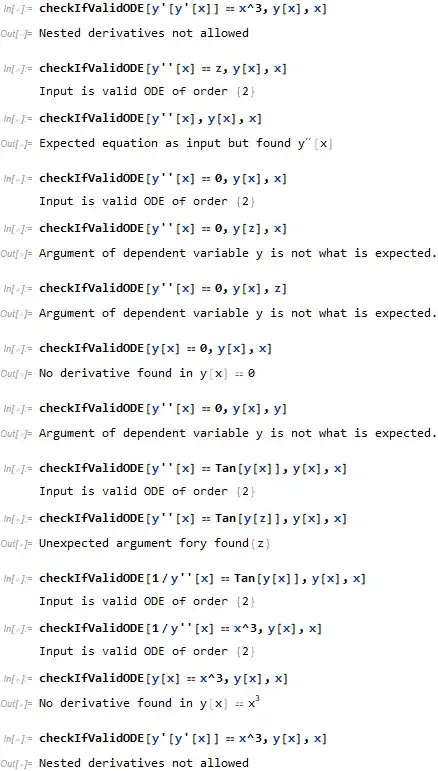
Test code
checkIfValidODE[y'[y'[x]] == x^3, y[x], x]
checkIfValidODE[y''[x] == z, y[x], x]
checkIfValidODE[y''[x], y[x], x]
checkIfValidODE[y''[x] == 0, y[x], x]
checkIfValidODE[y''[x] == 0, y[z], x]
checkIfValidODE[y''[x] == 0, y[x], z]
checkIfValidODE[y[x] == 0, y[x], x]
checkIfValidODE[y''[x] == 0, y[x], y]
checkIfValidODE[y''[x] == Tan[y[x]], y[x], x]
checkIfValidODE[y''[x] == Tan[y[z]], y[x], x]
checkIfValidODE[1/y''[x] == Tan[y[x]], y[x], x]
checkIfValidODE[1/y''[x] == x^3, y[x], x]
checkIfValidODE[y[x] == x^3, y[x], x]

