This is my first topic and I continue work on that: Lagrangian of three-mass system with Mathematica
I found interesting problem here, and try reproduce results.

Assumption: $d_1=0$
Algorithm:
- Write Lagrangian:
$L=W_k-W_p=\frac{J_1 \omega_1^2}{2}+\frac{J_2 (\frac{r_2}{r_1}\omega_2)^2}{2}-\frac{c_1(\phi_1-\frac{r_2}{r_1}\phi_2)^2}{2}$
where $W_k$ and $W_n$ - kinetic and potential energy.
- Using formula:
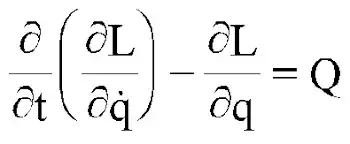
find equation of motion for coordinates:
$\frac{d}{dt}\frac{\partial L}{\partial \dot{\phi_1}}-\frac{\partial L}{\partial \phi_1}=0$
$\frac{d}{dt}\frac{\partial L}{\partial \dot{\phi_2}}-\frac{\partial L}{\partial \phi_2}=0$
I implemented all this in Mathematica:
Clear["Derivative"];
ClearAll["Global`*"];
Remove[c, J, r];
L = Sum[1/2 Subscript[J, i] D[Subscript[[Phi], i][t], t]^2, {i, 2}] -
    Sum[1/2 Subscript[c,
      10 i + i +
       1] (Subscript[[Phi], i][t] -
        Subscript[[Phi], i + 1][t])^2, {i, 1}];
L = -(1/2) Subscript[c,
    12] (Subscript[[Phi], 1][
       t] - ((Subscript[r, 2]/Subscript[r, 1]) Subscript[[Phi], 2][
         t]))^2 +
   1/2 Subscript[J, 1] Derivative[1][Subscript[[Phi], 1]][t]^2 +
   1/2 Subscript[J,
    2] ((Subscript[r, 2]/Subscript[r, 1]) Derivative[1][
       Subscript[[Phi], 2]][t])^2;
eq1 = D[D[L, Derivative[1][Subscript[[Phi], 1]][t]], t] -
  D[L, Subscript[[Phi], 1][t]]
eq2 = D[D[L, Derivative[1][Subscript[[Phi], 2]][t]], t] -
  D[L, Subscript[[Phi], 2][t]]
But the results didn't match the picture. Where did I go wrong?

EDIT:
There is my code for three-mass system:
Clear["Derivative"]
ClearAll["Global`*"]
Remove[c, J]
(***Gear ratios)
gr = {Subscript[n, 1], Subscript[n, 2]};
L = Sum[1/2 Subscript[J, i] D[Subscript[[Phi], i][t], t]^2, {i, 3}] -
    Sum[1/2 Subscript[c,
      10 i + i +
       1] (Subscript[[Phi], i][t]/gr[[i]] -
        Subscript[[Phi], i + 1][t])^2, {i, 2}];
eq1 = D[D[L, Derivative[1][Subscript[[Phi], 1]][t]], t] -
     D[L, Subscript[[Phi], 1][t]] == Subscript[T, 1][t] // Simplify;
eq20 = D[D[L, Derivative[1][Subscript[[Phi], 2]][t]], t] -
     D[L, Subscript[[Phi], 2][t]] == Subscript[T, 2][t] // Simplify;
eq3 = D[D[L, Derivative[1][Subscript[[Phi], 3]][t]], t] -
     D[L, Subscript[[Phi], 3][t]] == Subscript[T, 3][t] // Simplify;
eq2 = ApplySides[Expand[Subscript[n, 1]^2*#1] &,
   eq20 /. Subscript[n, 1] -> 1/Subscript[n, 1]];


I also assumed that the rigid shafts are installed after the gearboxes, and not in front of them.
The only thing that didn't work for me was to apply a line of code.
– dtn Jun 28 '21 at 19:05ApplySides[Expand[igr^2*#1] & , eq20 /. gr -> 1/igr]For some reason, the expression is not modified with it.ApplySideshas been in the WL since 11.3. What is the output you are getting and is it the same aseq20? And what version are you using and which OS? – Suba Thomas Jun 28 '21 at 22:22eq1 = D[D[L, Derivative[1][Subscript[\[Phi], 1]][t]], t] - D[L, Subscript[\[Phi], 1][t]] == Subscript[T, 1][t] // Simplify;eq20 = D[D[L, Derivative[1][Subscript[\[Phi], 2]][t]], t] - D[L, Subscript[\[Phi], 2][t]] == Subscript[T, 2][t] // Simplify;eq3 = D[D[L, Derivative[1][Subscript[\[Phi], 3]][t]], t] - D[L, Subscript[\[Phi], 3][t]] == Subscript[T, 3][t] // Simplify;
– dtn Jun 29 '21 at 05:05eq2 = ApplySides[Expand[Subscript[n, 1]^2*#1] &, eq20 /. Subscript[n, 1] -> 1/Subscript[n, 1]];