Zeta[-13] == Zeta[-1] == -1/12
Why do these two different zetas produce the same value?
Zeta[-13] == Zeta[-1] == -1/12
Why do these two different zetas produce the same value?


In order to understand the issue, we should provide the underlying definitions. Mathematica helps in verifying appropriate relations and definitions. The main functional equation relating Riemann's zeta function $\zeta\;$, to Euler's $\Gamma\;$, established in Riemann's famous paper Über die Anzahl der Primzahlen unter einer gegebener Grösse (1859, English translation here), where he formulated the Riemann hypothesis, can be simply written and evaluated with the system:
Through @ { HoldForm, FullSimplify}[
             Zeta[z] == 2^z Pi^(z - 1) Sin[Pi z/2] Gamma[1 - z] Zeta[1 - z]]//
Column // TraditionalForm
$$\begin{align*}&\zeta(z)=2^z\pi^{-1+z}\Gamma(1-z)\sin\left(\frac{\pi z}{2}\right)\zeta(1-z)\\
&\text{True}\end{align*}$$
Similarly we can exploit the definition of Zeta for Re[z] > 1 (see SumConvergence[1/n^z, n]):
Sum[ 1/n^z, {n, Infinity}] == Defer[ Sum[ 1/n^z, {n, Infinity}]] ==
Defer[Product[ 1/(1 - Prime[i]^-z), {i, Infinity}]] // TraditionalForm
$$\zeta(z)=\sum_{n}^\infty \frac1{n^z}=\prod_{i}^\infty \frac1{1-(p_i)^{-z}}$$
List @@ (2^z Pi^(z - 1) Sin[Pi z/2] Gamma[1 - z] Zeta[1 - z])
$$\left\{2^z,\pi^{z-1},\Gamma(1-z),\sin\left(\frac{\pi z}{2}\right),\zeta(1-z)\right\}$$
Let's find adequate values:
Table[{2^z, Pi^(z - 1), Sin[Pi z/2], Gamma[1 - z], Zeta[1 - z]},
      {z, {-1, -13}}] // Column
$$\begin{align*} &\left\{\frac12,\frac1{\pi^2},-1,1,\frac{\pi^2}{6}\right\}\\ &\left\{\frac1{8192},\frac1{\pi^{14}},-1,6227020800,\frac{2\pi^{14}}{18243225}\right\} \end{align*}$$
For positive even integers, Zeta evaluates to exact values, and one can calculate them from the above definition, but Mathematica can do it too, e.g.:
HoldForm[ Sum[ 1/n^14, {n, Infinity}]] == Sum[1/n^14, {n, Infinity}] // TraditionalForm
$$\sum_n^\infty \frac1{n^{14}}=\frac{2\pi^{14}}{18243225}$$
Moreover, we have a simple relation between the Euler gamma function and factorial for natural numbers:
FullSimplify[ Gamma[n] == Factorial[n - 1], n ∈ Integers && n > 0]
True
Finally, one has to check also the rational coefficients of the above formulae:
FactorInteger @ { 8192, 18243225, 6227020800} // Column
{{3, 6}, {5, 2}, {7, 1}, {11, 1}, {13, 1}}
{{2, 10}, {3, 5}, {5, 2}, {7, 1}, {11, 1}, {13, 1}}
{{2, 13}}
Comparison of the factorization results completes our proof. Q.E.D.
Edit
There are infinitely many arguments where Zeta[x]==-1/12, though -13 and -1 seem to be the only integers among them on the other hand negative odd arguments yield rational values.
Reduce[ Zeta[x] == -(1/12) && -1000 < x < 1000, x, Integers]
x == -13 || x == -1
Here we add a plot of contours of the real part equal to -1/12 and the vanishing imaginary part of Zeta in the complex plane:
ContourPlot[ {Re[Zeta[x + I y]] == -(1/12), Im[Zeta[x + I y]] == 0},
             {x, -20, 20}, {y, -20, 20}, Evaluated -> True,
             PlotPoints -> 100, MaxRecursion -> 5]
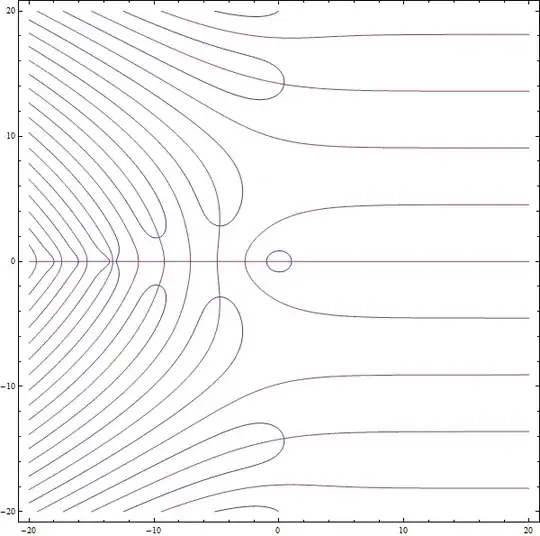
Points of Zeta[x + I y] == -(1/12) lie on intersections of the blue and red curves

(This is a math question, not a Mathematica question.)
To add to Artes's answer, there is the well-known(!) identity
$$\zeta(-n)=\frac{(-1)^n}{n+1}B_{n+1}$$
so you might as well ask why
$$\begin{align*} -\frac12\times B_2&=-\frac1{14}\times B_{14}\\ -\frac12\times \frac16&=-\frac1{14}\times \frac76 \end{align*}$$
A justification for the relationship with the Bernoulli numbers is discussed in many references, e.g. Edwards's, Riemann's Zeta Function.
In fact there are lots of Zetas which produce the same value, e.g. try these:
$\{\zeta(-2), \zeta(-4), \zeta(-6),\ldots ,\zeta(-2n)\}$
{Zeta[-2], Zeta[-4], Zeta[-6]}

 (* {0, 0, 0} *)
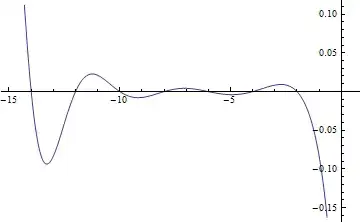
Using Plot may shed some light on this:
Plot[Zeta[x], {x, -15, 0.5}]

FullSimplify[Zeta[-n] == (-1)^n/(n + 1) BernoulliB[n + 1], n ∈ Integers && n > 0]returnsTrue. – Artes May 18 '13 at 13:54