Since I got a thumbs up, I will present something. To the author of the OP, please let me know whether this is useful or not. If not, I am happy to delete it.
We begin by recording the Rodrigues' formula for the Hermite polynomials
$$
\begin{equation}
H_n (x) = (-1)^n e^{x^2} \frac{d^n}{dx^n} \left( e^{-x^2} \right)
\end{equation}
$$
Using the above we can re-write the integral of interest as follows:
$$
\begin{equation}
\int^{\infty}_{-\infty} ~ dx ~ e^{-x^2} ~ H_m(x) ~ H_n(x) = (-1)^n \int^{\infty}_{-\infty} ~ dx ~ H_m(x) ~ \frac{d^n}{dx^n} \left( e^{-x^2} \right)
\end{equation}
$$
And now we can separate two cases:
Case 1 We examine $m \neq n$. We will choose $m < n$ without loss of generality and integrate by parts to take all derivatives on the Hermite polynomial.
Assuming[{n, m} ∈ NonNegativeIntegers && m > n,
 Integrate[
  D[HermiteH[m, x], {x, n}] Exp[-x^2], {x, -Infinity, Infinity}]]

Case 2 here we have $m=n$. Here, Mathematica provides us with the following
Assuming[{n} ∈ NonNegativeIntegers && n >= 0,
 Integrate[
  D[HermiteH[n, x], {x, n}] Exp[-x^2], {x, -Infinity, Infinity}]]

The first bit is easy to see that is what we want, since
Factorial[n] == Gamma[1 + n] == FactorialPower[n, n] // FullSimplify

The thing that I have not understood as of yet, is why Mathematica is giving a 0. If I do
Integrate[
 D[HermiteH[0, x], {x, 0}] Exp[-x^2], {x, -Infinity, Infinity}]
I get

Edit thanks to @BobHanlon for reminding me.
With
res = Assuming[{n} ∈ NonNegativeIntegers && n >= 0,
  Integrate[
   D[HermiteH[n, x], {x, n}] Exp[-x^2], {x, -Infinity, Infinity}]]
FunctionExpand will automatically convert FactorialPower to a Gamma.
Then, we can change the ComplexityFunction
gammatofac[expr_, n_] :=
  FullSimplify[expr, n ∈ Integers && n > 0,
   ComplexityFunction -> ((LeafCount@# +
        10 Count[#, _Gamma | _Pochhammer, {0, \[Infinity]}]) &)];
to convert the Gamma to a Factorial. Altogether it reads
gammatofac[Flatten[(res // FunctionExpand)[[1]]][[1]], n]
and returns
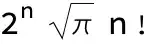
To the mathematicians: please do not hunt me down and kill for writing $\int dx ~ \texttt{stuff}$. We do it all the time in Physics.


Assuming[Element[{n}, PositiveIntegers], Integrate[ E^(-x^2) HermiteH[n, x] HermiteH[1, x], {x, -Infinity, Infinity}, GenerateConditions -> True]]returns 0 if $n >1$. No mention for $n=1$. – bmf Feb 14 '23 at 04:55Integrate[]which detects such an integral and returns the expected result? Would you be satisfied with that? – Somos May 13 '23 at 19:34