This problem can be solved with using the Euler wavelets collocation method as follows. We introduce same normalized variable as here in the form $x\rightarrow \frac {x}{s(t)}$. First, we test code utilizing numerical solution from @ybeltukov answer
OEm[m_, x_] :=
 Sqrt[2 m +
    1] Sum[(-1)^(m - k) x^k Binomial[m, k] Binomial[m + k, k], {k, 0,
    m}]; UE[m_, t_] := OEm[m, t];
psi[k_, n_, m_, t_] :=
 Piecewise[{{2^((k - 1)/2) UE[m, 2^(k - 1) t - n + 1], (n - 1)/
      2^(k - 1) <= t < n/2^(k - 1)}, {0, True}}];
PsiE[k_, M_, t_] :=
 Flatten[Table[psi[k, n, m, t], {n, 1, 2^(k - 1)}, {m, 0, M - 1}]]
k0 = 3; M0 = 4;
With[{k = k0, M = M0},
  nn = Length[Flatten[Table[1, {n, 1, 2^(k - 1)}, {m, 0, M - 1}]]]];
dx = 1/(nn); xl = Table[l*dx, {l, 0, nn}]; xcol =
 Table[(xl[[l - 1]] + xl[[l]])/2, {l, 2, nn + 1}];
Psijk = With[{k = k0, M = M0}, PsiE[k, M, t1]]; Int1 =
 With[{k = k0, M = M0}, Integrate[PsiE[k, M, t1], t1]];
Int2 = Integrate[Int1, t1];
Psi[y_] := Psijk /. t1 -> y;
int1[y_] := Int1 /. t1 -> y;
int2[y_] := Int2 /. t1 -> y;
wA = Table[wa[i][t], {i, nn}]; wB = Table[wb[i][t], {i, 2}];
v2[x_] := wA . Psi[x]; v1[x_] := wA . int1[x] + wB[[1]];
v0[x_] := wA . int2[x] + wB[[1]] x + wB[[2]];
equ = {D[v0[x], t] + (x v1[1] v1[x])/s[t]^2 == v2[x]/
   s[t]^2}; eqnS = {s'[t] == -v1[1]/s[t]};
eqx = Table[equ, {x, xcol}];
eqs = Join[Flatten[eqx], eqnS];
bc = Join[{v1[0] + s[t] == 0}, {v0[1] == 0}]; icx = {v0[x] == 0 /.
   t -> 0}; ic = Table[icx, {x, xcol}] // Flatten;
varAll = Join[wA, wB, {s[t]}];
icn = Join[ic, bc /. t -> 0, {s[0] == 10^-3}]; eqnN =
 Join[eqs, D[bc, t]]; var1 = D[varAll, t];
{vec, mat} = CoefficientArrays[eqnN, var1];
f = Inverse[mat // N] . (-vec);
vr0 = varAll /. t -> 0; {w0, mat0} = CoefficientArrays[icn, vr0];
s0 = Inverse[mat0 // N] . (-w0); rul0 =
 Table[vr0[[i]] -> s0[[i]], {i, Length[vr0]}];
f0 = f /. t -> 0 /. rul0; m = Length[f];
sol = NDSolve[{Table[var1[[i]] == f[[i]], {i, Length[var1]}],
    Table[vr0[[i]] == s0[[i]], {i, Length[vr0]}]}, varAll, {t, 0, 1}];
Visualization and comparison with @ybeltukov solution (dashed lines)
lst = Table[{{t, x}, v0[x] /. sol[[1]]}, {t, 0, 1, .1}, {x, 0,
   1, .1}]; u = Interpolation[Flatten[lst, 1]]; S =
 Interpolation[Table[{t, s[t] /. sol[[1]]}, {t, 0, 1, .01}]];
{Show[{DensityPlot[
   u[t, x/S[t]] UnitStep[S[t] - x], {t, 0, 1}, {x, 0, 1},
   FrameLabel -> {"t", "x"}, ColorFunction -> "Rainbow"],
  Plot[s[t] /. sol[[1]], {t, 0, 1}, PlotStyle -> {Red, Dashed}]}],Plot[{u[t, 0], u[1, t/S[1]] UnitStep[S[1] - t], S[t]}, {t, 0, 1},
 PlotLegends -> Automatic, Frame -> True,
 PlotStyle -> {Red, Blue, Black}]}
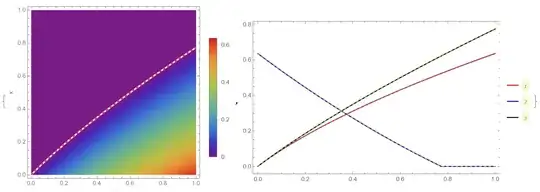
Note, that two numerical solution are in a good agreement, therefore we can try to solve problem proposed by Josè. In this case we consider solution with initial data $v(x,0)=vini(x)=x, s(0)=3$, we have
s0 = 3; F[t_] := t; vini[x_] := x; tmax = 1.;
OEm[m_, x_] :=
 Sqrt[2 m +
    1] Sum[(-1)^(m - k) x^k Binomial[m, k] Binomial[m + k, k], {k, 0,
    m}]; UE[m_, t_] := OEm[m, t];
psi[k_, n_, m_, t_] :=
  Piecewise[{{2^((k - 1)/2) UE[m, 2^(k - 1) t - n + 1], (n - 1)/
       2^(k - 1) <= t < n/2^(k - 1)}, {0, True}}];
PsiE[k_, M_, t_] :=
 Flatten[Table[psi[k, n, m, t], {n, 1, 2^(k - 1)}, {m, 0, M - 1}]]
k0 = 3; M0 = 4;
With[{k = k0, M = M0},
  nn = Length[Flatten[Table[1, {n, 1, 2^(k - 1)}, {m, 0, M - 1}]]]];
dx = 1/(nn); xl = Table[l*dx, {l, 0, nn}]; xcol =
 Table[(xl[[l - 1]] + xl[[l]])/2, {l, 2, nn + 1}];
Psijk = With[{k = k0, M = M0}, PsiE[k, M, t1]]; Int1 =
 With[{k = k0, M = M0}, Integrate[PsiE[k, M, t1], t1]];
Int2 = Integrate[Int1, t1];
Psi[y_] := Psijk /. t1 -> y;
int1[y_] := Int1 /. t1 -> y;
int2[y_] := Int2 /. t1 -> y;
wA = Table[wa[i][t], {i, nn}]; wB = Table[wb[i][t], {i, 2}];
v2[x_] := wA . Psi[x]; v1[x_] := wA . int1[x] + wB[[1]];
v0[x_] := wA . int2[x] + wB[[1]] x + wB[[2]];
equ = {D[v0[x], t] + (x v1[1] v1[x])/s[t]^2 ==
   v2[x]/s[t]^2}; eqnS = {s'[t] == -v1[1]/s[t]};
eqx = Table[equ, {x, xcol}];
eqs = Join[Flatten[eqx], eqnS];
bc = Join[{v0[0] == 0}, {v1[1] - v0[1] == s[t] F[t]}]; icx = {v0[x] ==
     vini[x] s0 /. t -> 0}; ic = Table[icx, {x, xcol}] // Flatten;
varAll = Join[wA, wB, {s[t]}];
icn = Join[ic, bc /. t -> 0, {s[0] == s0}]; eqnN =
 Join[eqs, D[bc, t]]; var1 = D[varAll, t];
f = var1 /. Solve[eqnN, var1][[1]];
vr0 = varAll /. t -> 0; s00 = vr0 /. Solve[icn, vr0][[1]];
sol = NDSolve[{Table[var1[[i]] == f[[i]], {i, Length[var1]}],
    Table[vr0[[i]] == s00[[i]], {i, Length[vr0]}]},
   varAll, {t, 0, tmax}];
Visualization
S = Interpolation[
  Table[{t, s[t] /. sol[[1]]}, {t, 0, tmax, .01}]]; lst =
 Table[{{t, x}, v0[x] /. sol[[1]]}, {t, 0, tmax, .05}, {x, 0,
   1, .05}];
Show[{DensityPlot[
   u[t, x/S[t]] UnitStep[S[t] - x], {t, 0, tmax}, {x, 0, S[tmax]},
   FrameLabel -> {"t", "x"}, ColorFunction -> "Rainbow",
   PlotRange -> All, PlotLegends -> Automatic],
  Plot[S[t], {t, 0, tmax}, PlotStyle -> {Red, Dashed},
   PlotRange -> All]}]

Update 1. Second method to solve this problem is FDM, same as @ybeltukov, but much clear
ns = 101; h = 1/(ns - 1);
x[t_] = Table[Symbol["x" <> ToString[i]][t], {i, 1, ns}];
xgrid = Table[k h, {k, 0, ns - 1}]; M2 =
 NDSolve`FiniteDifferenceDerivative[Derivative[2], xgrid,
   DifferenceOrder -> 2]@"DifferentiationMatrix"; M1 =
 NDSolve`FiniteDifferenceDerivative[Derivative[1], xgrid,
   DifferenceOrder -> 2]@"DifferentiationMatrix";
eqnS = {s'[t] == -(M1 . x[t])[[ns]]/s[t]}; eq =
 Table[(D[x[t], t])[[i]] +
    xgrid[[i]] (M1 . x[t])[[ns]] (M1 . x[t])[[i]]/
      s[t]^2 == (M2 . x[t])[[i]]/s[t]^2, {i, 2, ns - 1}];
bc = {(M1 . x[t])[[1]] == -s[t], x[t][[ns]] == 0};
ini = Join[{s[0] == .001}, Table[x[0][[i]] == 0, {i, 2, ns - 1}]];
sol = NDSolve[{Join[eqnS, eq, D[bc, t]], Join[ini, bc /. t -> 0]},
   Join[{s[t]}, x[t]], {t, 0, 1}];
Visualization and comparison with previous solution (dashed lines)
u = Interpolation[
  Flatten[Table[{{t, xgrid[[i]]}, x[t][[i]] /. sol[[1]]}, {t, 0,
     1, .1}, {i, ns}], 1]];
S = Interpolation[Table[{t, s[t] /. sol[[1]]}, {t, 0, 1, .001}]];
{Show[{DensityPlot[
   u[t, x/S[t]] UnitStep[S[t] - x], {t, 0, 1}, {x, 0, 1},
   FrameLabel -> {"t", "x"}, ColorFunction -> "Rainbow"],
  Plot[S[t], {t, 0, 1}, PlotStyle -> {Red, Dashed}]}],Plot[{u[t, 0], u[1, t/S[1]] UnitStep[S[1] - t], S[t]}, {t, 0, 1},
Frame -> True, PlotStyle -> {Red, Green, Blue},
 PlotLegends -> Automatic]}

Finally we can solve problem proposed by Josè with initial data $v(x,0)=v_0(x)=x,s(0)=3$, and for $F(t)=t$, we have
F[t_] := t; v0[x_] := x;
ns = 101; h = 1/(ns - 1);
x[t_] = Table[Symbol["x" <> ToString[i]][t], {i, 1, ns}];
xgrid = Table[k h, {k, 0, ns - 1}]; M2 =
NDSolveFiniteDifferenceDerivative[Derivative[2], xgrid, DifferenceOrder -> 2]@"DifferentiationMatrix"; M1 = NDSolveFiniteDifferenceDerivative[Derivative[1], xgrid,
DifferenceOrder -> 2]@"DifferentiationMatrix";
eqnS = {s'[t] == -(M1 . x[t])[[ns]]/s[t]}; eq =
Table[(D[x[t], t])[[i]] +
xgrid[[i]] (M1 . x[t])[[ns]] (M1 . x[t])[[i]]/
s[t]^2 == (M2 . x[t])[[i]]/s[t]^2, {i, 2, ns - 1}];
bc = {(M1 . x[t])[[ns]] - x[t][[ns]] == s[t] F[t], x[t][[1]] == 0};
ini = Join[{s[0] == 3},
Table[x[0][[i]] == 3 v0[xgrid[[i]]], {i, 2, ns - 1}]];
sol = NDSolve[{Join[eqnS, eq, D[bc, t]], Join[ini, bc /. t -> 0]},
Join[{s[t]}, x[t]], {t, 0, 1}];
Visualization and comparison with wavelets solution (dashed lines)
Show[{DensityPlot[
   u[t, x/S[t]] UnitStep[S[t] - x], {t, 0, 1}, {x, 0, 3},
   FrameLabel -> {"t", "x"}, ColorFunction -> "Rainbow"],
  Plot[S[t], {t, 0, 1}, PlotStyle -> {Red, Dashed}]}];
Plot[{u[1, t/S[1]] UnitStep[S[t] - t], S[t]}, {t, 0, 1},
 PlotStyle -> Dashed, PlotLegends -> Automatic];
u = Interpolation[
  Flatten[Table[{{t, xgrid[[i]]}, x[t][[i]] /. sol[[1]]}, {t, 0,
     1, .1}, {i, ns}], 1]];

S = Interpolation[Table[{t, s[t] /. sol[[1]]}, {t, 0, 1, .001}]];

{Show[{DensityPlot[
   u[t, x/S[t]] UnitStep[S[t] - x], {t, 0, tmax}, {x, 0, s0},
   FrameLabel -> {"t", "x"}, ColorFunction -> "Rainbow",
   PlotRange -> All, PlotLegends -> Automatic],
  Plot[S[t], {t, 0, tmax}, PlotStyle -> {Red, Dashed},
   PlotRange -> All]}],Plot[{u[1, t/S[1]] UnitStep[S[t] - t], S[t]}, {t, 0, 1},
 PlotStyle -> {Red, Blue}, PlotLegends -> Automatic]}


DChange/DSolveChangeVariables. – xzczd Mar 23 '23 at 09:43