A typical case is as follows.
n = 26; Plot[(Csc[n t] Sin[t] Sin[(1 + n) t])/Pi, {t, 0, Pi/(n + 1)}]
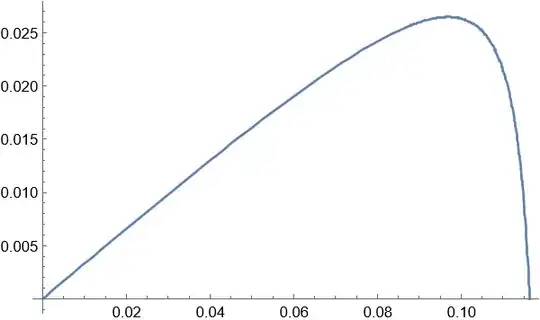
We see the maximum of the differentiable in $t$ function under consideration
is reached near $t=\frac \pi {n+1}$. In view of it we substitute t -> Pi/(n + 1) - a in
its derivative and expand the derivative by powers of a near zero.
ClearAll[n];Series[D[(Csc[n t] Sin[t] Sin[(1 + n) t])/Pi, t] /.
t -> Pi/(n + 1) - a, {a, 0, 1}] // Normal
-(((1 + n) Csc[(n \[Pi])/(1 + n)] Sin[\[Pi]/( 1 + n)])/\[Pi]) - (1/\[Pi]) 2 a (-Cos[\[Pi]/(1 + n)] Csc[(n \[Pi])/(1 + n)] - n Cos[\[Pi]/(1 + n)] Csc[(n \[Pi])/(1 + n)] + n Cot[(n \[Pi])/(1 + n)] Csc[(n \[Pi])/(1 + n)] Sin[\[Pi]/( 1 + n)] + n^2 Cot[(n \[Pi])/(1 + n)] Csc[(n \[Pi])/(1 + n)] Sin[\[Pi]/( 1 + n)])
({a, 0, 2} does not make things better.) Then we equate the above to zero and solve in a.
sol=Solve[% == 0, a]
{{a -> Sin[\[Pi]/(1 + n)]/( 2 (Cos[\[Pi]/(1 + n)] - n Cot[(n \[Pi])/(1 + n)] Sin[\[Pi]/(1 + n)]))}}
We are interested in the maximum value so we substitute that value of a in the function.
((Csc[n t] Sin[t] Sin[(1 + n) t])/Pi /. t -> Pi/(n + 1) - a) /. sol
{(1/\[Pi]) Csc[n (\[Pi]/(1 + n) - Sin[\[Pi]/(1 + n)]/( 2 (Cos[\[Pi]/(1 + n)] - n Cot[(n \[Pi])/(1 + n)] Sin[\[Pi]/(1 + n)])))] Sin[\[Pi]/( 1 + n) - Sin[\[Pi]/(1 + n)]/( 2 (Cos[\[Pi]/(1 + n)] - n Cot[(n \[Pi])/(1 + n)] Sin[\[Pi]/(1 + n)]))] Sin[(1 + n) (\[Pi]/(1 + n) - Sin[\[Pi]/(1 + n)]/( 2 (Cos[\[Pi]/(1 + n)] - n Cot[(n \[Pi])/(1 + n)] Sin[\[Pi]/(1 + n)])))]}
At last, in order to find the asymptotic,
Series[%, {n, Infinity, 2}]
{1/(3 n)-7/(18 n^2)+O[1/n]^3}
Calculations confirm the exponent -1.
getVal[n_] := First@NMaximize[{(Csc[n t] Sin[t] Sin[(1 + n) t])/\[Pi],
 0 < t < Pi/(n + 1)}, t];Table[Log[getVal[n]]/Log[n], {n, 200, 260}]
{-1.02648, -1.02639, ... , -1.02222, -1.02217}
Addition. Here is my successful attempt. Let us write down $\sin((n+1)t)=\sin(nt)\cos(t)+\cos(nt)\sin(t)$. Because $t\in \left[0,\frac \pi {n+1}\right]$ and $n$ tends to $\infty$, I replace $\sin(t)$ by $t$ and $\cos(t)$ by $1- \frac {t^2} 2$. It's summer now and I'm not in the mood to give error estimates. Let us look at a typical case
n = 26; Plot[{(Sin[n*t]*(1 - t^2/2) + Cos[n*t]*t)*t*Csc[n*t]/Pi,
(Sin[t]* Csc[n t] Sin[(1 + n) t])/\[Pi]}, {t, 0, Pi/n}, PlotStyle -> {Red, {Blue, Dashed}}]

It is convenient to make a replacement
ClearAll[n]; (Sin[n*t]*(1 - t^2/2) + Cos[n*t]*t)*t*Csc[n*t]/Pi /. t -> x/n
(x Csc[x] ((x Cos[x])/n + (1 - x^2/(2 n^2)) Sin[x]))/(n \[Pi])
Now we expand it around Pi
b = Series[(x Csc[x] ((x Cos[x])/n + (1 - x^2/(2 n^2)) Sin[x]))/(n*Pi), {x, Pi, 4}] // Normal
(4 n + 2 n^2 - \[Pi]^2)/(2 n^3) + \[Pi]/( n^2 (-\[Pi] + x)) + ((6 n + 6 n^2 - 9 \[Pi]^2 - 2 n \[Pi]^2) (-\[Pi] + x))/( 6 n^3 \[Pi]) + ((-9 - 4 n) (-\[Pi] + x)^2)/( 6 n^3) + ((-45 - 30 n - 2 n \[Pi]^2) (-\[Pi] + x)^3)/( 90 n^3 \[Pi]) - (2 (-\[Pi] + x)^4)/(45 n^2)
I repeat it's summer now and I'm not in the mood to give error estimates.
Maximize[{b, x >= Pi/2 && x <= Pi && n >= 35}, x] // First
produces a huge result in terms of a Root of a polynomial of 5-th degree. Now
Series[%, {n, Infinity, 1}]
1/n+O[1/n]^(3/2)
Calculations confirm it by
getVal[n_] := First@NMaximize[{(Csc[n t] Sin[t] Sin[(1 + n) t])/\[Pi],
0 < t < Pi/(n + 1)}, t]; Table[getVal[n]*n, {n, 3000000, 3000020}]
{0.998846, 0.998846, 0.998846, 0.998846, 0.998846, 0.998846, 0.998846, 0.998846, 0.998846, 0.998846, 0.998846, 0.998846, 0.998846, 0.998846, 0.998846, 0.998846, 0.998846, 0.998846, 0.998846, 0.998846, 0.998846}
Moreover, the result of
getVal[n_] := First@NMaximize[{(Csc[n t] Sin[t] Sin[(1 + n) t])/\[Pi],  0 < t < Pi/(n + 1)}, t];
Table[(getVal[n] - 1/n)*n^(3/2), {n, 3000000, 5000000, 500000}]
{-1.99884, -1.99893, -1.99902, -1.99906, -1.99911}
confirms $O(n^{-3/2}),\,n\to \infty.$


f=Map[First,Table[Maximize[{Sin[t]Sin[(n+1)t]Csc[n t]/Pi,0<t<Pi/(n+1)} ,t],{n,1,60}]//N]; g=Transpose[{Range[60],f}]; h=Fit[g,{1,1/x^.75},x]; Show[ListPlot[g,PlotRange->All],Plot[h,{x,1,60},PlotRange->All]]Use at your own risk ;} – Bill Jul 30 '23 at 00:14