Methods to circumvent the errorprone definite integral algorithms in Mathematica vs 13
The function has the form
f[z_, a_] = (z - a)/Sinh[z - a] (z + a)/Sinh[z + a] // TrigReduce
$$f(z,a)= 2 \frac{z^2-a^2}{\cosh(2z)-\cosh(2a)}$$
an even function with a cancellation of the singularities of the denominator at $z=\pm a$ on the real line. By $z = x \pm i \pi$ the first four poles are revealed at $\log x =\pm \log a $.
   ComplexPlot3D[
     f[z, Log[4]], {z, -(5 + 1.1 I \[Pi]), (5 + 1.1 I \[Pi])},
       PlotRange -> {0, 7},
       Ticks -> {{-Log[4], 0, Log[4]}, {-\[Pi], 0, \[Pi]}, Automatic}]
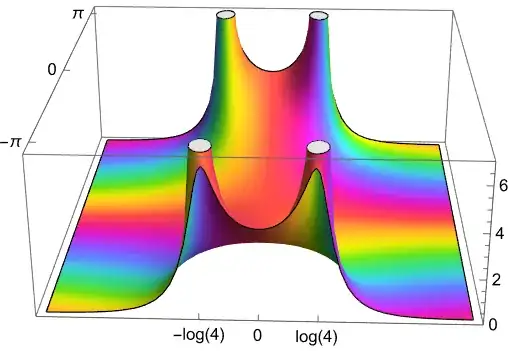
The direct integration yields an error, possibly by evalution of residues and the difficulties of decomposing the integrand on the shifted contour at $z->z + 3/2 i \pi$ to get a closed contour, closed with imaginary lines at real $z\to \pm \infty+ i y$ and value zero.
So try direct substitution by logs
f[Log[u], Log[a]]/u // FullSimplify
$$\frac{4 a^2 u \left(\log ^2(a)-\log ^2(u)\right)}{a^4 u^2-a^2 \left(u^4+1\right)+u^2}$$
Just for fun, Mathematica demands a to be complex in order to avoid a possible singularity at $z=\pm 1$, that is removable as we know:
    Assuming[ Im[a] > 0,
    Integrate[(4 a^2 u Log[a ] ^2)/
            (u^2 + a^4 u^2 - a^2 (1 + u^4)),
              {u, 0, \[Infinity]}]]
$$\frac{4 a^2 \log ^2(a) (2 \log (a)-i \pi )}{a^4-1}$$
  Assuming[ Im[a] > 0,
   Integrate[(4 a^2 u Log[u ] ^2)/
            ( u^2 + a^4 u^2 - a^2 (1 + u^4)),
            {u, 0, \[Infinity]}]]
$$\frac{4 a^2 (\pi +i \log (a)) (\pi +2 i \log (a)) \log (a)}{3-3 a^4}$$
 if[a_] = (4 a^2 Log[a]^2 (-I \[Pi] + 2 Log[a]))/(-1 + a^4) -
         ( 4 a^2 (\[Pi] + I Log[a]) (\[Pi] + 2 I Log[a]) Log[a])/
            (3 - 3 a^4) //Simplify
$$\frac{4 a^2 \log (a) \left(4 \log ^2(a)+\pi ^2\right)}{3 \left(a^4-1\right)}$$
Confirm
if[E^2.0] --> 1.26394
NIntegrate[f[z, 2], {z, -\[Infinity], \[Infinity]}]   -->  1.26394


f = (z-a)/Sinh[z-a] (z+a)/Sinh[z+a]; Integrate[f, {z, -Infinity,Infinity}, Assumptions->{a>0}]yields2/3 a (4 a^2 + \[Pi]^2) Csch[2 a], without the spurious imaginary part. – march Mar 13 '24 at 22:59bugstag. According to thebugstag wiki: "This tag is reserved for questions where the problem has been vetted by this community and the observed behavior is confirmed to be a bug. Please do not use this tag for new questions. Please use the standard bugs header instead of version tags in conjunction with this tag." – march Mar 13 '24 at 23:01bugstag. Also filed a report for it. – Daniel Lichtblau Mar 14 '24 at 18:51