5

My equation is

I e2 s2 w (m1^2 m2 q1 s1^2 s2 + m1 m2^2 q2 s1^2 s2 + m1^2 q1 s1^2 s2 ζ - 
  m2^2 q2 s1^2 s2 ζ - 2 m1 q1 s1^2 s2 ζ^2 - m2 q1 s1^2 s2 ζ^2 + m1 q2 s1^2 s2 ζ^2 + 
  q1 s1^2 s2 ζ^3 - q2 s1^2 s2 ζ^3) + 
1/w s1 γ ζ^3 (2 I m2^2 q2 s1 s2^2 ζ + 2 I m2 q1 s1 s2^2 ζ^2 - 
  2 I m2 q2 s1 s2^2 ζ^2 - 2 I q1 s1 s2^2 ζ^3) - 
I (m1^2 m2 q1 s1 s2^2 + m1 m2^2 q2 s1 s2^2 - m1^2 q1 s1 s2^2 ζ + m2^2 q2 s1 s2^2 ζ + 
  m2 q1 s1 s2^2 ζ^2 - m1 q2 s1 s2^2 ζ^2 - 2 m2 q2 s1 s2^2 ζ^2 - q1 s1 s2^2 ζ^3 + 
  q2 s1 s2^2 ζ^3) (-e1 s1 w + (s1 γ ζ^3)/w) == 0

and

m1 = Sqrt[ζ^2 - I*w/s1]; m2 = Sqrt[ζ^2 - I*w/s2];

The independent variable is w. All the other variables are constant except ζ (complex number).

q1 = 1; q2 = 0.5; e1 = 1; e2 = 0.8; s1 = 1; s2 = 0.6; γ =1000;

I used FindRoot and solved this problem. FindRoot gives the solution only for one case of w, but I want to plot the graph of w and ζ.

How do I plot Re[ζ] vs.w and Im[ζ] vs. w?

m_goldberg
  • 107,779
  • 16
  • 103
  • 257
user132682
  • 317
  • 3
  • 8
  • 2
    You could define eqs[w_] = and sol[w_?NumericQ] := FindRoot[eqs[w] == 0, {\[Zeta], 1 + I 1/2}][[1, 2]]. – b.gates.you.know.what Sep 15 '13 at 08:21
  • Hi @b.gatessucks, may I know why you chose $1 + I 1/2$ as a start point? Because I found that in my problem the choice of initial value have a large influence in the plot. – W. Robin Dec 13 '16 at 03:21
  • @W.Robin I just picked a value as an example. The method works under the assumption that there is only one root; if not the starting value will make a difference. Additionally, the square roots, for instance, introduce branch cuts so one should keep track of where they are. – b.gates.you.know.what Dec 13 '16 at 08:29

1 Answers1

4

First, I would suggest simplifying your equation. For this I've converted all constants to exact numbers

q1 = 1; q2 = 1/2; e1 = 1; e2 = 8/10; s1 = 1; s2 = 6/10; γ = 1000;
m1 = Sqrt[ζ^2 - I*w/s1]; m2 = Sqrt[ζ^2 - I*w/s2];

Then applying Simplify to your equation gives

eq[w_] := -2 I w ζ^2 (3 ζ + 12 Sqrt[-I w + ζ^2] - 5 Sqrt[-15 I w + 9 ζ^2])
  + w^2 (-ζ + 45 Sqrt[-I w + ζ^2] + 18 Sqrt[-15 I w + 9 ζ^2]) == 
  5000 ζ^3 (-11 ζ + 5 Sqrt[-I w + ζ^2] + 2 Sqrt[-15 I w + 9 ζ^2])

This is solved by b.gatessucks method

sol[w_?NumericQ] := FindRoot[eq[w], {ζ, 1 + I 1/2}][[1, 2]]

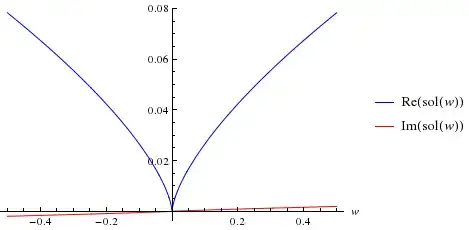
Then Plot command produces a nice graph

Plot[{Re[sol[w]], Im[sol[w]]}, {w, -1/2, 1/2}, 
   AxesLabel -> {w, None}, PlotLegends -> "Expressions",
   PlotStyle -> {Blue, Red}]

enter image description here

m_goldberg
  • 107,779
  • 16
  • 103
  • 257
mmal
  • 3,508
  • 2
  • 18
  • 38