If you flip the area being calculated about the line $y=x$, you get that the following two integrals are equivalent:
Integrate[Tan[x] - Floor[Tan[x]], {x, 0, Pi/2}]
Integrate[ArcTan[Ceiling[y]] - ArcTan[y], {y, 0, Infinity}]
The second is equal to the limit of the difference of the integral and the sum, as n approaches Infinity:
int = Integrate[ArcTan[x], {x, 0, n}, Assumptions -> n > 0]
sum = Sum[ArcTan[k], {k, n}]
You can but you don't have to trust the Numerical Calculus package:
Needs["NumericalCalculus`"];
NLimit[sum - int, n -> Infinity]
(*
   0.69836
*)
You don't have to, because the error of sum - int for a given n is less than Pi/2 - ArcTan[n]. So for 6 digits of accuracy, evaluate for n -> 10^6.
sum - int /. n -> 10^6 // N
(*
   0.698359
*)
Some pictures to show the equivalence:
Plot[{Tan[x], Floor[Tan[x]]}, {x, 0, Pi/2}, Filling -> {1 -> {2}}]
Plot[{ArcTan[Ceiling[x]], ArcTan[x]}, {x, 0, 7}, Filling -> {1 -> {2}}]
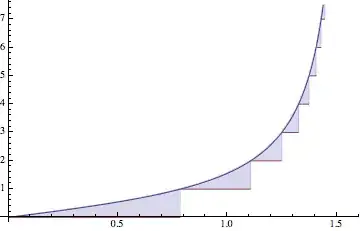
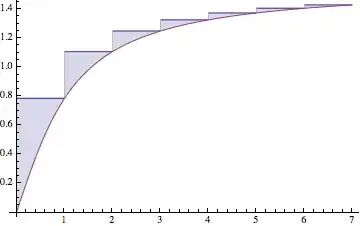
Below we can see that sum - int underestimates the integral and the error is actually less than (Pi/2 - ArcTan[n])/2, the factor of 1/2 following from the concavity of ArcTan. (The error consists of "concave triangles" that fit in the space above the last triangle and below $y=\pi/2$.)
Show@Table[
  ParametricPlot[
   {1 - t, t}.{{x - i + 1, ArcTan[i]}, {x - i + 1, ArcTan[x]}},
   {x, i - 1, i}, {t, 0, 1},
   Mesh -> None, PlotRange -> {Automatic, {0, Pi/2}}],
  {i, 10}]





NSum[-n (-ArcTan[n] + ArcTan[1 + n]) + 1/2 Log[1 + (1 + 2 n)/(1 + n^2)], {n, 0, ∞}, AccuracyGoal -> 15, WorkingPrecision -> 30]which yields0.6983596795324668. – Artes Jan 19 '14 at 22:20Gammais a generalization ofFactorial, I wanted to update my answer here since I was sure there had to be a more elegant form but I've been busy recently, now I guess you don't expect any updates of my answer, do you? – Artes Feb 01 '14 at 20:48