Mathematica can use ContourPlot to draw implicit Cartesian equations, but doesn't seem to have a similar function to plot an implicit polar equation, for example
$\theta ^2=\left(\frac{3 \pi }{4}\right)^2 \cos (r)$
What's the best way to do this?
Mathematica can use ContourPlot to draw implicit Cartesian equations, but doesn't seem to have a similar function to plot an implicit polar equation, for example
$\theta ^2=\left(\frac{3 \pi }{4}\right)^2 \cos (r)$
What's the best way to do this?


Since ContourPlot[] returns a GraphicsComplex, you could also replace the point list of the plot with g @@@ pointlist where g is the coordinate transformation. For example
f[r_, th_] := th^2 - (3 Pi/4)^2 Cos[r]
g[r_, th_] := {r Cos[th], r Sin[th]}

pl = ContourPlot[f[r, th] == 0, {r, 0, 8 Pi}, {th, 0, 2 Pi}, PlotPoints -> 30];
pl[[1, 1]] = g @@@ pl[[1, 1]];

Show[pl, PlotRange -> All]
which produces
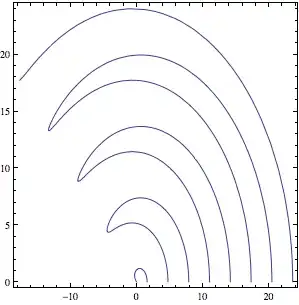
The advantage of this method is that it also works for coordinate transformations for which the inverse transformation is hard to find.

AspectRatio -> Automatic in Show so that this "looks nice."
– Mr.Wizard
Jan 24 '12 at 14:20
pl[[1, 1, 1]] = g @@@ pl[[1, 1, 1]];
– yode
Jan 03 '22 at 19:21
Does this
ContourPlot[
 Evaluate@With[
   {r = Sqrt[x^2 + y^2],
    θ = ArcTan[x, y]},
   θ^2 - Cos[r] == 0
   ],
 {x, 0.1, 4 Pi}, {y, 0, 4 Pi}
 ]
work?
Plot:
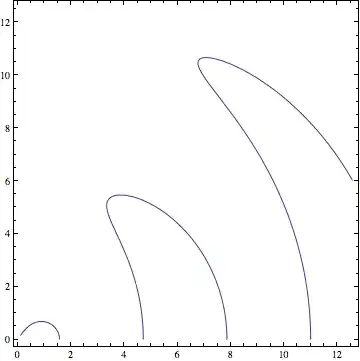
ContourPlot substitution, this is something I tried originally but couldn't get to work.
– one-more-minute
Jan 23 '12 at 21:17
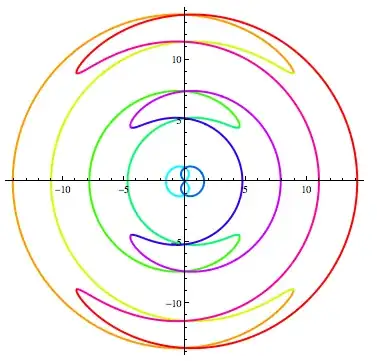
If you allow negative radii, there's another entire half of the solution:
PolarPlot[
   Evaluate[Flatten[
      Table[{-ArcCos[(16 t^2)/(9 Pi^2)], ArcCos[(16 t^2)/(9 Pi^2)]} + k 2 Pi,
            {k, -2, 2}]
      ]],
   {t, -Pi, Pi},
   PlotStyle -> Table[Directive[Thick, Hue[i/10]], {i, 10}]
   ]

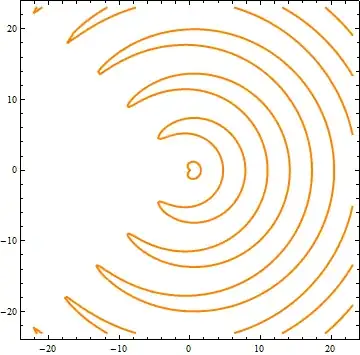
You can do something like this:
ContourPlot[ArcTan[x,y]^2 == (3 Pi/4)^2 Cos[Sqrt[x^2 + y^2]],
{x, -23, 23}, {y, -23, 23}, ContourStyle -> Directive[Thick, Orange]]

All the other three solutions use ContourPlot. Here's a solution using PolarPlot.
PolarPlot[{ArcCos[#2^2/(3 π/4)^2] + 2 π #1,
    -ArcCos[#2^2/(3 π/4)^2] + 2 π (#1 + 1)} & @@ QuotientRemainder[Abs@ θ, 2 π],
    {θ, -7 π, 8 π}, PlotStyle -> {Thick, Darker@Green}]
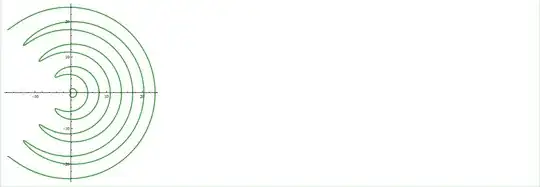
This makes use of the fact that the solution to $\theta^2=\displaystyle\left(\frac{3\pi}{4}\right)^2\cos(r)$ is
$$r=\pm\arccos\left(\frac{16\theta^2}{9\pi^2}\right)+2\pi n,\ n\in\mathbb{Z}$$


