4

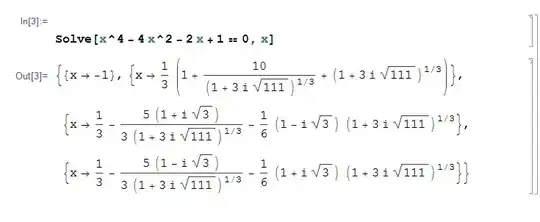
The polynomial $P(x)=x^‎‏4‏‎-‎‏4‏x^‎‏2‏‎-‎‏2‏x+‎‏1$‏‎ has ‎‏4‏‎ real roots (this can be clearly checked by plotting). But solving $P(x)=‎‏0‏‎$, using Solve[x^‎‏4‏‎-‎‏4‏x^‎‏2‏‎-‎‏2‏x+‎‏1‏‎==‎‏0‏‎,x] leads to x=-‎‏1‏‎ and ‎‏3‏‎ other roots which (however they're ‎not) seems complex number as they are represented in terms of $i$ (the imaginary unit):‎ Solve result

But I want to have the roots represented in a real closed radical expression. I mean neither in ‎trigonometric representation (such as the output of ComplexExpand[]) nor with any $i$'s in it. Is ‎there any simplification function or procedure that can help?‎ ‎ I've tried Simplify[] and FullSimplify[] and their various options. Even I've combined them with ‎some other expression manipulation functions such as Expand[], Refine[] and ComplexExpand[], ‎but I could not reach my goal.

J. M.'s missing motivation
  • 124,525
  • 11
  • 401
  • 574
Toughee
  • 113
  • 5

2 Answers2

5

As stated in the comments, it is not possible to get the exact roots in the desired form.
However, it is possible to get them in any arbitrary precision (100-digit precision in the following example):

Rationalize[N[Solve[x^4 - 4 x^2 - 2 x + 1 == 0, x], 100], 0]
{{x -> -1}, 
 {x -> 148845339002531569051638627576397352071169969019092/
       68589588442601901747538163421051848353066356246917}, 
 {x -> -(53523407249914715278682495786123302627314986818931/
       36135304532328057570688476882478262824336711940507)}, 
 {x -> 24375413419753596751919874615468440606916785148237/
       78350372608103708508713638007384658562420306644851}}
x^4 - 4 x^2 - 2 x + 1 /. % // N
{0., 3.3459*10^-99, 4.60681*10^-100, 1.13719*10^-100}
Karsten7
  • 27,448
  • 5
  • 73
  • 134
3

Radicals are traditional bronze-age mathematics, but they aren't the nicest way to express the roots of a polynomial. Radical expressions are numerically unstable when a discriminant is near zero, and they often require complex arithmetic even for real results, as you've seen.

In the space age, we have Root objects, one of the real gems of Mathematica.

roots = Solve[x^4 - 4 x^2 - 2 x + 1 == 0, x, Cubics -> False]

{{x -> -1}, {x -> Root[1 - 3 #1 - #1^2 + #1^3 &, 1]}, {x -> Root[1 - 3 #1 - #1^2 + #1^3 &, 2]}, {x -> Root[1 - 3 #1 - #1^2 + #1^3 &, 3]}}

Root objects look a little peculiar, but when constructed using exact constants (as above) Mathematica treats them as exact numbers. It can, for example, tell you that the imaginary part of each root is exactly zero:

Im[x /. roots]
{0, 0, 0, 0}

When you want numerical results, Root objects are not prone to the numerical instability of radical expressions, nor will real roots contain the imaginary artifacts of incomplete cancellation.

roots // N
{{x -> -1.}, {x -> -1.48119}, {x -> 0.311108}, {x -> 2.17009}}
John Doty
  • 13,712
  • 1
  • 22
  • 42