I was curious about the difference in speed between Total and Sum. I found out Total was faster. However on another occasion I used a longer list and then the result was reversed.
Upon closer inspection, I saw that Sum behaved strangely, see the repetitive code below:
Sum[x, {x, 1, 10^4}] // AbsoluteTiming
Sum[x, {x, 1, 10^5}] // AbsoluteTiming
Sum[x, {x, 1, 10^6}] // AbsoluteTiming
Sum[x, {x, 1, 10^7}] // AbsoluteTiming
Sum[x, {x, 1, 10^8}] // AbsoluteTiming
Sum[x, {x, 1, 10^9}] // AbsoluteTiming
{0.000377, 50005000}
{0.002676, 5000050000}
{0.162434, 500000500000}
{0.000157, 50000005000000}
{0.000112, 5000000050000000}
{0.000110, 500000000500000000}
I can not make any sense of the results above.
Compare those with the more expected results from Total
Total[Range[10^4]] // AbsoluteTiming
Total[Range[10^5]] // AbsoluteTiming
Total[Range[10^6]] // AbsoluteTiming
Total[Range[10^7]] // AbsoluteTiming
Total[Range[10^8]] // AbsoluteTiming
Total[Range[10^9]] // AbsoluteTiming
{0.000115, 50005000}
{0.000931, 5000050000}
{0.010395, 500000500000}
{0.101801, 50000005000000}
{1.166246, 5000000050000000}
{12.470277, 500000000500000000}
Can anyone explain what causes this strange behavior ?


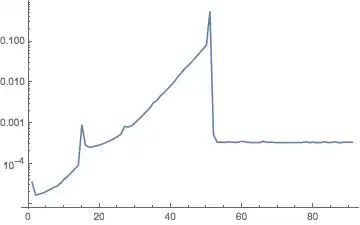


Totalwill most surely sum blindly, whileSum[]could use known properties (at least it will try whennis large enough) – Dr. belisarius Nov 04 '14 at 19:45sum[n_Integer?Positive] = Sum[x, {x, 1, n}]– Bob Hanlon Nov 04 '14 at 19:58Sums on my Mathematica in a different order and got qualitatively different results. The 10^6 took a lot longer, but the 10^7 took even longer. Then, 10^8 was very quick. When using Mathematica for timing, be sure to clear caches/etc to make sure you're not getting inaccurate times. Restarting Mathematica each time might also make the timing more accurate. – Nov 04 '14 at 20:54