18

Is there any easy, general way to handle algebra on variable Sums? For examples, Gaussian Mixtures or Fourier Series:

gau[x_, m_, var_] := (E^(-(x - m)^2/(2 var)))/Sqrt[2 Pi*var];
f[x_] := Sum[gau[x, m[[i]], v[[i]]], {i, 1, n}];
ga[x_] := Sum[a[[m]]*Sin[m*x], {m, 0, Infinity}] // Inactive;
gb[x_] := Sum[b[[m]]*Sin[m*x], {m, 0, Infinity}] // Inactive;

$$f[x]=\sum _{i=1}^n \frac{e^{-\frac{(x-m[[i]])^2}{2 v[[i]]}}}{\sqrt{2 \pi } \sqrt{v[[i]]}}$$

It's easy on paper to do things like integrate this expression:

$$\int_{-\infty }^{\infty } \left(\sum _{i=1}^n \frac{e^{-\frac{(x-m[[i]])^2}{2 v[[i]]}}}{\sqrt{2\pi } \sqrt{v[[i]]}}\right) \, dx = \sum _{i=1}^n 1 = n$$

...or to integrate f[x]^2 analytically:

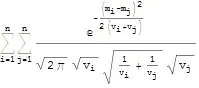
$$\int_{-\infty }^{\infty } \left(\sum _{i=1}^n \frac{e^{-\frac{(x-m[[i]])^2}{2 v[[i]]}}}{\sqrt{2\pi } \sqrt{v[[i]]}}\right){}^2 \, dx = \frac{1}{2 \sqrt{\pi }} \sum _{i=1}^n \frac{1}{\sqrt{v[[i]]}}+\sum _{i=2}^n \left(\sum _{j=1}^{i-1} \frac{e^{-\frac{(m[[i]]-m[[j]])^2}{2(v[[i]]+v[[j]])}}}{\sqrt{2 \pi } \sqrt{v[[i]]+v[[j]]}}\right) $$

(Sorry, no code for these results; I did them by hand and wrote them in TeX)

In an Answer below, @chris posted code to get MMa to handle just these two specific instances.

MapAt[Integrate[#, {x, -Infinity, Infinity}] &, f[x],    1] // PowerExpand

tt = f[x]^2 /. Power[Sum[a__, b__], 2] :> sum[a (a /. i -> j) // Release, b, b /. {i -> j}]

MapAt[Integrate[#, {x, -Infinity, Infinity}] &, tt, 1] /.sum -> Sum // PowerExpand

But we would have to write new pattern/substitution code if the index was other than "i" or if we wanted to Integrate any higher powers of f or to do other operations on the Sum.

Other examples that would require new code:

exp1 = Integrate[ga[x]*gb[x],{x,0,2Pi}];

equals (derived by hand because MMa pooped out)

Pi*Sum[a[[m]]*b[[m]], {m, 0, Infinity}]

exp2 = Integrate[ga[x]^3,{x,0,2Pi}];

equals (also derived by hand)

(Pi/2)*Sum[Sum[a[[m]]*a[[n]]*(a[[m + n]] + a[[m - n]]), {n, 1, m - 1}], {m, 2,Infinity}]

Is there any way to handle algebraic Sums so that we don't have to anticipate and code around every conceivable math function we might do on them?

(Sorry for posting TeXForm, but no one understood what I was asking for the first time I tried to post this question.)

Jerry Guern
  • 4,602
  • 18
  • 47
  • @wolfies Thanks for the advice. I reposted the question to make it more clear. – Jerry Guern Nov 12 '14 at 00:55
  • MapAt[Integrate[#, {x, -Infinity, Infinity}] &, f[x], 1] // PowerExpand would work for the first – chris Nov 12 '14 at 05:34
  • and the second one tt = f[x]^2 /. Power[Sum[a__, b__], 2] :> sum[a (a /. i -> j) // Release, b, b /. {i -> j}] then MapAt[Integrate[#, {x, -Infinity, Infinity}] &, tt, 1] /. sum -> Sum // PowerExpand – chris Nov 12 '14 at 05:39
  • I am curious: if random variable $X_i$ has pdf $f_i(x)$, what is the statistical meaning of $\sum_{i=1}^n f_i(x)$? What does it represent? – wolfies Nov 12 '14 at 14:58
  • @wolfies You have a subscript _i on your f_i[x], so I assume you're not talking about the f[x] in my Question. Your sum(f_i[x])/n would be the pdf of (X_1 OR X_2 OR ... X_n) – Jerry Guern Nov 12 '14 at 18:38
  • @chris Thank you! If you put your answer in the Answer box instead of the Comments, I'll vote it up and Accept. – Jerry Guern Nov 12 '14 at 18:41
  • @JerryGuern Well, if you are going to include the $\frac{1}{n}$ (which is not in your question), then you are just working with a Normal $n$-component-mix (with equal weights). And since this is just a pdf, integrating over the domain of support is plainly 1. So, so far, I am not sure what using MMa adds to the 'plot'. – wolfies Nov 13 '14 at 02:35
  • @wolfies I think we have miscommunicated. You asked about a sum of f_i's, while I have single f this is a sum of guassians, so I probably misunderstood what you were asking. My Question was just about how to make MMA do algebra with Sums bcuz I have to calculate integrals of (f^2 * x^m), f*ln(f), lots of other messy stuff. In my problem, the x_i's are samples from an unknown pdf u[x]. The f[x] is an attempt to reconstruct u[x] from the samples. I'm working out criteria from finding the v_i's that makes f[x] -> u[x] optimally. If you want to discuss more, how can we talk offline? – Jerry Guern Nov 13 '14 at 06:12

2 Answers2

17

As far as I know, there is no easy, general way to handle this kind of algebra with Sum expressions.

What follows is an attempt to use replacement rules to handle a wider range of cases than chris's example. I don't consider it to be the canonical answer that is required, but perhaps someone might be able to use it as a starting point.

I use Inactive on Sum to stop Mathematica from attempting to evaluate the sums at every stage. I've also used Indexed in place of Part. So getting started:

sum = Inactive[Sum];
SetOptions[Integrate, GenerateConditions -> False];

gau[x_, m_, var_] := (E^(-(x - m)^2/(2 var)))/Sqrt[2 Pi*var]
f[x_] := sum[gau[x, Indexed[m, i], Indexed[v, i]], {i, 1, n}]
ga[x_] := sum[Indexed[a, m]*Sin[m*x], {m, 0, Infinity}]
gb[x_] := sum[Indexed[b, m]*Sin[m*x], {m, 0, Infinity}]

The first thing to note is that by using Indexed we avoid getting those part specification errors. Also it displays more nicely:

Activate@f[x]

enter image description here

Now some rules...

reindex = s : sum[_, {i_, __}] :> (s /. i -> Unique@i);

unpower = s_sum^p_Integer :> Times @@ Table[s /. reindex, {p}];

expand = sum[e1_, i1__] sum[e2_, i2__] :> sum[e1 e2, i1, i2];

distribute = Integrate[sum[e_, s__], i__] :> sum[Integrate[e, i], s];

niceindex[expr_] := expr /. (Thread[# -> Take[{i, j, k, l}, Length[#]]] &@
     DeleteDuplicates[Cases[expr, s_Symbol /; SymbolName[s]~StringMatchQ~"*$*" :> s, -1]]);

doitall[expr_] := expr /. unpower /. reindex //. expand /. distribute // niceindex;

Description of the rules:

  • reindex simply replaces the summation index by a unique symbol. This will allow us to expand powers and products of sums without getting colliding symbols.

  • unpower expands integer powers of sums into explicit products.

  • expand expands a product of sums into a sum of products.

  • distribute distributes Integrate over Sum, i.e. it converts the integral of a sum into a sum of integrals.

  • niceindex replaces the unique symbols generated by reindex with plain i,j,k,l. As written this assumes that there are no more than four summation indices required in the final result, and that the symbols i,j,k,l are not in use. These are both dangerous assumptions! Ideally you should not use this function (or write a better version), but personally I find summation indices like i$123456 hard to read.

  • doitall applies all the rules in an attempt to transform the expression.

So here are a couple of examples. For this one we only need distribute:

Integrate[f[x], {x, -∞, ∞}] /. distribute

enter image description here

Having done the integration we can now Activate the sum to get the desired result (I've also applied the assumption that $v_i$ is positive)

Simplify[%, Indexed[v, i] > 0] // Activate

n

For the next two I've used doitall to apply the full set of transformations:

Integrate[f[x]^2, {x, -∞, ∞}] // doitall

enter image description here

Integrate[ga[x] gb[x], {x, 0, 2 Pi}] // doitall

enter image description here

Simon Woods
  • 84,945
  • 8
  • 175
  • 324
  • 2
    Thanks, Simon. It would be nice to see this kind of functionality well integrated into Mathematica before Facebook etc., IMHO. – Mr.Wizard Nov 18 '14 at 15:19
  • @Mr.Wizard, I wonder if some of these Sum transformations are already built in, somewhere inside the colossal rule set for Simplify. But I agree wholeheartedly with your comment. – Simon Woods Nov 18 '14 at 19:31
9

Yes we can !

MapAt[Integrate[#,{x,-Infinity,Infinity}]&,f[x],1]//PowerExpand 

(* n *)

 tt = f[x]^2 /. Power[Sum[a__, b__], 2] :> 
      sum[a (a /. i -> j) // Release, b, b /. {i -> j}]

  MapAt[Integrate[#, {x, -Infinity, Infinity}] &, tt, 1] /. 
        sum -> Sum // PowerExpand
chris
  • 22,860
  • 5
  • 60
  • 149