MOST RECENT UPDATE
I sligtly revised the code, mainly to avoid NSolve to compute lines intersections and to directly get intersection in the proper order, if possible.
This first helper function, with a binary search algorithm, give the gridline index to wich all coordinates vals given belong, or a half-odd if not on gridline; sameTest allow to configure the accuracy of the check.
BinPositions[vals_, brakes_, sameTest_] :=
 Map[val \[Function]
   Catch@Module[{lo = 1, mid, hi = Length[brakes], el, res},
     While[lo <= hi, Which[
       TrueQ@sameTest[val, el = brakes[[mid = Floor[(lo + hi)/2]]]],
       Throw[mid],
       el > val, hi = mid - 1,
       True, lo = mid + 1]];
     lo - 1/2],
  vals]
This second helper function, based on some output of the previous functions, gives the indices of the crossed gridlines. Maybe we can do better.
NearestIntegersBetween = {m, n} \[Function]
   With[{\[Delta] = n - m, p = IntegerQ[m]}, Which[
     \[Delta] > 1 || \[Delta] == 1 && p, {Ceiling[m], Floor[n]},
     \[Delta] > 0, {Floor[m] + 1},
     \[Delta] == 0 && p, {m, n},
     -\[Delta] > 1 || -\[Delta] == 1 && p, {Floor[m], Ceiling[n]},
     -\[Delta] > 0, {Floor[n] + 1},
     True, {}
     ]];
This third helper function compute the intersections of a line segment with the crossed gridlines, in the order of the segment.
SegmentGridIntersections =
  {x1, y1, x2, y2, xl, yl} \[Function]
   Module[{m11 = y2 - y1, m12 = x1 - x2, v1 = x1 y2 - x2 y1},
    Which[
     Length@xl == 0,
     {(v1 - m12*yl)/m11, yl}\[Transpose],

     Length@yl == 0,
     {xl, (v1 - m11*xl)/m12}\[Transpose],

     True, Join[
        {(v1 - m12*yl)/m11,
          yl}\[Transpose], {xl, (v1 - m11*xl)/m12}\[Transpose]
        ] // Sort // If[x1 <= x2, #, Reverse@#] &
     ]
    ];
This last helper function process a single contour of a MeshRegion:
AdjustPolygonToGrid[vertices_, grids_, sameTest_] :=
  Module[{positions, lines},
   positions = MapThread[BinPositions[#1, #2, SameTest -> sameTest] &, {vertices\[Transpose], grids}]\[Transpose];
   lines = Apply[NearestIntegersBetween,Transpose[Partition[positions, 2, 1], {1, 3, 2}], {2}];
   lines = MapThread[Extract, {grids, Map[List, lines\[Transpose], {2}]}]\[Transpose];
   MapThread[SegmentGridIntersections[Sequence @@ Flatten@#1, Sequence @@ #2] &, {Partition[vertices, 2, 1], lines}] // Flatten[#, 1] & // Append[#, #[[1]]] &
   ];
This main function finally process a whole MeshRegion.
AdjustMeshToGrid[meshRegion_, grids_, sameTest_] :=
 Module[{polygons, vertices, map},
  polygons = meshRegion["BoundaryPolygons"][[All, 1]];
  polygons = AdjustPolygonToGrid[#, grids, sameTest] & /@ polygons;

  vertices = DeleteDuplicates[Join @@ polygons];
  map = AssociationThread[vertices, Range@Length@vertices];

  (* Restituisce la mesh adattata *)
  BoundaryMeshRegion[vertices,
   Sequence @@ Line /@ Map[map, polygons, {2}]]
  ]
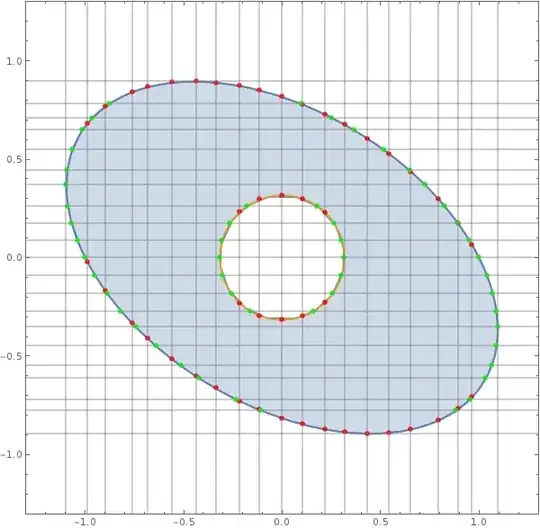
With thid code there are the results compared to the routine proposed by @Michael E2 on a uniform grid.
timeAvg =
  Function[func,
   Do[If[# > 0.3, Return[#/5^i]] & @@ Timing@Do[func, {5^i}], {i, 0,
     15}], HoldFirst];

\[CapitalOmega] =
  ImplicitRegion[
   2 x^2 + 3 y^2 + 2 x y - 2 <= 0 \[And] x^2 + y^2 > .1, {x, y}];
\[CapitalOmega]b = RegionBounds[\[CapitalOmega]];

data = Table[Module[{grids, mesh, n},
    grids =
     N@Map[range \[Function]
        Range @@
         Append[range, -Subtract @@ range/20/2^k], \[CapitalOmega]b];
    (*grids=Union/@Map[g\[Function]{g[[1]],
    Sequence@@(g[[2;;-2]]RandomReal[{1-.02,1+.02},Length[g]-2]),
    g[[-1]]},grids];*)
    n = Length@First@grids;
    mesh =
     BoundaryDiscretizeRegion[\[CapitalOmega],
      MaxCellMeasure -> Mean@Flatten[Differences /@ grids]];
    <|
     "Gridlines Count" -> n,
     "AdjustMeshToGrid" -> (AdjustMeshToGrid[mesh, grids,
         Abs[#1 - #2] <= 10.^-10 &] // timeAvg),
     "snaptogrid" -> (snaptogrid[mesh, Sequence @@ grids] // timeAvg)
     |>
    ], {k, 0, 10}] // Dataset

ListPlot[
 Values@*Normal /@ {data[
    All, {"Gridlines Count", "AdjustMeshToGrid"}],
   data[All, {"Gridlines Count", "snaptogrid"}]},
 Joined -> True, PlotLegends -> {"AdjustMeshToGrid", "snaptogrid"},
 Frame -> True, Mesh -> Full, GridLines -> Automatic,
 FrameTicks -> Automatic, PlotRange -> All]

FIRST ANSWER
I finally found a relatively short way to do. Not perfect, many special cases should be handled. Michael E2 routine permorms better on small uniform grids. I don't know why but on small random grids the rating is reversed.
I can do:
mesh = BoundaryDiscretizeRegion[\[CapitalOmega]];
polygons = mesh["BoundaryPolygons"][[All, 1]];
polygons =
  AdjustPolygonToGrid[#, {xg, yg}, Abs[#1 - #2] <= 10^-6 &] & /@
   polygons;
vertices = DeleteDuplicates[Join @@ polygons];
verticesMap = AssociationThread[vertices, Range@Length@vertices];
adjustedMesh = BoundaryMeshRegion[vertices,
 Sequence @@ Line /@ Map[verticesMap, polygons, {2}]];

Graphics[{Opacity[.7], HighlightMesh[adjustedMesh, 0]["Show"][[1]]},
 Frame -> True, GridLines -> {xg, yg},
 GridLinesStyle -> Darker[LightGray]]
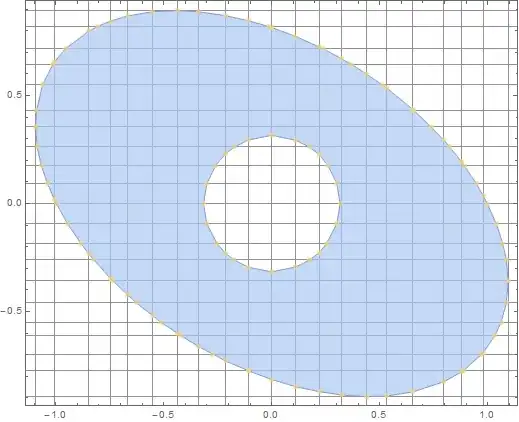
with the main helper's function:
AdjustPolygonToGrid[vertices_, grids_, sameTest_] :=
 Module[{positions, v1, p1},
  positions =
   MapThread[
     BinPositions[#1, #2,
       SameTest -> sameTest] &, {vertices\[Transpose],
      grids}]\[Transpose];
  {v1, p1} = {vertices[[1]], positions[[1]]};
  Apply[{v2, p2} \[Function] Module[{lines, vlnew},
         If[AnyTrue[p2, IntegerQ], Sow[v2],
          lines = MapThread[NearestIntegersBetween, {p1, p2}];
          If[lines =!= {{}, {}},
           lines = MapThread[#1[[#2]] &, {grids, lines}];

           lines =
            RegionUnion @@
             Flatten@{InfiniteLine[{#, 0}, {0, 1}] & /@ lines[[1]],
               InfiniteLine[{0, #}, {1, 0}] & /@ lines[[2]]};

           vlnew =
            Block[{x, y}, {x, y} /.
              NSolve[{x, y} \[Element]
                 Line[{v1, v2}] \[And] {x, y} \[Element] lines, {x,
                y}, Reals]];

           vlnew =
            If[OrderedQ[{v1, v2}], Sort[vlnew], Reverse@Sort[vlnew]];
           Sow /@ vlnew;
           ];
          ];
         {v1, p1} = {v2, p2}
         ], RotateLeft@Transpose@{vertices, positions}, {1}] //
      Reap // Last // Last // Append[#, #[[1]]] &
  ]
and two simple helper's function:
BinPositions[vals_, brakes_, sameTest_] :=
 Map[val \[Function]
   Catch@Module[{lo = 1, mid, hi = Length[brakes], el, res},
     While[lo <= hi, Which[
       TrueQ@sameTest[val, el = brakes[[mid = Floor[(lo + hi)/2]]]],
       Throw[mid],
       el > val, hi = mid - 1,
       True, lo = mid + 1]];
     lo - 1/2],
  vals]

NearestIntegersBetween = {m, n} \[Function]
   Which[#1 < #2, {##}, #1 == #2, {#1},
      True, {}] & @@ ({Floor[#1] + 1, Ceiling[#2 - 1]} & @@
      Sort[{m, n}]);
For example original and ajusted small polygon:
polygon = mesh["BoundaryPolygons"][[1, 1]];
AdjustPolygonToGrid[polygon, {xg, yg}, Abs[#1 - #2] < 10^-6 &];
Graphics[{
  Opacity[.5], LightGray, Polygon@polygon, Opacity[1],
  Orange, AbsolutePointSize[Large], Point@polygon,
  Blue, Line@%,
  Red, AbsolutePointSize[Medium], Point@%,
  Green, Point@polygon[[1]],
  Yellow, Point@polygon[[2]]},
 PlotRange -> RegionBounds@Line@polygon,
 PlotRangePadding -> Scaled[.05], Frame -> True,
 GridLines -> {xg, yg}, GridLinesStyle -> Darker[LightGray]]

The overall procedure is a bit slow, also with this simple mesh. Some special cases are not handled (for example if two or more vertices of the original mesh are on the same cell edge).