A certain research paper gives a recipe for building Amman-Beenker tilings as a special type of cut-and-project algorithm. The result is usually a pleasant kind of aperiodic tiling shape.
The algorithm defines two sets of vectors $a_k$ and $a_k^\ast$ which are in a sense dual to one another. Using the first set of vectors we look for integer combinations of the vectors lying in a unit octagon:
$$ U = \{ (u_1, u_2, u_3, u_4) \in \mathbb{Z}^4 : \mathrm{Re} \big[e^{2\pi i m/8}\sum a_k^\ast u_k \big] < 1\}$$
Then we take those same vectors and transcribe them from cut-space to project-space using the $\ast$-map.
$$ V = \{ \vec{a}\cdot \vec{u} : \vec{u} \in U \}$$
This is very similar to what one would find in de Brujin's paper
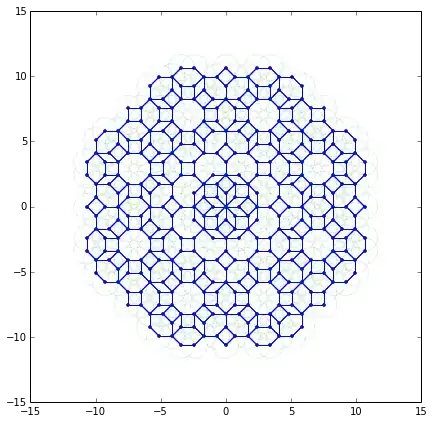
Using brute force, I computed the vertices and found that certain vertices are missing. Could it be that the octagon criterion is wrong? What is the correct size of the octagon?
A general idea could suffice but if you get a working code, I would love to see yours
From What is Aperiodic Order? - Baake Grimm Moody

My result: notice the missing vertices.
The question how to generate no-periodic tilings asks about a different cut and project tiling and uses a substitution method. There are other good tiling questions on this page as well.


