To me the question is more about calculating the function than generating the plot.
Given an equation that cannot be solved symbolically, we can approximate the implicit function with NDSolve. (There are several examples on this site., e.g., Getting an InterpolatingFunction from a ContourPlot, Plotting implicitly-defined space curves.)
implicitFunction::usage = "implicitFunction[equation, {y, y0}, {x, x0, start, end}]";
Begin["implicitFunction`"];
implicitFunction[eq_, {f_Symbol, f1_?NumericQ},
     {x_Symbol, x1_?NumericQ, xmin_?NumericQ, xmax_?NumericQ}] :=
  Block[{f0, xt},
   f0 = f /. FindRoot[eq /. x -> x1, {f, f1}];
   NDSolveValue[
     {eq /. {x -> x[xt], f -> f[xt]}, x'[xt] == 1, f[x1] == f0, x[x1] == x1},
     f, {xt, xmin, xmax}]
   ];
End[];
We need to propose a domain for our approximation and approximate initial values for x and y. FindRoot is used to refine the initial value for the function x.
eq1 = Exp[x y] == y;
ξ = implicitFunction[eq1, {x, 0}, {y, 1, -3, 3}];
NDSolveValue::ndsz: At implicitFunction`xt == 1.111713753522611`*^-16, step size is effectively zero; singularity or stiff system suspected. >>
The warning just means that NDSolve has computed the domain for us:
ξ["Domain"]
(*  {{1.11171*10^-16, 3.}}  *)

Plot[ξ[y] + y, Evaluate @ Flatten[{y, ξ["Domain"]}]]
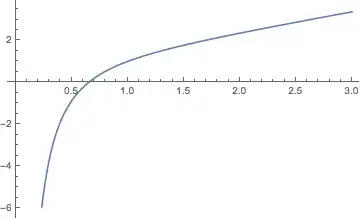
One could further process the result by wrapping the interpolating function with FindRoot. For this we need to add the attribute HoldAll. The following could be incorporated as a second definition of implicitFunction, but here I'll simply make a second definition. The only advantage is when a more accurate value is needed. One can take advantage of the FindRoot options.
SetAttributes[implicitFunction2, HoldAll];
implicitFunction2[eq_, f_Symbol, x_Symbol, init_: (0 &), opts : OptionsPattern[FindRoot]][x1_?NumericQ] :=
  Block @@ Hold[{f, x}, f /. FindRoot[eq /. x -> x1, {f, init[x1]}]];
The init function supplies the initial value for the root. We can use the NDSolve interpolating function to do that (at least within its domain).
ξ2 = implicitFunction2[eq1, x, y, ξ];
Plot[ξ2[y] + y, Evaluate@Flatten[{y, ξ["Domain"]}]]
(* plot looks the same as above *)
This form also works with the default init, but that is because the equation is easy to solve from any starting point.
ξ2 = implicitFunction2[eq1, x, y];
Of course, it's slower than just using ξ.


![y+Log[y]/y](../../images/e90e8accae4e614fea1dfc6fc62df82f.webp)

ClearAll[f, g, h]; f[x_, y_] := x + y; g[y_] := Log[y]/y; h[y_] := f[g[y], y]– kglr Feb 09 '15 at 03:47