There is no best general way to check if any two trigonometric expressions are equal. One can use TrigReduce, TrigExpand, TrigFactor, TrigToExp, Together and Apart (especially with the Trig->True option), Simplify, FullSimplify, etc. All these functions have their advantages and we discuss some of them. For more complicated examples when using Simplify and FullSimplify we can encounter problems with timings and/or memory allocation, we give an appropriate example later.
In case of your example I recommend to evaluate TrigReduce on the difference of the both expressions.
Sometimes you needn't use any simplifications, and quite inevident expressions are simplified automatically by built-in rewrite rules.
First we consider a few examples where no Mathematica functions are needed.
ex 1.
$$\sum_{\small{k = 1}}^{\small{k = m-1}} \;\frac{1}{\sin^{2}(\frac{k\; \pi}{m})} = \frac{m^{2} -1}{3} $$
Sum[ 1/Sin[ k Pi/m]^2, {k, 1, m - 1}]
1/3 (-1 + m^2)
if we set e.g. m = 21, the above doesn't simplify and we need e.g. FullSimplify
m = 21;
FullSimplify @ Sum[ 1/Sin[ k Pi/m]^2, {k, 1, m - 1}]
440/3
The larger one sets m, the more time it takes.
Here is another example where we need no simplifications and the result is obtained with help of built-in rewrite rules :
ex 2.
$$\sum_{\small{k = 0}}^{\small{k = m-1}} \; \cos(a + k b) = \frac{\sin(\frac{n b}{2})}{\sin(\frac{b}{2})} \cos(\frac{2 a+(n-1) b}{2})$$
(Sum[ Cos[ a + k b], {k, 0, m - 1}] -
      Sin[ (m b)/2]/Sin[ b/2]  Cos[ (2 a + (m - 1) b)/2]) /. m -> 137
0
but if we make no substitution we'll need e.g. Simplify
Simplify[ (Sum[ Cos[ a + k b], {k, 0, m - 1}] -
                Sin[ (m b)/2]/Sin[ b/2]  Cos[ (2 a + (m - 1) b)/2]) ]
0
It works even if we add the option Simplify[ expr, Trig -> False].
ex 3.
$$\sum_{\small{k = 0}}^{\small{k = n-2}} \; \tan(\frac{\pi}{2^{n - k}}) = \cot(\frac{\pi}{2^{n}})$$
Here we define e.g.
f[n_] := Sum[2^k Tan[Pi/2^(n - k)], {k, 0, n - 2}] - Cot[Pi/2^n]
In this case the following functions work equally well if we set e.g. n == 15 :
Together[ f[n], Trig -> True] == Simplify[ f[n]] == TrigReduce[ f[n]] == 0
True
however for larger n we can easily see advantages of various approaches, e.g. for n == 21 we observe that Together[ expr, Trig->True] is the best, while Simplify cannot tackle such an expression :
TrigReduce[ f[21]] // AbsoluteTiming
Together[f[21], Trig -> True] // AbsoluteTiming
{0.1404000, 0}
{0.0312000, 0}
while
Simplify[f[21]] // AbsoluteTiming
returns
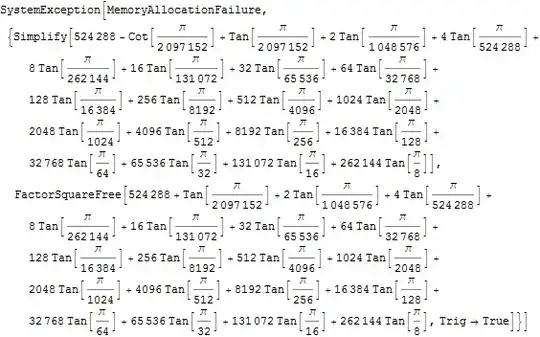
If we evaluate e.g. f[n], where we haven't assigned to n any value, we get ComplexInfinity.
At last we consider two simple examples :
ex 4.
expr1 = -1 + 50 Cos[x]^2 - 400 Cos[x]^4 + 1120 Cos[x]^6 - 1280 Cos[x]^8;
expr2 = -512 Cos[x]^10 + Cos[10 x];
In this case one can use
TrigReduce[ expr1 - expr2]
0
as well as one of these
Together[ expr1 - expr2, Trig -> True]
or
Apart[ expr1 - expr2, Trig -> True]
Let's consider your example :
ex 5.
exprA =        - 1/15 Cos[4 x] + (1/15 + 6) Cos[x] + 11 Sin[x];
exprB =   1/30 (  182 Cos[x] - 5 Cos[x] Cos[3 x] + 3 Cos[x] Cos[5 x] + 330 Sin[x]
              + 5 Sin[x] Sin[3 x] + 3 Sin[x] Sin[5 x] );
compare various ways (TrigReduce and TrigExpand are optimal here) :
TrigReduce[exprA - exprB] // AbsoluteTiming
TrigExpand[exprA - exprB] // AbsoluteTiming
{0., 0}
{0., 0}
but FullSimplify and TrigFactor also work, though are a bit slower :
TrigFactor[exprA - exprB] // AbsoluteTiming
FullSimplify[exprA - exprB] // AbsoluteTiming
{0.0156000, 0}
{0.0312000, 0}
Thus using TrigReduce seems to be more appropriate for this type of trigonometric expressions. We can observe that timing for is a multiple of 0.0156000 for TrigFactor and FullSimplify.


FindInstance[expr1[x] != expr2[x], x]doesn't yields any answer it doesn't mean thatexpr1[x] == expr2[x]!!!!! – Artes Jun 26 '12 at 13:53Sin[x] == Tan[x] Cos[x]withoutFullSimplify, it returnsTruebecause of built-in rewrite rules, so your example is completely inadequate. – Artes Jun 26 '12 at 15:32Sin[x] === Tan[x] Cos[x]yieldsTrue, whileSin[x] != Tan[x] Cos[x]returnsFalse, alsoSin[x] - Tan[x] Cos[x]yields0. No need neither forPossibleZeroQ,FindInstance, norFullSimplify. – Artes Jun 29 '12 at 13:50