How is it possible to track common features in the following sequence of images (e.g. holes or corner points along the top margin), ? I have had no luck with ImageFeatureTrack[images] so far: it returns {{}, {}, {}, {}}, i.e. it apparently does not find nor track any features.



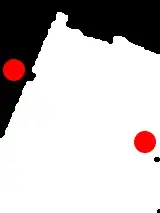
Update I've also tried ImageCorrespondingPoints like this, but it does not seem to find correct features either:
points = ImageCorrespondingPoints[images[[1]], images[[2]]]
c[image_, points_] :=
  ImageCompose[image, Graphics[Prepend[Disk /@ points, Red]]]
MapThread[c, {{images[[1]], images[[2]]}, points}]


ImageCorrespondingPointsiteratively over pairs of images in a sequence, making sure to generate a padded mask at each step based on the keypoints returned. This way the mask is passed as an option to each successive iteration to limit the keypoint search to those found in the first image, rather than new ones each time. – IPoiler Jul 29 '15 at 11:35ImageKeypoints,ImageCorners,EdgeDetect,ImageLines,CrossingDetectall seem to give pretty reasonable results when I run them on these images without tweaking thresholds; I'm not sure why an update which was touted as bringing huge improvements to the image processing toolbox would still have such abysmal performance forImageFeatureTrack. – IPoiler Jul 29 '15 at 11:57KeypointStrength,MaxFeatures, etc. Even the best image processing programs can only make guesses without feedback from the user; ultimately you have to toy with the threshold levels of detection to get precisely what you desire. You may need to use more basic functions likeImageKeypoints(whichImageCorrespondingPointsuses) that have more adjustable properties. I know it sounds tedious but it's very difficult to find a one-size-fits-all solution in the world of image processing. – IPoiler Jul 29 '15 at 12:44