20

Let $C$ be an axis-parallel orthogonal polygon with a finite number of sides. Define an anti-rectangle in $C$ as a set of small squares in $C$, such that no two of them are covered by a single large rectangle in $C$. Define a maximum anti-rectangle as an anti-rectangle that contains a maximum number of squares. For example, the following L-shape has a maximum anti-rectangle with 2 squares:

L-shape

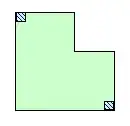
The following C-shape has a maximum anti-rectangle with 3 squares:

C-shape

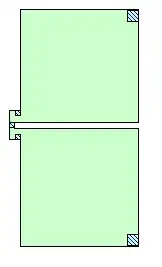
And the following shape has a maximum anti-rectangle with 5 squares:

C-C-shape

When I try to build an anti-rectangle, I usually start with putting squares in the corners of $C$, because intuitively, the corners have the least chance of being covered by a rectangle. This raises the following conjecture:

For every $C$, there is a maximum anti-rectangle, which contains a corner square.

(- a corner square is a square with at least two adjacent sides that are in the boundary of $C$).

I found in Chaikan et al (1981) a proof that the conjecture is true when $C$ is linearly-convex (- contains every vertical or horizontal line that connects two of its points; like the L-shape above).

Their proof is not valid when $C$ is not linearly-convex, but I also cannot find a counter-example. What do you say?


CONCLUSION: Many thanks to all repliers. The conjecture is false when the polygon may have holes (as shown by dmotorp). It is true when the polygon is hole-free (as proven by Nick Gill and mhum).

UPDATE: I cited this thread in the following working paper. I hope it will be accepted.

  • You need/I want more clarity. I am guessing size corresponds to number of squares in the set. Yes/no? Can the polygon have more than a finite number of sides? Also, if there are counterexamples, I would consider shapes like a block letter C or G in my search. Gerhard "Or Even Kerned Italic H" Paseman, 2013.11.05 – Gerhard Paseman Nov 05 '13 at 20:26
  • @GerhardPaseman yes, size=number of elements. (I thought that a polygon by definition has a finite number of sides..) – Erel Segal-Halevi Nov 05 '13 at 21:05

7 Answers7

11

I think the answer is YES .

Suppose that $d$ is a little square that lies in exactly one maximal subrectangle $C$ in the polygon. Then any anti-rectangle contains exactly one little square in $C$. We can replace this square by $d$ and still have an anti-rectangle.

So one is required to prove the following:

Proposition: In every hole-free polygon, there exists a corner square that lies in exactly one maximal subrectangle.

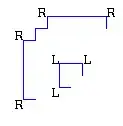
Sketch of proposed proof: Observe that as one moves clockwise around the perimeter of the polygon, one must go either left or right at various stages. One obtains a sequence: $R,R,L, R, L \cdots$ and it is clear that the number of $R$'s is 4 more than the number of $L$'s.

Motivating observation: suppose that in this sequence one has three $R$'s in a row. Then the corner corresponding to the middle $R$ will lie in a unique maximal subrectangle. (Edit: as commeters have pointed out - this isn't true. But it's not used in what follows.)

The problem is that one may not have three $R$'s in a row - one does, however, have at least $2$ $R$'s in a row. Let us examine whether or not one of the two corresponding corners lies in a unique maximal subrectangle.

(Here my sketch will get icky, because I don't have Joseph O'Rourke's excellence in drawing pictures...)

I claim that the only way both of these $R$-corners can fail to lie in a maximal sub-rectangle, is if the piece of the polygon 'opposite' the corners has some kind of crenellation, i.e. two knobs sticking out opposite each corner. These might not be 'smooth' - there could be many many bends in them but, still, if one gives this a little thought it becomes quite clear that this can only happen if `opposite' the edge between the two consecutive $R$-corners one has two consecutive $L$-corners.

Now we know that this cannot happen to all consecutive $R$-corners, because the number of $R$-corners exceeds the number of $L$-corners by $4$.

(Edit: @mhum pointed out that one may have several pairs of $R$-corners opposing a single pair $\mathcal{P}$ of $L$-corners. However if this were to happen, then each pair of $R$-corners would necessarily be separated by a pair of $L$-corners that were also opposite to $\mathcal{P}$, and so our count would not be affected.)

QED

Nick Gill
  • 11,161
  • 39
  • 70
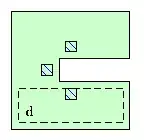
  • I am stuck at your preliminary claim: "We can replace this square by d and still have an anti-rectangle". See the C-shape image I just added to the question: http://i.stack.imgur.com/17bKQ.png There is a unique maximal subrectangle C (dashed), and there is a little square d that lies in it, and there is an anti-rectangle that contains another square in C (3 blue squares), but if we replace this square with d, the result is not an anti-rectangle anymore. – Erel Segal-Halevi Nov 14 '13 at 11:48
  • in the example you've shown your square $d$ doesn't lie in a unique maximal subrectangle... – Nick Gill Nov 14 '13 at 12:43
  • Ah, sorry, I probably misunderstood the word "unique" (which means that d lies only in a single maximal subrectangle). – Erel Segal-Halevi Nov 14 '13 at 12:51
  • exactly right... – Nick Gill Nov 14 '13 at 13:21
  • Consider all sides with either RR or LL corners, and select a shortest one. There can be no crenellations on the opposite side. Do you think this is sufficient? – Erel Segal-Halevi Nov 14 '13 at 18:13
  • 2
    I may not be understanding correctly, but is it necessarily the case that 3 R-corners guarantees the property you're looking for? In this figure http://i.imgur.com/vI128yH.png, I think the red corners form 3 consecutive R-corners and none of them seem to be contained in a unique maximal rectangle. – mhum Nov 14 '13 at 19:00
  • Also, in your proof, you're matching pairs of R-corners to pairs of L-corners. But, how do you ensure that each of the matched L-corners is only matched once? I.e.: how do you know a different pair of R-corners isn't also matched up against one (or both) of these previously matched L-corners? – mhum Nov 15 '13 at 03:17
  • I was also thinking along these lines and believe that this approach has a chance to work. As a first correction, as pointed out my mhum, we need something stronger. How about that the 3 R-corners can be covered by one rectangle? – domotorp Nov 15 '13 at 07:23
  • @mhum Good example, thanks. What do you think about my criterion - the shortest RR/LL side - is it always true that at least one corner in this side is contained in exactly one maximal rectangle? – Erel Segal-Halevi Nov 15 '13 at 09:42
  • @Erel, I don't think you're criterion quite works because we need the shortest side to lie between RR-corners. LL-corners won't work. – Nick Gill Nov 15 '13 at 09:46
  • @domotorp, I think your criterion does guarantee that the middle R-corner has the property we want. I still feel hopeful, though, that we can just work with the criterion for 2 R-corners. – Nick Gill Nov 15 '13 at 09:51
  • @mhum: your comment about more than one pair of RR-corners being matched with a pair of LL-corners is a valid point - but I think such a situation would result in their being LL-corners in between the RR-corners and our count would not be affected. Thoughts? – Nick Gill Nov 15 '13 at 09:51
  • @NickGill and if we take the shortest RR side? – Erel Segal-Halevi Nov 15 '13 at 09:54
  • @Erel, there might be an even shorter LL side that is opposite this RR side - so neither of the R corners would be in a unique maximal subrectangle. (This `shortest side' idea was the approach that I initially thought of, but I couldn't make it work and ended up doing the count that I wrote down. Something like this might work of course, but I couldn't figure it out.) – Nick Gill Nov 15 '13 at 09:56
  • Using the minimal RR side is probably not a good idea. In the following shape: http://i.stack.imgur.com/vYUhL.png the minimal RR side (at the west) does not have a corner contained in exactly one maximal rectangle, but the larger RR sides (at the east) do. – Erel Segal-Halevi Nov 15 '13 at 12:48
  • @NickGill Please see the answer I added just now, which attempts to complement/simplify your proof. Do you think it is correct? If it is, then you can merge it with your answer. – Erel Segal-Halevi Nov 15 '13 at 13:39
  • I believe that this proof can be made rigorous but I feel like one more observation is missing. Also, I think it proves the stronger statement that unless the polygon is a rectangle, there is a maximum antirectangle that has at least TWO corner squares. – domotorp Nov 15 '13 at 16:49
  • You wrote that "mhum pointed out that one may have several pairs of R-corners opposing a single pair P of L-corners" - I do not think this is possible, at least if a pair of R-corners is matched to a pair of L-corners, then the LL side's "shadow" has to fall on the RR side. So your proof is complete. It also gives 4 good RR sides, which implies 2 corners (unless C is a rectangle). – domotorp Nov 15 '13 at 20:00
  • 1
    @domotorp I think I sort of see what's going on now. Part of it was the looseness of the description was a little confusing to me. I just put up an answer that tries to formalize the correspondence a little better. – mhum Nov 15 '13 at 21:00
9

The answer is negative if you allow holes. Consider a 5 times 5 square with its center missing. Then the 4 squares adjacent to the center form an antirectangle, but any antirectangle that contains a corner square has at most three squares.

domotorp
  • 18,332
  • 3
  • 54
  • 121
7

This answer is more or less just a formalization of the intuition put forward by Nick Gill in his answer. The beginning parts are mostly just formalities, so you can probably skip down to the diagram.

Let $C$ be an axis-aligned orthogonal polygon. Following Chaikan et al., we'll consider $C$ as a union of squares. For any square $x \in C$, we define $$R(x) = \{ y \in C \;|\; \exists \text{ a rectangle in $C$ containing $x$ and $y$}\}$$ with the understanding that $x\in R(x)$. Next, we define a pre-order $\leq$ on $C$ by $$ x \leq y \iff R(x) \subseteq R(y)$$

Let $x$ and $y$ form an anti-rectangle and let $R(z) \subseteq R(x)$. Then, we can show that $z$ and $y$ also form an anti-rectangle. It follows that given an anti-rectangle $\{x_1, x_2, \ldots, x_k\}$, we can find another anti-rectangle $\{x_1', x_2', \ldots, x_k'\}$ of equal cardinality where each $x_i'$ is chosen to be a minimal element such that $x_i' \leq x_i$. In fact, we can construct a maximum anti-rectangle by selecting one representative from each of the minimal equivalence classes (defined in the usual way by the pre-order).

It now remains to show that if $C$ does not contain any holes, then there exists at least one minimal corner square. We will actually show slightly more: that there is at least one corner square $x$ on a "support edge" (by Chaikan et al's terminology) such that $R(x)$ is a rectangle. Observe that if $R(x)$ is a rectangle, then $x$ is minimal; we leave as an exercise for the reader to construct an example that shows that the converse is false.

Each edge in $C$ can be categorized by the squares at its endpoints. An edge can have either two, one, or zero corners at its endpoints. In the terminology laid out in Nick Gill's answer, these would correspond to $RR$, $RL$ (or $LR$), and $LL$ edges respectively (also, $RR$ edges correspond to "support edges" in Chaikan et al's terminology).

The key lemma we will need is that if $C$ is a simple, orthogonal polygon then it has strictly more $RR$ edges than $LL$ edges. First, we'll take as given that there are strictly more $R$ corners than $L$ corners (again, as defined in Nick Gill's answer) in $C$. Let $rr$, $ll$, and $rl$ be the number of $RR$, $LL$, and $RL$ edges. We will now try to count the number of each type of corner via counting each edge. Each $RR$ edge we'll count as two $R$ corners, each $LL$ edge as two $L$ corners, and each $RL$ edge as one $R$ and one $L$ corner. Counting in this way, we end up counting each corner exactly twice. So, we have $2r = 2rr+rl$ and $2l = 2ll+rl$. Thus, $0 < 2r - 2l = 2rr - 2ll$ and hence there are strictly more $RR$ edges than $LL$ edges.

Consider the following diagram of an $RR$ edge:
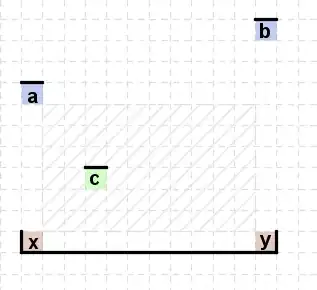
enter image description here

The heavy black lines indicate known boundaries of $C$. The red squares, $x$ and $y$ are the corners of the $RR$ edge. The blue squares $a$ and $b$ are the edge squares directly above $x$ and $y$ respectively (i.e.: all the squares between $x$ and $a$ and between $y$ and $b$ are interior squares).

If there were no edge squares in the shaded region, then $R(x)$ would be a rectangle and we would be done. So, let $c$ be an edge square in the shaded region. Furthermore, we choose $c$ to one of the edge squares closest to the $xy$ edge (i.e.: $c$ is one of the southernmost edge squares in the shaded region). Call the edge corresponding to $c$, $E$. Note that while there may be more than once such edge, for our purposes we will only need to choose one.

We now infer that $E$ must be an $LL$ edge. By construction of the shaded region, the endpoints of $E$ must lie inside the shaded region (otherwise, it would violate one of the clear paths between $x$ and $a$ or $y$ and $b$). Thus, if one of the endpoints of $E$ were a corner, it would contradict the choice of $c$ as one of the southernmost edge squares. Finally, we see that $E$ can be uniquely identified in this way with the $RR$ edge corresponding to $xy$. Otherwise, it would once again contradict the choice of $c$ as closest to $xy$.

So, we conclude that any $RR$ edge where the corners are not minimal can be uniquely identified with an $LL$ edge. Since there are more $RR$ edges than $LL$ edges, one of them must contain a minimal corner.
mhum
  • 1,625
  • One note -- you might match up your RR edge with more than one LL edge, I think, if there were two Es that were exactly as far south as one another. But this doesn't affect the result, because there are still more RR than LL, so putting even more LL on a single RR still leaves us with excess RR. – Harry Altman Nov 15 '13 at 22:42
  • 1
    Yes, that was the idea of the last sentence of the third-to-last paragraph: "Note that while there may be more than once such edge, for our purposes we will only need to choose one". I could have fixed the choice as, say, the left-most of such edges, but I thought it would be a little overkill. – mhum Nov 15 '13 at 22:45
  • I am not sure about "there are strictly more RR edges than LL edges". There are more R's than L's, but, what if there is a sequence LLL, such that the first LL pair matches an RR pair, and the second LL pair matches a disjoint RR pair, such as the following: http://i.stack.imgur.com/1jNJo.png – Erel Segal-Halevi Nov 16 '13 at 19:40
  • BTW, the observation "we can construct a maximum anti-rectangle by selecting one representative from each of the minimal equivalence classes" is interesting in itself as a basis for an algorithm for finding anti-rectangles. – Erel Segal-Halevi Nov 16 '13 at 19:43
  • @ErelSegal-haLevi In inferred that there are more RR edges than LL edges not from the matching but from the fact that there are more R corners than L corners. Let $r$ and $l$ be the number of R and L corners. Let $rr$, $ll$, and $rl$ be the number of RR, LL, and RL/LR edges. Note that $rr+rl=2r$ and $ll+rl=2l$. Then, $0< r-l = (rr-ll)/2$. So $rr > ll$. – mhum Nov 17 '13 at 04:30
  • @mhum Excuse my simple question, but, I just cannot figure out your latter equation. For example, in a square, $r=4$, $rr=4$ and $rl=0$, so $rr+rl \neq 2r$. In an L-shape, $r=5$, $l=1$, $rr=4$ and $rl=2$, so again $rr+rl \neq 2r$... – Erel Segal-Halevi Nov 17 '13 at 07:11
  • @ErelSegal-haLevi Whoops! That's embarrassing! That'll teach me to go too fast. I've updated my answer with a better exposition (paragraph starting "The key lemma..."). – mhum Nov 17 '13 at 16:39
  • Thank you very much! Now the answer seems complete so I am marking it as the correct answer. Unfortunately I cannot give the bounty twice and I hope you will excuse me for giving it to Nick which initiated the idea... – Erel Segal-Halevi Nov 17 '13 at 17:14
  • 1
    @ErelSegal-haLevi No problem. The equivalence classes defined above might be an interesting clue for whatever else you're looking at too. I'm pretty sure they're formed out of the rectangles you obtain by extending the edges of the polygon (if you work out some examples, I think you'll see what I mean). – mhum Nov 17 '13 at 17:37
  • @mhum I would like to cite your answer in a paper. What name should I use? (You can email me if you want) – Erel Segal-Halevi Nov 18 '13 at 08:56
  • @mhum, I've been offline for the week-end and just seen your answer. Good work at straightening things out! (And forgive me for writing such a sketchy original answer - my excuse is that I was writing it on someone else's ipad-thingy and it was driving me mad.) – Nick Gill Nov 18 '13 at 10:07
  • @ErelSegal-haLevi, perhaps when the paper is written you could add a link on this page - it would be good to see how this bit of work is used. – Nick Gill Nov 18 '13 at 10:10
  • @NickGill Sure, I will. It might take several months until I have a paper, though. – Erel Segal-Halevi Nov 19 '13 at 06:02
  • @mhum "In fact, we can construct a maximum anti-rectangle by selecting one representative from each of the minimal equivalence classes" - I think this claim is slightly stronger than the previous claim. Are you sure that, if we take a minimal element from EVERY equivalence class, we get an anti-rectangle? (It is not relevant for the rest of the proof, but still interesting to know) – Erel Segal-Halevi Nov 21 '13 at 09:38
  • @ErelSegal-haLevi We don't take a minimal element from every equivalence class. We take an element from every minimal equivalence class (i.e.: each equivalence class containing a minimal element). – mhum Nov 21 '13 at 18:42
  • @NickGill I added a link to a working paper in which I cited this thread. Thanks again! – Erel Segal-Halevi Jan 23 '14 at 14:13
3

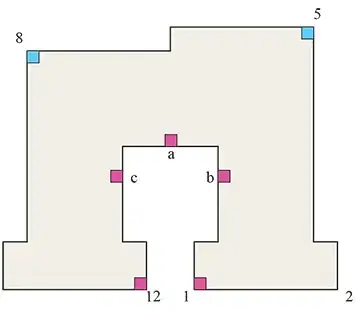
Could you please clarify your definitions via the example polygon below?
   AntiRect1
Is $\{a,b,c,1,12\}$ an antirectangle of size $5$? Is this a maximal antirectangle? What is a largest antirectangle that includes a corner in this example?


Again, just illustrating the definitions, here is a maximal antirectangle, following the OP's comments:
   AntiRect2
Joseph O'Rourke
  • 149,182
  • 34
  • 342
  • 933
  • 3
    If I see correctly, ${a,b,c,1,12}$ is an antirectangle of size 5, but it is not maximum size, because you can add a square at the corner to the left of $5$ (maybe slide $a$ slightly to the left so that they don't intersect). – Erel Segal-Halevi Nov 11 '13 at 13:52
  • @ErelSegal-haLevi: Thanks for clarifying. And if the top $(5,6,7,8)$ were just a straight segment, then the max size is $5$, but some include a corner. – Joseph O'Rourke Nov 11 '13 at 14:04
  • Yes, this is correct. – Erel Segal-Halevi Nov 11 '13 at 14:14
  • I don't get it. ${,a,b,c,1,5,12,}$ isn't an anti-rectangle, since there's a rectangle containing $b$ and 5, no? And ${,a,b,c,1,12,}$ includes a corner, indeed two corners, 1 and 12, so if it's maximal then it is the largest antirectangle that includes a corner. – Gerry Myerson Nov 11 '13 at 22:37
  • 2
    @GerryMyerson: ${a,b,c,1,5,12}$ is not an antirectangle, correct. And ${a,b,c,1,12}$ is an antirectangle, but not a maximal one, because there is another set (now also illustrated) of six mutually invisible squares: ${a,b,c,1,6,12}$. – Joseph O'Rourke Nov 12 '13 at 01:01
2

Here is a very very simple observation, inspired by Nick's three R's in a row approach.

Claim: If there is a maximal rectangle Q in C, such that C\Q is connected, then there is a corner of C (and also Q) that must be in every maximal antirectangle.

Proof: This follows simply by noticing that the boundary of C and Q intersect each other in a continuous arc, so if the corners of Q are denoted abcd, then (without loss of generality) ab and bc are also sides of C and so are the beginning of the segments ad and cd. In this case b can see at most as much as any other point in Q.

Of course, there are polygons without such a Q, e.g., a cross.

domotorp
  • 18,332
  • 3
  • 54
  • 121
1

Here is an approach which is incomplete, but might be combined with Nick Gill's approach to yield something nice.

I 'll let others do the routine of formalizing the notions of cover, orthogonal cover by rectangles, reduced cover. The key idea is that a reduced cover covers a polygon by axis aligned rectangles, that it does so with finitely many such, that each rectangle is as large as can be in the cover, and that there is no redundancy, which gives that a maximal anti rectangle can be constructed from a reduced cover, and an anti rectangle can produce a cover which can be reduced to one that produces another anti rectangle containing the first anti rectangle. (The map from AR to RC to AR seems important, but is not necessary.)

Now note that we are trying to find an RC such that a polygon corner is covered by only one rectangle. Consider the directed inclusion graph with rectangles as vertices and edges joining a to b if b contains a corner of a. I think the graph has a cycle only if the polygon has a hole, and that otherwise there is a degree 1 vertex. Perhaps someone can prove this, from which the original poster's conjecture follows.

  • Of course other details remain, such as insisting that union of a cover is contained in the polygon. I think if there is no degree 1 vertex, then there is a cycle, from which one might show there is a hole. – The Masked Avenger Nov 14 '13 at 17:44
  • DIt looks like the idea needs more work. A pinwheel type polygon permits a cycle in the graph, so perhaps a graph based on the corners of the rectangles in the reduced cover is needed. – The Masked Avenger Nov 14 '13 at 23:41
  • 1
    You should have a look at the paper that the OP links to - it discusses rectangular covers, and in particular shows that, in general, there is a 'gap' between the size of a minimal cover, and the size of a maximal anti-rectangle. I fear this `gap' might fatally compromise the cover-approach... – Nick Gill Nov 15 '13 at 10:00
  • 1
    Arrange 4 domino tiles in a pinwheel. If anti rectangles were sets of points, I'd say the largest had 4 points. Since they are small squares and not points, is a maximal AR one with 5 squares? – The Masked Avenger Nov 15 '13 at 16:57
1

This is an attempt to complement Nick Gill's answer. If it is correct (I am not sure), it should be merged into his answer.

Proposition: In every hole-free polygon, there exists a corner square that lies in exactly one maximal subrectangle.

Proof: Observe that as one moves clockwise around the perimeter of the polygon, one must go either left or right at various stages. One obtains a sequence: $R,R,L, R, L \cdots$ and it is clear that the number of $R$'s is 4 more than the number of $L$'s. Therefore there must be a pair of two adjacent $R$'s.

Assume w.l.o.g. that there is such a pair such that the side between the corners faces west. Consider the maximal rectangle that covers the two $R$ corners (red in the pictures below). This rectangle must run into at least one eastern side. There are two cases:

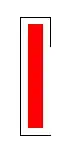
Case A: The eastern side is connected to an $R$ corner adjacent to the $RR$ pair at the north or south:

Case A

In this case, the middle $R$ corner is contained in exactly one maximal rectangle (the red one) and we are done.

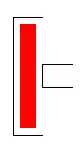
Case B: The eastern side is between two adjacent $L$ corners:

Case B

By the construction, it is clear that this $LL$ pair cannot be used in the same way with any other $RR$ pair.

Now we know that this cannot happen to all consecutive $R$-corners, because the number of $R$-corners exceeds the number of $L$-corners by $4$.

EDIT: I am not sure about the latter counting argument. What if there is a sequence LLL, such that the first LL pair matches an RR pair, and the second LL pair matches a disjoint RR pair?

RR RR LLL