I have just started with the Pico Pi and have no idea where to get info on how to power 5V 3A PTC heating element using the Pico and a MOSFET. Would there be anyone who could give me a pointer as I have been going in circles.
Asked
Active
Viewed 186 times
2

-
1https://raspberrypi.stackexchange.com/questions/70931/how-do-i-do-a-basic-mosfet-switch-with-pi may be of help. It applies to a RPi, rather than a pico, but the advice still stands. TLDR: most MOSFETs do not work well with 3.3V, so find a different solution... – David Arno Feb 01 '23 at 08:50
-
What device you are using to control the unspecified element is irrelevant. The circuitry would be the same regardless of controller. – Milliways Feb 01 '23 at 09:00
-
1I appreciate the pointers, thank you – Colin Thomson Feb 01 '23 at 09:02
-
1This might help: https://www.circuitlab.com/circuit/b45c4a7snvv9/irl540n_2023feb0103/ – tlfong01 Feb 01 '23 at 12:58
3 Answers
3
Don't use a MOSFET with Pico (or Pi) GPIO; use a bipolar transistor.
Why? RPi and Pico GPIOs switch between Gnd & 3.3V; most MOSFETs need a higher gate-source voltage than that to reduce the drain-source resistance. The MOSFETs that do operate as a proper switch at 3.3V gate-source generally come with tradeoffs that are undesirable in prototypes & hobbyist construction. For example:
They often come in tiny packages designed for surface-mount construction techniques.
In general, MOS devices are more vulnerable to ESD-induced failures due to handling and unplanned events.
If one is building a performance-critical, production prototype device, there may be strong incentives to use low-Vgs MOSFETs in a Raspberry Pi project. But there are tradeoffs associated with most all decisions; e.g. ease-of-use & component ruggedness vs better performance. As your question is currently worded, you're better-suited to make those tradeoffs than we are.
OTOH, there are numerous bipolar Darlingtons that will handle your 5V, 3A load:
- 2N6040−2N6045 Series,
- TIP120−TIP122 Series,
- TIP125−TIP127 Series
With a (typical) DC Current Gain (hFE) of 2000 or higher, one of these Darlingtons can efficiently switch 3A with a tiny 1.5 mA source current from the GPIO - well within their range. They are available in "leaded" packages (e.g. TO-220, etc) for easy breadboard construction, and fairly cheap (<$1 USD last I checked).
A heating element can be driven with a "low side" switch arrangement as shown below.
You can find data sheets online for the Darlington devices listed above. Let us know if you have questions.
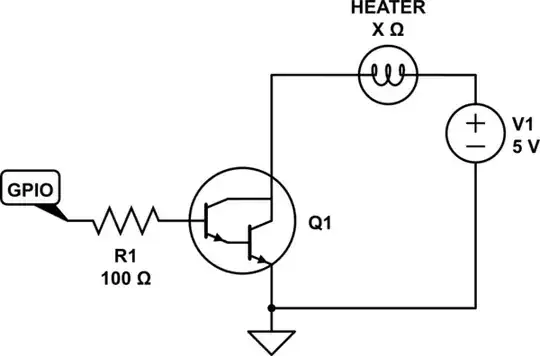
simulate this circuit – Schematic created using CircuitLab


Seamus
- 21,868
- 3
- 33
- 70
-
Many thanks, this is exactly the nudge I needed to get started. Thank you – Colin Thomson Feb 02 '23 at 13:37
-
2
I would recommend using a MOSFET, a darlington will lose about 1.4V when saturated leaving you 5-1.4V = 3.6V for the heater. A MOSFET will have a much lower drop. Look at the Si8424DB, Si8424DB, RFP30N06LE as a starting point. There are many others that will do more current with more becoming available every week.

Gil
- 1,228
- 4
- 5
0
I have been running a rp for at least 7 years 24/7/365 as a radius server. It is on stable power and running headless. Other than clearing the log files once in a while and blowing off the dust, that's all I need to do. I do complete backups of the data every night.

George F
- 21
- 3