OK, I'm working from the 1st edition of the book, so section 4.2.4 of my edition starts on page 75, but the text appears otherwise to be the same.
Initially, the book re-writes the equations of motion of the robot, given earlier as Eq. 4.2:
$ \dot x = \nu cos \theta $
$ \dot y = \nu sin \theta $
$ \dot \theta = \frac {\nu} {L} tan \gamma $
in matrix form:
$
\begin{pmatrix}
\dot x \\
\dot y \\
\dot \theta
\end{pmatrix}
=
\begin{pmatrix}
cos \theta & 0 \\
sin \theta & 0 \\
0 & 1
\end{pmatrix}
\begin{pmatrix}
\nu \\
\gamma
\end{pmatrix}
$
These equations are then transformed into polar coordinate form using the notation from the following figure (figure 4.12 in my edition, yours may vary):
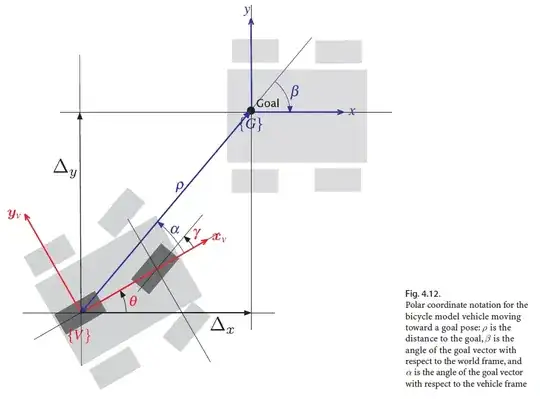
From this figure, we obtain your first set of equations:
$ \rho = \sqrt {\Delta ^{2} _{x} + \Delta ^{2} _{y}} $
$ \alpha = tan ^{-1} \frac {\Delta _{y}} {\Delta _{x}} - \theta $
$ \beta = - \theta - \alpha $
Next, we apply the chain rule. Multiply both sides of Eq 4.2 by the Jacobian of the coordinate transformation, J.
There are a couple of ways to obtain the Jacobian, J. Either differentiate the forward map to get
$
J =
\begin{pmatrix}
{\frac {\Delta _{x}} {\sqrt {\Delta ^{2} _{x} + \Delta ^{2} _{y}}}} & {\frac {\Delta _{y}} {\sqrt {\Delta ^{2} _{x} + \Delta ^{2} _{y}}}} & 0 \\
-{\frac {\Delta _{y}} {{\Delta ^{2} _{x} + \Delta ^{2} _{y}}}} & {{\frac {\Delta _{x}} {{\Delta ^{2} _{x} + \Delta ^{2} _{y}}}}} & -1 \\
{\frac {\Delta _{y}} {{\Delta ^{2} _{x} + \Delta ^{2} _{y}}}} & -{{\frac {\Delta _{x}} {{\Delta ^{2} _{x} + \Delta ^{2} _{y}}}}} & 0
\end{pmatrix}
=
\begin{pmatrix}
-\cos\beta & \sin\beta & 0 \\
-{\frac {\sin \beta} {\rho}} & -{\frac {\cos \beta} {\rho}} & -1 \\
{\frac {\sin \beta} {\rho}} & {\frac {\cos \beta} {\rho}} & 0
\end{pmatrix}
$
Alternatively, since we can write the inverse as:
$ \Delta _{x} = -\rho\cos(-\beta) = -\rho\cos\beta $
$ \Delta _{y} = -\rho\sin(-\beta) = \rho\sin\beta $
$ \theta = -(\alpha + \beta) $
we could write this in matrix form and differentiate to get:
$
\begin{pmatrix}
-\cos \beta & 0 & \rho \sin \beta \\
\sin\beta & 0 & \rho \cos \beta \\
0 & -1 & -1
\end{pmatrix}
$
and then invert to obtain J:
$
J =
\begin{pmatrix}
-\cos\beta & \sin\beta & 0 \\
-{\frac {\sin \beta} {\rho}} & -{\frac {\cos \beta} {\rho}} & -1 \\
{\frac {\sin \beta} {\rho}} & {\frac {\cos \beta} {\rho}} & 0
\end{pmatrix}
$
$
J
\begin{pmatrix}
cos \theta & 0 \\
sin \theta & 0 \\
0 & 1
\end{pmatrix}
\begin{pmatrix}
\nu \\
\gamma
\end{pmatrix}
=
\begin{pmatrix}
-\cos \beta \cos \theta + \sin \beta \sin \theta & 0 \\
- \frac {1} {\rho} (\cos \beta \sin \theta + \sin \beta \cos \theta) & -1 \\
\frac {1} {\rho} (\cos \beta \sin \theta + \sin \beta \cos \theta) & 0
\end{pmatrix}
\begin{pmatrix}
\nu \\
\gamma
\end{pmatrix}
$
Simplifying and then substituting $ \theta = -(\alpha + \beta) $ gives:
$
=
\begin{pmatrix}
- \cos (\beta + \theta) & 0 \\
- \frac {1} {\rho} \sin (\beta + \theta) & -1 \\
\frac {1} {\rho} \sin (\beta + \theta) & 0
\end{pmatrix}
\begin{pmatrix}
\nu \\
\gamma
\end{pmatrix}
=
\begin{pmatrix}
- \cos \alpha &0 \\
{\frac {\sin \alpha} {\rho}} & -1 \\
- {\frac {\sin \alpha} {\rho}} & 0
\end{pmatrix}
\begin{pmatrix}
\nu \\
\gamma
\end{pmatrix}
$
So, we can write:
$
\begin{pmatrix}
\dot \rho \\
\dot \alpha \\
\dot \beta
\end{pmatrix}
=
\begin{pmatrix}
-cos \alpha & 0 \\
\frac {sin \alpha} {\rho} & -1 \\
-\frac {sin \alpha} {\rho} & 0
\end{pmatrix}
\begin{pmatrix}
\nu \\
\gamma
\end{pmatrix},
\text { if }
\alpha \in
\begin{pmatrix}
-\frac {\pi} {2} , \frac {\pi} {2}
\end{pmatrix}
$
Which is your second equation.
The equations
$ \nu = k _{\rho} \rho $
$ \gamma = k _{\alpha} \alpha + k _{\beta} \beta $
are the linear control law which, when applied to the equation we just derived gives us:
$
\begin{pmatrix}
\dot \rho \\
\dot \alpha \\
\dot \beta
\end{pmatrix}
=
\begin{pmatrix}
- k _{\rho} \rho \cos \alpha \\
k _{\rho} \rho \sin \alpha - k _{\alpha} \alpha - k _{\beta} \beta \\
-k _{\rho} \sin \alpha
\end{pmatrix}
$
for the closed-loop system.
And yes, it looks like there may be a typo in the book (on page 76 for the first edition, presumably on page 109 in yours?)
A list of errata for RVC can be found on Peter's website, and this doesn't appear to be listed for either edition. I've emailed him (using the address on the errata page) to let him know about it with a link to your question.
Alternatively, Peter has recently started using Robotics:SE, so he may see it here (I've suggested an edit to the title to include the name of the book).


