What? afraid of going beyond 255? not me!

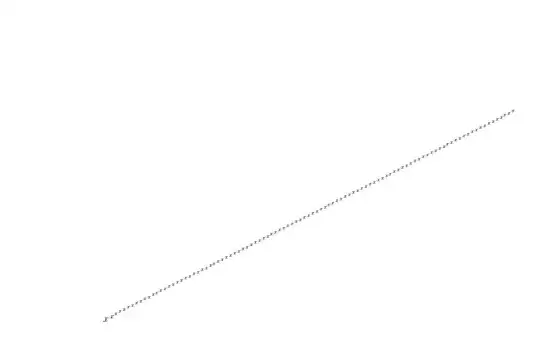
This was obtained as $\epictower{x}{600}$.
This reproduces exactly what TeX would have done (were it not for
the limitation to 255 group levels) inclusive of a quite odd feature
of TeX regarding extra horizontal space on the right.
update 2015. I forgot to say in 2013 what I was referring too: the
horizontal whitespace extending to the the right of the power towers,
on the side of the character glyphs. The image with the 600 x's does
not show the resulting (big) extra horizontal space because the figure
was clipped to the contained ink. The images below with shorter
staircases display using fboxes the extra whitespace, look on right of
the rightmost characters the distance to the fbox frame. You can also
experiment with David Carlisle's macro inside an fbox (with
\fboxsep=0pt or rather -0.4pt).

In the next picture, on top left what is produced by \epictower, on the right and bottom the original thing, to demonstrate that horizontal and vertical placement is correct (the font size is set to 60pt and then standard size).


And here is the code:
\documentclass{article}
% use this for 600 x's!
% \usepackage [paperheight=65cm,paperwidth=100cm]{geometry}
\usepackage {geometry}
\pagestyle{empty}

\makeatletter
\newdimen \epic@x
\newdimen \epic@y
\newdimen \epic@extrax
\newdimen \epic@extray
\newbox \epic@one
\newbox \epic@two
\newcommand{\epictower}[2]{\ifcase #2\relax
         1\or #1\or {#1}^{#1}\or {#1}^{{#1}^{#1}}\else \epic@tower {#1}{#2}\fi }
\def\epic@tower #1#2{%
    \sbox\epic@one{\m@th $\scriptscriptstyle #1$}%
    \sbox\epic@two{\m@th $\scriptscriptstyle {#1}^{#1}$}%
    \epic@x=\wd\epic@one
    \epic@extrax=\wd\epic@two
    \advance\epic@extrax by -\epic@x
    \advance\epic@extrax by -\epic@x
    \epic@y=\ht\epic@two
    \advance\epic@y by -\ht\epic@one
    \epic@extray=\ht\epic@one
    \advance\epic@extray by -\epic@y
    \toks@ \expandafter{\the\numexpr #2-3}%
    {#1}^{{#1}^{%
    \setlength{\unitlength}{1sp}%
    \begin{picture}({\numexpr (#2-2)*\epic@x+(#2-3)*\epic@extrax\relax},%
                    {\numexpr (#2-2)*\epic@y+\epic@extray\relax})
    \count@\z@
    \loop
        \put (\numexpr \count@ * \epic@x\relax,%
              \numexpr \count@ * \epic@y\relax){\copy\epic@one}%
    \ifnum\the\toks@>\count@
    \advance\count@ \@ne
    \repeat
    \end{picture}}}}
\makeatother


\begin{document}\thispagestyle{empty}

\fboxsep-.4pt
\fontsize{60}{60}

\newcommand{\testtexpowers}[1]{%
\setbox 1 \hbox{$\scriptscriptstyle #1$}%
\setbox 2 \hbox{$\scriptscriptstyle #1^{\fbox{\copy1}}$}%
\setbox 3 \hbox{$\scriptscriptstyle #1^{#1^{\fbox{\copy1}}}$}%
\setbox 4 \hbox{$\scriptscriptstyle #1^{#1^{#1^{\fbox{\copy1}}}}$}%
\setbox 5 \hbox{$\scriptscriptstyle #1^{#1^{#1^{#1^{\fbox{\copy1}}}}}$}%
\setbox 6 \hbox{$\scriptscriptstyle #1^{#1^{#1^{#1^{#1^{\fbox{\copy1}}}}}}$}%
\setbox 7 \hbox{$\scriptscriptstyle #1^{#1^{#1^{#1^{#1^{#1^{\fbox{\copy1}}}}}}}$}%
\setbox 8 \hbox{$\scriptscriptstyle #1^{#1^{#1^{#1^{#1^{#1^{#1^{\fbox{\copy1}}}}}}}}$}%
\setbox 9 \hbox{$\scriptscriptstyle #1^{#1^{#1^{#1^{#1^{#1^{#1^{#1^{\fbox{\copy1}}}}}}}}}$}%
\leavevmode\rlap{\rlap{\rlap{\rlap{\rlap{\rlap{\rlap{\rlap{\fbox{\box1}}\fbox{\box2}}\fbox{\box3}}\fbox{\box4}}\fbox{\box5}}\fbox{\box6}}\fbox{\box7}}\fbox{\box8}}\fbox{\box9}}

\testtexpowers{x}

\testtexpowers{X}

\testtexpowers{xX}

\clearpage

\fbox{$\epictower {x}{1}$}\fbox{$x$}\hrule\fbox{$x$}
\hrule
\fbox{$\epictower {x}{2}$}\fbox{$x^x$}\hrule\fbox{$x^x$}
\hrule
\fbox{$\epictower {x}{3}$}\fbox{$x^{x^x}$}\hrule\fbox{$x^{x^x}$}
\hrule
\fbox{$\epictower {x}{4}$}\fbox{$x^{x^{x^x}}$}\hrule\fbox{$x^{x^{x^x}}$}
\hrule
\fbox{$\epictower {x}{5}$}\fbox{$x^{x^{x^{x^x}}}$}\hrule\fbox{$x^{x^{x^{x^x}}}$}
\hrule
\fbox{$\epictower {x}{6}$}\fbox{$x^{x^{x^{x^{x^x}}}}$}\hrule\fbox{$x^{x^{x^{x^{x^x}}}}$}
\hrule


\clearpage

\fbox{$\epictower {X}{1}$}\fbox{$X$}\hrule\fbox{$X$}
\hrule
\fbox{$\epictower {X}{2}$}\fbox{$X^X$}\hrule\fbox{$X^X$}
\hrule
\fbox{$\epictower {X}{3}$}\fbox{$X^{X^X}$}\hrule\fbox{$X^{X^X}$}
\hrule
\fbox{$\epictower {X}{4}$}\fbox{$X^{X^{X^X}}$}\hrule\fbox{$X^{X^{X^X}}$}
\hrule
\fbox{$\epictower {X}{5}$}\fbox{$X^{X^{X^{X^X}}}$}\hrule\fbox{$X^{X^{X^{X^X}}}$}
\hrule
\fbox{$\epictower {X}{6}$}\fbox{$X^{X^{X^{X^{X^X}}}}$}\hrule\fbox{$X^{X^{X^{X^{X^X}}}}$}
\hrule

\end{document}

% comment-out the preceding, sets page dimensions in geometry
% only limited by TeX's \maxdimen !

$\epictower{x}{600}$

\end{document}




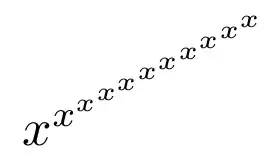


$x^{\scriptscriptstyle x^{x^{x^{x^{x^{x^{x^{x^{x}}}}}}}}}$– egreg Nov 11 '13 at 21:30\(x\uparrow\uparrow10\)just because. – You Nov 11 '13 at 23:53$x \uparrow 10$; two\uparrows and you would havex \uparrow 10exponentiation steps. (But this is almost entirely beside the point.:)) – Sean Allred Nov 12 '13 at 00:59