Is it possible to have a macro like this one:
\documentclass{article}
\usepackage{xparse}
\pagestyle{empty}
\ExplSyntaxOn
\NewDocumentCommand{\HowManyArguments}{ oooooooo }
    {
        \IfNoValueTF {#1} { 0 }{
            \IfNoValueTF {#2} { 1 }{
                \IfNoValueTF {#3}  { 2 }{
                     \IfNoValueTF {#4}  { 3 }{
                          \IfNoValueTF {#5}  { 4 }{
                               \IfNoValueTF {#6}  { 5 }{
                                    \IfNoValueTF {#7}  { 6 }{
                                         \IfNoValueTF {#8}  { 7 }{ So many }
                                    }
                               }
                          }
                     }
                }
            }
        }
    }
\ExplSyntaxOff
\begin{document}

The amount of arguments in this macro is \HowManyArguments[Cake][Chair][Stool][Bicycle] .

\end{document}
Except one that doesn't have limitations, a bit like the \powertower thread, where the result is embedded in the rest every time: How do I typeset a tenfold powering (a tower-of-powers) with LaTeX?
The idea is then to use the first argument of the macro to define the number of arguments.
The reason why I need the "powertower" approach is because of part 2: I want to rotate between colours based on the number of the argument.
Try compiling this:
\documentclass{article}
\usepackage{xparse}
\usepackage{xcolor}
\pagestyle{empty}
\ExplSyntaxOn
\NewDocumentCommand{\HowManyArguments}{ oooooooo }
    {
        \IfNoValueTF {#1} {}{
            \IfNoValueTF {#2} {\textcolor{blue}{#1(}...\textcolor{blue}{)}}{
                \IfNoValueTF {#3}  {\textcolor{blue}{#1(}\textcolor{green}{#2(}...\textcolor{green}{)}\textcolor{blue}{)}}{
                     \IfNoValueTF {#4}  {\textcolor{blue}{#1(}\textcolor{green}{#2(}\textcolor{red}{#3(}...\textcolor{red}{)}\textcolor{green}{)}\textcolor{blue}{)}}{
                          \IfNoValueTF {#5}  {\textcolor{blue}{#1(}\textcolor{green}{#2(}\textcolor{red}{#3(}\textcolor{blue}{#4(}...\textcolor{blue}{)}\textcolor{red}{)}\textcolor{green}{)}\textcolor{blue}{)}}{
                               \IfNoValueTF {#6}  {\textcolor{blue}{#1(}\textcolor{green}{#2(}\textcolor{red}{#3(}\textcolor{blue}{#4(}\textcolor{green}{#5(}...\textcolor{green}{)}\textcolor{blue}{)}\textcolor{red}{)}\textcolor{green}{)}\textcolor{blue}{)}}{
                                    \IfNoValueTF {#7}  {\textcolor{blue}{#1(}\textcolor{green}{#2(}\textcolor{red}{#3(}\textcolor{blue}{#4(}\textcolor{green}{#5(}\textcolor{red}{#6(}...\textcolor{red}{)}\textcolor{green}{)}\textcolor{blue}{)}\textcolor{red}{)}\textcolor{green}{)}\textcolor{blue}{)}}{
                                         \IfNoValueTF {#8}  {\textcolor{blue}{#1(}\textcolor{green}{#2(}\textcolor{red}{#3(}\textcolor{blue}{#4(}\textcolor{green}{#5(}\textcolor{red}{#6(}\textcolor{blue}{#7(}...\textcolor{blue}{)}\textcolor{red}{)}\textcolor{green}{)}\textcolor{blue}{)}\textcolor{red}{)}\textcolor{green}{)}\textcolor{blue}{)}}{\textcolor{blue}{#1(}\textcolor{green}{#2(}\textcolor{red}{#3(}\textcolor{blue}{#4(}\textcolor{green}{#5(}\textcolor{red}{#6(}\textcolor{blue}{#7(}\textcolor{green}{#8(}...\textcolor{green}{)}\textcolor{blue}{)}\textcolor{red}{)}\textcolor{green}{)}\textcolor{blue}{)}\textcolor{red}{)}\textcolor{green}{)}\textcolor{blue}{)}}
                                    }
                               }
                          }
                     }
                }
            }
        }
    }
\ExplSyntaxOff
\begin{document}

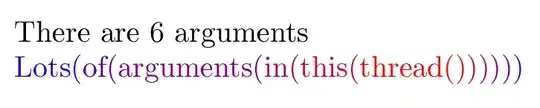
Try this one instead: \HowManyArguments[Mandatory][Argument][What][Have][You][Done]

\end{document}
This is the full idea of what I'm trying to build, but without limitations.




\color[named]{red}and\color[rgb]{1,0,0}not\color[rgb]{1}{0}{0}the number of arguments doesn't depend on the colour model even though the logical number of parameters needed does depend on the model. – David Carlisle May 07 '14 at 14:26