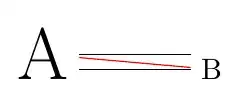
Instead of changing the nodes, you can use the perpendicular coordinate system (compare the red inclined rule with the two horizontal black rules):
\documentclass{article}
\usepackage{tikz}

\begin{document}

\begin{tikzpicture}
\node[anchor=south] (A) {\Huge A};
\node[anchor=south] at (2,0) (B) {B};
\draw[red] (A) -- (B);
\draw (A) -- (B.west|-A);
\draw (A.east|-B.west) -- (B.west);
\end{tikzpicture}

\end{document}
(<name1>|-<name2>) has the x-coordinate of <name1> and the y-coordinate of <name2>; (<name1>-|<name2>) has the y-coordinate of <name1> and the x-coordinate of <name2>.
If, however, you want the nodes to have the same total height, assign equal values to the keys text height and/or text depth:
\documentclass{article}
\usepackage{tikz}

\begin{document}

\begin{tikzpicture}
\node[draw] (A) {$t$};
\node[draw] at (2,0) (B) {$t_{l_{m}}$};
\draw[red] (A.south east) -- (B.south west);
\begin{scope}[xshift=3cm]
\node[draw,text depth=0.35ex] (A) {$t$};
\node[draw,text depth=0.35ex] at (2,0) (B) {$t_{l_{m}}$};
\draw (A.south east) -- (B.south west);
\end{scope}
\end{tikzpicture}

\end{document}


