EDIT: You may be asking for this:
\documentclass[tikz,border=3mm]{standalone}
\usepackage{pgfplots}
\pgfplotsset{compat=1.17}
\usepgfplotslibrary{groupplots}
\begin{document}
\begin{tikzpicture}[declare function={
g(\x,\m,\SIG)= 1/(sqrt(2*pi))*exp(-0.5*(pow((\x-\m),2))/(2*\SIG^2));
h(\x,\m,\SIG)=1/(1 + exp(-0.07056*((\x-\m)/\SIG)^3 - 1.5976*(\x-\m)/\SIG));
phi(\z)=1/(1+exp(-1.702*\z));
z(\phi)=-ln((1-\phi)/\phi)/1.702;
}]
\edef\m{0}
\edef\SIG{1}
\edef\NumRand{50}
\newcommand\RandDist[1]{\edef\irun{0}%
\pgfmathsetmacro{\mysum}{0}%
\edef\lstcoords{}%
\edef\lstcm{}%
\edef\lstgf{}%
\loop
\pgfmathsetmacro{\myrnd}{rnd}%
\pgfmathsetmacro{\mysum}{\mysum+\myrnd}%
\edef\lstcoords{\lstcoords (#1,\myrnd)}%
\pgfmathsetmacro{\myz}{z(\myrnd)}%
\edef\lstcm{\lstcm (\myz,\myrnd)}%
\pgfmathsetmacro{\myg}{g(\myz,\m,\SIG)}%
\edef\lstgf{\lstgf (\myz,\myg)}%
\edef\irun{\the\numexpr\irun+1}%
\ifnum\irun<\NumRand\relax
\repeat
}
\RandDist{0}
\begin{groupplot}[group style={
            group size=2 by 2, horizontal sep=0pt, vertical sep=0pt,
            xticklabels at=edge bottom},  legend pos=south east,
%       grid=both
        ]
        \nextgroupplot[group/empty plot]

        %---- top right    -------------------
        \nextgroupplot[]
        \addplot[forget plot,very thick,color=red,domain=-4:4,samples=\NumRand+1] ({x},{g(x,\m,\SIG)});
        \addplot[only marks,very thick,color=red]
         coordinates {\lstgf};
        \addlegendentry{$\mathcal{N}(0,1)$}

        %----  bottom left  -------------------
        \nextgroupplot
        \addplot+[only marks,fill=blue!60, opacity= 0.5]
            coordinates {\lstcoords};
        \addlegendentry{Uniform random numbers}
        %----  bottom right    -------------------
        \nextgroupplot[]
        \addplot[forget plot,very thick,color=red, domain=-4:4, samples=\NumRand+1] ({x},{h(x,\m,\SIG)});
        %\addplot[orange, domain=-4:4,]({x},{phi(x)});
        \addplot[only marks,fill=red!50]  coordinates {\lstcm};
        \addlegendentry{Normal cumulative}
        \end{groupplot}

\end{tikzpicture}
\end{document}
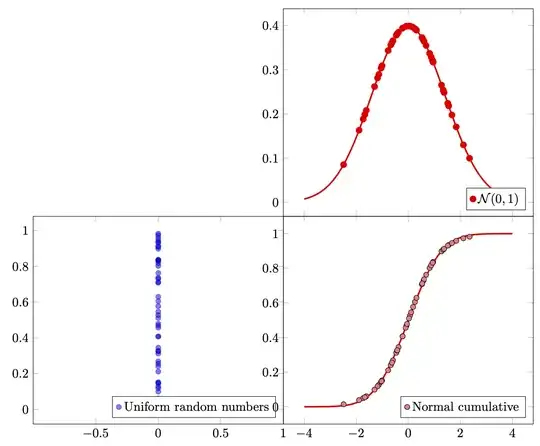
You can animate it.
\documentclass[tikz,border=3mm]{standalone}
\usepackage{pgfplots}
\pgfplotsset{compat=1.17}
\usepgfplotslibrary{groupplots}
\tikzset{declare function={
g(\x,\m,\SIG)= 1/(sqrt(2*pi))*exp(-0.5*(pow((\x-\m),2))/(2*\SIG^2));
h(\x,\m,\SIG)=1/(1 + exp(-0.07056*((\x-\m)/\SIG)^3 - 1.5976*(\x-\m)/\SIG));
phi(\z)=1/(1+exp(-1.702*\z));
z(\phi)=-ln((1-\phi)/\phi)/1.702;
}}
\begin{document}
\begingroup
\edef\m{0}
\edef\SIG{1}
\edef\NumRand{50}
\newcommand\RandDist[1]{\edef\irun{0}%
\pgfmathsetmacro{\mysum}{0}%
\edef\lstcoords{}%
\edef\lstcm{}%
\edef\lstgf{}%
\loop
\pgfmathsetmacro{\myrnd}{rnd}%
\pgfmathsetmacro{\mysum}{\mysum+\myrnd}%
\edef\lstcoords{\lstcoords (#1,\myrnd)}%
\pgfmathsetmacro{\myz}{z(\myrnd)}%
\edef\lstcm{\lstcm (\myz,\myrnd)}%
\pgfmathsetmacro{\myg}{g(\myz,\m,\SIG)}%
\edef\lstgf{\lstgf (\myz,\myg)}%
\edef\irun{\the\numexpr\irun+1}%
\ifnum\irun<\NumRand\relax
\repeat
}
\RandDist{0}
\pgfplotsinvokeforeach{1,...,\NumRand}{\begin{tikzpicture}
\begin{groupplot}[group style={
            group size=2 by 2, horizontal sep=0pt, vertical sep=0pt,
            xticklabels at=edge bottom},  legend pos=south east,
%       grid=both
        ]
        \nextgroupplot[group/empty plot]

        %---- top right    -------------------
        \nextgroupplot[]
        \addplot[forget plot,very thick,color=red,domain=-4:4,samples=\NumRand+1] ({x},{g(x,\m,\SIG)});
        \addplot[only marks,very thick,color=red,
            x filter/.expression={(\coordindex >#1 ? nan : x)}]
         coordinates {\lstgf};
        \addlegendentry{$\mathcal{N}(0,1)$}

        %----  bottom left  -------------------
        \nextgroupplot
        \addplot+[only marks,fill=blue!60, opacity= 0.5,
            x filter/.expression={(\coordindex >#1 ? nan : x)}]
            coordinates {\lstcoords};
        \addlegendentry{Uniform random numbers}
        %----  bottom right    -------------------
        \nextgroupplot[]
        \addplot[forget plot,very thick,color=red, domain=-4:4, samples=\NumRand+1] ({x},{h(x,\m,\SIG)});
        %\addplot[orange, domain=-4:4,]({x},{phi(x)});
        \addplot[only marks,fill=red!50,
            x filter/.expression={(\coordindex >#1 ? nan : x)}]  coordinates {\lstcm};
        \addlegendentry{Normal cumulative}
        \end{groupplot}
\end{tikzpicture}}
\endgroup
\end{document}
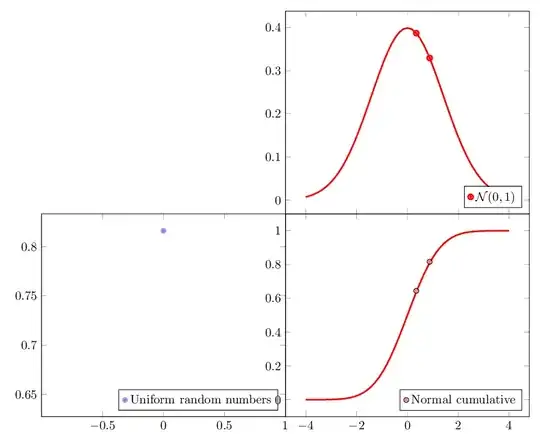
However, I am not sure about the interpretation.
ORIGINAL ANSWER: This may be missing the whole point of this exercise. All this does is to generate a set of random distributions of points, computes their averages and plots the distribution of averages. And it varies the number of sets in an animation.
\documentclass[tikz,border=3mm]{standalone}
\usepackage{pgfplots}
\pgfplotsset{compat=1.17}
\usepgfplotslibrary{groupplots,fillbetween}
\begin{document}
\foreach \X in {4,8,...,80}
{\begin{tikzpicture}
\edef\NumRand{50}
\edef\NumSamples{\X}
\edef\NumBins{25}
\edef\irun{0}%
\loop
\expandafter\edef\csname NumBin\irun\endcsname{0}%
\edef\irun{\the\numexpr\irun+1}%
\ifnum\irun<\NumBins\relax
\repeat
\newcommand\RandDist[1]{\edef\irun{0}%
\pgfmathsetmacro{\mysum}{0}%
\edef\lstcoords{}%
\loop
\pgfmathsetmacro{\myrnd}{rnd}%
\pgfmathsetmacro{\mysum}{\mysum+\myrnd}%
\edef\lstcoords{\lstcoords (##1,\myrnd)}%
\edef\irun{\the\numexpr\irun+1}%
\ifnum\irun<\NumRand\relax
\repeat
}
\pgfplotsforeachungrouped\isample in{0,...,\the\numexpr\NumSamples-1}
{\pgfmathsetmacro{\xsample}{2*\isample/\NumSamples-1}%
\RandDist{\xsample}%
\expandafter\edef\csname lstpst\isample\endcsname{\lstcoords}%
\pgfmathsetmacro{\avg}{\mysum/\NumRand}%
\expandafter\edef\csname avg\isample\endcsname{(\xsample,\avg)}%
\pgfmathtruncatemacro{\nBin}{25*\avg}%
\edef\currbin{\csname NumBin\nBin\endcsname}%
\expandafter\edef\csname NumBin\nBin\endcsname{\the\numexpr\currbin+1}%
}
\edef\lstbars{}%
\edef\irun{0}%
\loop
\edef\lstbars{\lstbars (\irun,\csname NumBin\irun\endcsname)}%
\edef\irun{\the\numexpr\irun+1}%
\ifnum\irun<\NumBins\relax
\repeat
%\typeout{\lstcoords,\mysum,\lstbars}
\begin{groupplot}[group style={
            group size=2 by 2, horizontal sep=2em, vertical sep=0pt,
            xticklabels at=edge bottom},  legend pos=south east,
%       grid=both
        ]
        \nextgroupplot[title=samples]
        \edef\temp{\noexpand\addplot[only marks,mark=*,fill=blue!60, opacity= 0.5]
        coordinates {\csname lstpst0\endcsname};
        \noexpand\addlegendentry{samples}
        \noexpand\addplot[only marks,mark=square*,fill=red!60]
        coordinates {\csname avg0\endcsname};
        \noexpand\addlegendentry{average}}
        \temp
        \pgfplotsinvokeforeach{1,...,\the\numexpr\NumSamples-1}
        {\edef\temp{\noexpand\addplot[forget plot,only marks,mark=*,fill=blue!60, opacity= 0.5]
        coordinates {\csname lstpst##1\endcsname};
        \noexpand\addplot[forget plot,only marks,mark=square*,fill=red!60]
        coordinates {\csname avg##1\endcsname};}
        \temp}
%        \addlegendentry{Uniform random numbers}
        %---- top right    -------------------
        \nextgroupplot[title=distribution of averages,
            xtick={0,...,\NumBins},xticklabel=\empty]
        \addplot[ybar,bar width=pi*1pt,fill=blue] coordinates{\lstbars};
        %----  bottom left  -------------------
        \end{groupplot}

\end{tikzpicture}}
\end{document}


