Given the below design which really violates the mechanical use for a breadboard, assuming that I were otherwise building a farmhouse table with pocket screws, what would be the appropriate way to mount a functional breadboard end in this scenario?

Given the below design which really violates the mechanical use for a breadboard, assuming that I were otherwise building a farmhouse table with pocket screws, what would be the appropriate way to mount a functional breadboard end in this scenario?

I can think of a couple options for mounting a breadboard, which you will have to adapt to suit your tools and skill set:
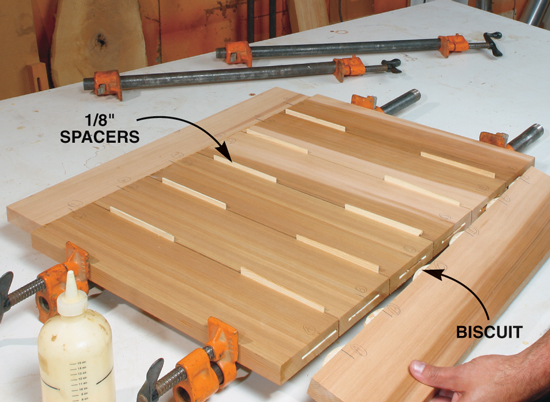
Use biscuits to join the breadboard to the rest of the top (not necessarily the best option since you have a continuous glue line across the width of the top) (source: Popular Woodworking)

Mortise & tenon joints (note the elongated holes for the pegs) (source: AlLadd.com)

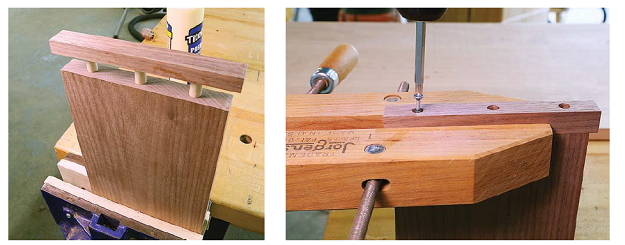
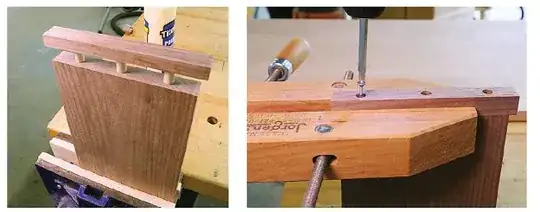
Dowels and/or screws (also not necessarily the best option as-shown due to expansion/contraction concerns) (source: Popular Woodworking)
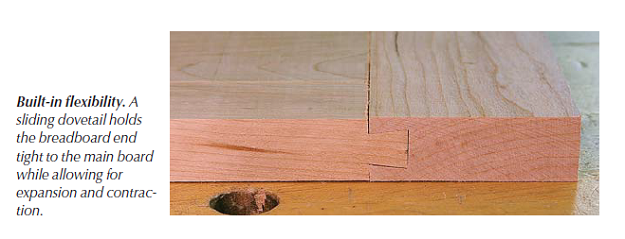
Sliding dovetail (source: Popular Woodworking)

Tongue & Groove with (optional) dowels (thanks @TX Turner) (source: Reddit). For this one, the tongue can also extend to the end of the breadboard, similar to the sliding dovetail example above.

As you probably know, when you make the joint, you want to keep the width-wise expansion of the top in mind so that the breadboard ends don't crack the top. This usually means you positively-attach the breadboards in the middle (with glue or fasteners) and allow the ends to float.