1

enter image description here

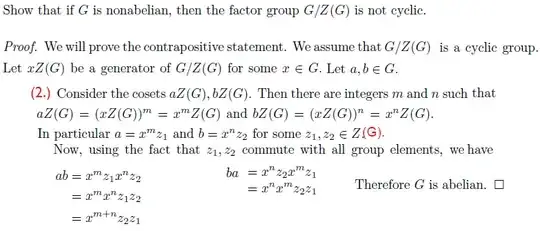
(1.) Why didn't Fraleigh state the result in the direct form like in my title? Why state it with the negations and then prove the contrapositive? Isn't this extra unnecessary work?

(2.) How do you envisage and envision to consider the cosets $aZ(G), bZ(G)$?
I know we presupposed $G/Z(G)$ is cyclic for the proof.

(3.) If $G/Z(G)$ is cyclic then $G/Z(G)$ has one element. What is it?

(4.) What's the intuition?

  • Are you familiar with the class equation? That was what finally made this theorem "intuitive" for me. – Aaron Taylor Feb 24 '14 at 07:41
  • @AaronTaylor: I'm not now. I don't know if my course covers it. Do you think I should learn it? –  Feb 24 '14 at 07:43
  • I just checked the 6th edition of your textbook on Amazon and it looks like you cover the class equation in section 4.3, "Applications of the Sylow Theory". It's pretty fundamental to group actions, so you will get to it eventually. I only mentioned it because it provides a different perspective that can help understand what is going on. This theorem is still very understandable from a direct approach, as I'm sure the answers you receive will illustrate. – Aaron Taylor Feb 24 '14 at 07:59
  • @AaronTaylor: Thanks. I'm using the 7th edition and Fraleigh moved "Applications of the Sylow Theory" to chapter 37 under 'Advanced Group Theory' which starts in chapter 36. Chapters 17-35 is about rings which aren't in my course. Should I learn conjugacy classes? –  Feb 24 '14 at 08:03

2 Answers2

1
  • I think that, although the proof is by contrapositive and therefore establishes the result of your title (and as a consequence the result you referred to in point (3)), Fraleigh stated the result as he did because it is really a result about non-Abelian groups (modulo their center they cannot possibly be cyclic). For Abelian groups one learns nothing new; it is obvious that modulo their center they are trivial.

  • As for intuition, I think this could be done simpler. Given a group that is cyclic modulo its center, there is a representative $x$ of the generator of the quotient, and then the group is generated by $x$ and $Z(G)$ together. But that is a bunch of elements that all commute with each other, so the group must be Abelian (and in the end there is no need for $x$ after all).

  • Your first point is why I prefer the version that goes "If the quotient by any subgroup of the center is cyclic, then the group is abelian". – Tobias Kildetoft Feb 24 '14 at 08:22
0

1) He didn't state the full contrapositive statement because it's strictly not needed. He has stated what he wants to show in the proof, he has said that he wants to proof the contrapositive, and he assumes the negation of the conclusion. At the end he has shown the negation of the hypothesis, and the theorem is proven.

2) You consider the cosets $aZ(G)$ and $bZ(G)$ because you want, in the end, to prove that $ab = ba$.

3) If a quotient group $G/H$ has one element, then $H = G$, and the one element in the quotient group is the (co)set of all elements in $G$.

Arthur
  • 199,419
  • Thanks a lot. I bungled my question (1) so just clarified it. (2.) I know G Abelien means $ab = ba \forall a,b \in G$ and that's what we want to prove. But I'm still confounded. Can you please notify me in your answer, and not in comments? –  Feb 24 '14 at 08:00