One can use Picard-type iteration to get the solution: Using an approximation to x'[t] (in the integral), we can integrate the ODE to obtain a new approximation. Remarkably, it converges in just two steps. My original thought was to step through the integration using the tools from tutorial/NDSolveStateData to build an interpolation of x'[t] at each step for use in the integration term; that proved too difficult to manage (or perhaps I had set it up in way that made it difficult).
The approximation of x'[t] is represented by xp[t]. We start with the initial guess for it to be xp[t] == 0.01 t, which corresponds to extrapolating from the initial conditions (by inspection -- one might solve the ODE for x''). (Actually, starting with xp[t] == 0 works nearly as well and makes the first iteration faster.) We put the integration factor in separate black-box function y0. Adding the dummy algebraic equation y[t] == y0[t] to the system helps with the accuracy.
ClearAll[xp, y0, t, x, y];

xp = 0.01 # &;
y0[t_?NumericQ] := NIntegrate[xp[t - τ]/Sqrt[τ], {τ, 0, t}];

ode = 0.01 - 6.25 x[t] + 1.2 y0[t] / 10^7 == 16 x''[t];
dae = y[t] == y0[t];
ics = {x[0] == 0, x'[0] == 0};

{sol[10.]} = NDSolve[{ode, ics, dae}, x, {t, 0, 10}];
xp = x' /. sol[10.];  (* iterate with next approximation to x' *)
{sol["Final"]} = NDSolve[{ode, ics, dae}, x, {t, 0, 10}];
Let's compare with the solution produced by the numerical Laplace method used by xzczd's answer. In what follows, we'll use
sol["Laplace"] = x -> FunctionInterpolation[GWR[f, t], {t, $MachineEpsilon, 10}]
where f and GWR are as in the other answer.
The solutions are roughly the same:
Plot[{x[t] /. sol["Laplace"], x[t] /. sol["Final"]}, {t, 0, 10}]
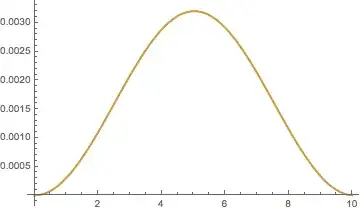
We can compare how well the solutions track the ODE. The main reason that the Laplace method appears much worse is due to FunctionInterpolation. It does, however, appear to be a better approximation at small values of t. The function opODE gives the residual of a given solution sol at time t of the OP's ODE, with NIntegrate in place of Integrate.
opODE[t_?NumericQ, sol_] := Hold[
   0.01 - 6.25 x[t] + (1.2 NIntegrate[x'[t - τ]/Sqrt[τ], {τ, 0, t}])/10^7 - 16 x''[t]
   ] /. sol // ReleaseHold;

GraphicsRow[
 Plot[{opODE[t, sol["Laplace"]], opODE[t, sol["Final"]]},
    {t, ##}, PlotPoints -> 20, MaxRecursion -> 2, PlotRange -> All
    ] & @@@ {{0., 0.001}, {0.001, 1}, {1, 10}}
 ]

NDSolve is a better alternative to FunctionInterpolation for constructing an accurate interpolation. Oddly the Laplace method shows a similar erratic behavior near t == 0 as the NDSolve-iteration method. The function GWR of the numerical Laplace inversion package needs the argument t to be numeric, but does not protect it with ?NumericQ; hence the wrapper gwr below. With this method of interpolation the numerical Laplace method seems comparable.
gwr[t_?NumericQ] := GWR[f, t];
{sol["Laplace"]} = NDSolve[{x[t] == gwr[t], y'[t] == 1,
    y[$MachineEpsilon] == $MachineEpsilon},
   x, {t, $MachineEpsilon, 10}];

GraphicsRow[
 Plot[{opODE[t, sol["Laplace"]], opODE[t, sol["Final"]]},
    {t, ##}, PlotPoints -> 20, MaxRecursion -> 2, PlotRange -> All
    ] & @@@ {{0., 0.002}, {0.002, 1}, {1, 10}}
 ]

Presumably x -> gwr (from @xzczd) produces a highly accurate solution, but it takes a long time to evaluate. For instance,
opODE[0.01, x -> gwr] // AbsoluteTiming
opODE[9.95, x -> gwr] // AbsoluteTiming
(*
  {27.7618, -1.13159*10^-13 - 7.74942*10^-15 I}
  {35.6744, -1.36696*10^-15 - 6.18062*10^-26 I}
*)





FunctionInterpolation, you can improve it by adding derivatives of the expression to its first argument" - right, this is why Hermite interpolation is a good idea for approximating analytic functions; the more information you have, (hopefully) the better your approximant is. (This is also probably why Michael's solution was more accurate than your previous one, since the resultingInterpolatingFunction[]has derivative information.) – J. M.'s missing motivation Jun 03 '15 at 13:29solOrder3instead of numeric differentiation. It will be faster. You could also use the ODE to solve for the higher order derivatives, since, at the initial condition, the integration term is zero. – Michael E2 Jun 03 '15 at 13:48Solve[eq /. t -> 0, x''[0]]/. x[0] -> 0 (* => x''[0] == 0.000625 *), but when it comes toD[eq, t], a $\frac{x'(0)}{\sqrt{t}}$ term involves in. One may argue that since $x'(0)=0$ so this term is (probably) zero at $t=0$, too, but when it comes toD[eq, {t, 2}], a $\frac{x''(0)}{\sqrt{t}}$ term involves in… – xzczd Jun 04 '15 at 03:51