I have a parametric equation of two ellipses as follow
$\begin{cases} x=a_1 \text{sin$\theta $}+b_1 \text{cos$\theta $}+c_1 \\ y=d_1 \text{sin$\theta $}+e_1 \text{cos$\theta $}+f_1 \\ \end{cases}$
$\begin{cases} x=a_2 \text{sin$\theta $}+b_2\text{cos$\theta $}+c_2 \\ y=d_2 \text{sin$\theta $}+e_2 \text{cos$\theta $}+f_2 \\ \end{cases}$
Now I want to solve the intersection point coordinates and visualize them.
My trial
Here, mat1 owns the style {{a1,b1,c1},{d1,e1,f1}}.
solvePoints0[mat1_, mat2_] :=
 Module[{sol, θValue, θ, ptRule},
  sol =
   Solve[
    Thread[
     mat1.{Sin[θ1], Cos[θ1], 1} ==
      mat2.{Sin[θ2], Cos[θ2], 1}], {θ1, θ2}];
  θValue = Mod[(#[[1, 2, 1]] & /@ sol) /. C[1] -> 1., 2 Pi];
  ptRule = List /@ Thread[θ -> θValue];
  Cases[
   mat1.{Sin[θ], Cos[θ], 1} /. ptRule,{_Real, _Real}]
 ]

showEllipse0[mat1_, mat2_, opts : OptionsPattern[]] :=
 With[{pts = solvePoints0[mat1, mat2]},
   ParametricPlot[
    {mat1.{Sin[θ], Cos[θ], 1},
     mat2.{Sin[θ], Cos[θ], 1}}, {θ, 0, 2 Pi},
    Epilog -> {PointSize[Large], Red, Point[pts]},
    Evaluate[
     Sequence @@ FilterRules[{opts}, Options[ParametricPlot]]]
   ]
  ] /; MatrixQ[mat1, NumericQ] && MatrixQ[mat2, NumericQ]
Test
showEllipse0[##, ImageSize -> 200] & @@@
 {{{{1, 2, 1}, {2, 3, 4}}, {{2, 2, 2}, {3, 2, 4}}},
  {{{3, 1, 1}, {2, 3, 4}}, {{4, 2, 2}, {3, 4, 4}}},
  {{{3, 2, 1}, {2, 3, 4}}, {{2, 2, 2}, {3, 2, 4}}},
  {{{2, 1, 1}, {2, 3, 4}}, {{4, 1, 2}, {3, 2, 4}}}}

However, solvePoints0 has a bug
solvePoints0[{{4, 2, 1}, {2, 5, 6}}, {{6, 2, 2}, {3, 2, 4}}]
solvePoints0[{{5, 2, 1}, {2, 5, 6}}, {{6, 2, 2}, {3, 2, 4}}]
{}{}
In fact, they have intersection point coordinates.
showEllipse0 @@@
 {{{{4, 2, 1}, {2, 5, 6}}, {{6, 2, 2}, {3, 2, 4}}},
  {{{5, 2, 1}, {2, 5, 6}}, {{6, 2, 2}, {3, 2, 4}}}}
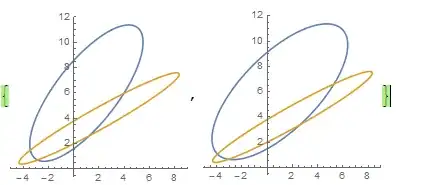
To fixed this bug, I rewrite the function solvePoints0 using NSolve
solvePoints[mat1_, mat2_] :=
 Module[
   {sol, θValue, θ, ptRule},
   sol =
    Quiet@
      NSolve[
        Thread[
         mat1.{Sin[θ1], Cos[θ1], 1.} ==
          mat2.{Sin[θ2], Cos[θ2], 1.}], {θ1, θ2}] /. C[1] -> 1.;
   θValue = #[[1, 2]] & /@ sol;
   ptRule = List /@ Thread[θ -> θValue];
   Cases[
    mat1.{Sin[θ], Cos[θ], 1} /. ptRule, {_Real, _Real}]
 ] /; MatrixQ[mat1, NumericQ] && MatrixQ[mat2, NumericQ]
Now,
solvePoints[{{4, 2, 1}, {2, 5, 6}}, {{6, 2, 2}, {3, 2, 4}}]
solvePoints[{{5, 2, 1}, {2, 5, 6}}, {{6, 2, 2}, {3, 2, 4}}]

Question
- I think my methods is fussy and bad, so I would like to know how to solve this question in a elegant way.
Update
Thanks for J.M's suggestions, with the help of Graphics`Mesh`FindIntersections
newSolution[mat1_, mat2_] :=
 Module[{graph, pts},
  graph =
   ParametricPlot[
    {mat1.{Sin[θ], Cos[θ], 1},
     mat2.{Sin[θ], Cos[θ], 1}}, {θ, 0, 2 Pi},Epilog -> {Point[{.1, .2}]}];
  pts = Graphics`Mesh`FindIntersections[First[graph]];
  graph /.
   (Epilog -> _) -> Epilog -> {Red, PointSize[Medium], Point[pts]}
]
Test
newSolution[##] & @@@
 {{{{1, 2, 1}, {2, 3, 4}}, {{2, 2, 2}, {3, 2, 4}}},
  {{{3, 1, 1}, {2, 3, 4}}, {{4, 2, 2}, {3, 4, 4}}},
  {{{3, 2, 1}, {2, 3, 4}}, {{2, 2, 2}, {3, 2, 4}}},
  {{{2, 1, 1}, {2, 3, 4}}, {{4, 1, 2}, {3, 2, 4}}}}

newSolution @@@
 {{{{4, 2, 1}, {2, 5, 6}}, {{6, 2, 2}, {3, 2, 4}}},
  {{{5, 2, 1}, {2, 5, 6}}, {{6, 2, 2}, {3, 2, 4}}}}
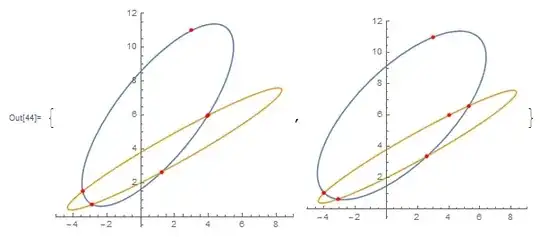
Obviously, this is not a good method owning to that it cannot find the intersection points correctly.


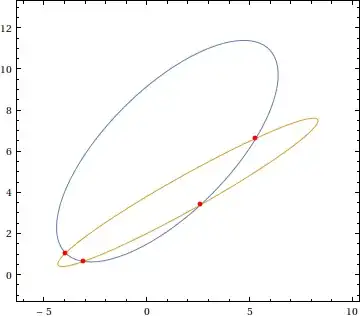

GroebnerBasis[]to produce the implicit Cartesian equations of the two ellipses, and feed those equations toSolve[]. Retain only the real solutions, and you're done. – J. M.'s missing motivation Jun 25 '15 at 08:03FindIntersectionscannot find all the intersection points correctly(Namely,it has wrong points or lacks of some right points). Please see my update. – xyz Jun 26 '15 at 01:56tangent points. – xyz Jun 26 '15 at 02:49