The most straightforward way would be FindRoot[ eq, {x, 0}] but since this specific polynomial eq has a singular Jacobian at x == 0 (evaluate e.g. Reduce[ D[ eq, x] == 0, x]) one would rather use FindRoot[ eq, {x, x0}] for small x0 > 0. The argument x0 depends on a case by case basis, but for the problem at hand an appropriate value might be 0 < x0 <= 2.4, e.g. :
FindRoot[ eq, {x, 0.5}]
{x -> 0.397412}
More general considerations must include huge order polynomials, which might have many real roots. So finding every root may be very inefficient. In such cases there is a handy function RootInterval which can be much more efficient than any NSolve approach and especially handy when using it together with FindRoot.
First @ RootIntervals[eq]
{{-(273/64), -(263/64)}, {-(33/64), -(23/64)}, {47/128, 57/128}, {263/64, 273/64}}
It shows where one can find the first positive root , i.e. in this interval : {47/128, 57/128}. To choose only intervals where positive roots may be found we use e.g. :
intervals = First @ RootIntervals[eq] ~ DeleteCases ~ {_, _?Negative}
{{47/128, 57/128}, {263/64, 273/64}}
Then we use it for finding roots numerically with Brent's method -- the most powerful algorithm available for FindRoot :
roots = FindRoot[ eq, {x, #[[1]], #[[2]]}, Method -> "Brent"][[All, 2]]& /@ intervals //
        Flatten
{0.397412, 4.22555}
The last step is standard :
Min @ roots
0.397412
The first root might be negative therefore we could use e.g. :
RankedMin[roots, #]& /@ {1, 2}
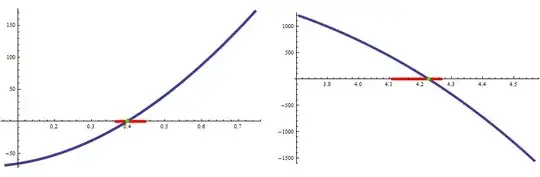
Now for the sake of completeness we demonstrate small intervals and roots on the plot of the polynomial over the positive reals :
Plot[ eq, {x, -4.5, 4.5}, PlotStyle -> Thick, AspectRatio -> 1/3, Epilog -> {
          Darker @ Red, Thickness[0.005], Line[{{#1, 0}, {#2, 0}}]& @@@ intervals,
          Green, PointSize[0.007], Point[{#, 0}] & /@ roots } ]
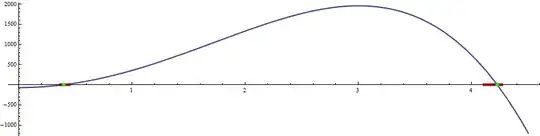
the same plot in pieces :
GraphicsRow[
    Plot[   eq, {x, #1 - 0.3, #2 + 0.3}, PlotStyle -> Thickness[0.01], Epilog -> {
                 Red, Thickness[0.011], Line[{{#1, 0}, {#2, 0}}] & @@@ intervals,
                 Green, PointSize[0.015], Point[{#, 0}] & /@ roots}] & @@@ intervals ]


Codegiven above to a system of nonlinear equations? I am struggling to find real solutions to the NL system. Can you give me an example, for example, for a system of 5 nonlinear (NL) equations? and find the equilibrium limited to only real values. – Tugrul Temel Apr 19 '19 at 10:25eq==0is a nonlinear equation, to solve a system you should use something likeFindRoot[{eq1==0,...,eq5==0},{{x1,y0},...,{x5,y5}}]possibly with an appropriate method. For a specific problem you should better ask another question. Sometimes you can get solutions withSolveorNSolvewith domain specification, eg.NSolve[{eq1==0,...eq5==0},{x1,...,x5},Reals]. – Artes Apr 19 '19 at 15:32NSolveis very slow for a system of 30 equations (mixed: linear and nonlinear). Regards. – Tugrul Temel Apr 19 '19 at 18:37FindRoot. – Artes Apr 19 '19 at 19:23